intellect
Insightful post about reason, abstract thinking, and science, highlighting gifted science fiction influencers.
World's Most Deadly Viruses
In the face of deadly viruses the only weapon humanity has is proper hand washing and disinfectant, but preventive measures may not be enough for the 10 deadliest viruses. A virus is a small infectious agent that replicates inside the living cells of other organisms. Viruses can infect all types of life forms, from animals and plants to bacteria and archaea. Science has not yet determined whether viruses constitute life because they lack key characteristics of life, such as cell structure. They have often been described as 'organisms at the edge of life.' What is known about viruses is that they cause serious illnesses and can destroy lives if not dealt with properly. The following viruses are not listed in any particular order but don't be fooled, they are all equally deadly. Also they are not just the only most dangerous, there are many more viruses that have brought humanity to its knees causing panic and terror in the hearts of many.
By George Gott10 years ago in Futurism
Carl Sagan Inspired Curiosity
Carl Sagan's enthusiasm and ability to convey ideas, such as humanity's place in the universe against the backdrop of a cosmic scale, inspired countless people to pursue their own curiosity. As the author of more than 600 scientific papers, editor of more than 20 books, and creator of Cosmos: A Personal Voyage, Sagan worked tirelessly to push science into the spotlight. He advocated heavily for scientific skeptical inquiry, pioneered exobiology, and promoted the Search for Extraterrestrial Intelligence (SETI). The name Sagan is inseparable from the word "curious."
By George Gott10 years ago in Futurism
Does the Earth Have a Hidden Twin?
For several years now we have been hearing about new planetary bodies being discovered inside and outside our solar system. There are suggestions that our familiar companions - Mercury Venus, Mars, and the rest - may not be all there is to the sun's family. There is evidence that one member or more still awaits discovery through scientific research. This idea is not new. With ideas like Planet X and also back a century ago it was widely thought that another planet could be found within the orbit of Mercury. It was even given a name: Vulcan.
By George Gott10 years ago in Futurism
Most Deceptive Scientific Frauds
There are so many problems in the world that demand solving, and scientific research is the source for such desired lifesaving innovation. However, this pressure can be a double-edged sword. Scientists are inspired to work hard to release quality research, but this can also lead to situations where people will stoop to deception to achieve fame. Fabricating data to prove a theory is an easy way to cut corners, after all, and peer review has its limitations.
By Futurism Staff10 years ago in Futurism
Thinking About Infinity
The following article was originally published on The Free Advice Man's website here. In 1982, in my eighteenth year, I found myself walking into this bookstore, "East West Books," on 5th Avenue, a couple blocks west of Union Square in Manhattan (New York City). I had walked past the store several times since arriving in 1980. I will get back to what happened in that bookstore soon enough, but I think this is a good time to help set the scene of what my life was like at the time, and how my social metropological surroundings affected the direction of my thoughts at the time.
By Jean-Pierre Fenyo10 years ago in Futurism
Morris Kline Interview
Morris Kline was a slender man, soft-spoken, polite, cultured. For most of his lifetime he was a mathematician, in pursuit of what Alfred North Whitehead called "a divine madness of the human spirit." Yet Kline did not display the madness so often paraded by his fellow mathematicians. He was a champion of common sense, but, as Lord Kelvin put it, "Mathematics is merely the etherealization of common sense." That connection eluded many of Kline's colleagues.
By Futurism Staff10 years ago in Futurism
Predictions from Sci-Fi Authors
Science fiction authors are modern-day prophets. Many of the predictions from the great writers like Isaac Asimov and Philip K. Dick came to fruition at the turn of the 21st century. Writer Michael Banks closely followed the growth of online web services and the evolution of the internet from the early 1980s onward. His perception on the predictive nature of science fiction can be proven through a study of the the great sci-fi author's ability to blur the lines between speculation and fact are often the catalyst for authentic advance in tech. His books, including Crosley: Two Brothers and a Business Empire That Transformed the NationandOn the Way to the Web: The Secret History of the Internet and Its Foundersdelve into the results of this chain of predictions. His perceptions will continue to drive further authors to continue to essentially create the future. Many of his theories were captured in a 1978 article from vintage sci-fi magazine Starlog.
By Futurism Staff10 years ago in Futurism
E.O. Wilson Interview
The publication of E.O. Wilson's Sociobiology in 1975 was to use a cliché—a landmark event in the history of biology. This enormous volume (697 oversize pages) is a truly remarkable compendium of a vast, widely dispersed literature on the relationship between biology and social behavior throughout the animal kingdom. It ranges from Homo sapiens to the social insects (Wilson is by trade an entomologist; his speciality—he calls them his "totem animal"—is ants). He intended it to be a scientifically respectable, thorough review, so it is full of tables and charts and extensively referenced. On the other hand, it is well written and handsomely illustrated.
By Futurism Staff10 years ago in Futurism
Pioneers of Astronomy
Nicholas Copernicus once said “The massive bulk of the earth does indeed shrink to insignificance in comparison with the size of the heavens." While we may attribute our knowledge of the solar system and astronomy to modern day telescopes, space shuttles, and space probes, it is important to remember that the size of the heavens would not even be discovered without the pioneers of astronomy. From Nicholas Copernicus and Albert Einstein to astronauts and space organizations like NASA, the pioneers of astronomy have laid down an important foundation for which exploration of the stars today is firmly rooted.
By Futurism Staff10 years ago in Futurism
History of Halley's Comet
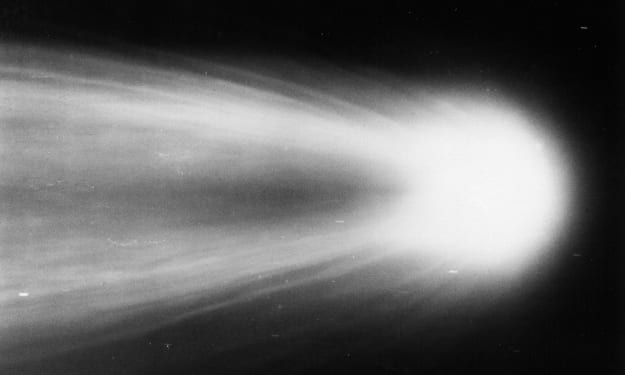
It was August in 1682 when the faint gleam first appeared in the night sky. From one night to the next, it grew slightly brighter and changed position among the background stars. The pioneers of astronomy peered at it through that new-fangled invention, the telescope, and watched it begin to sprout a tail. Among the majority of people, however, the instinctive reaction was fear. “A comet,” they whispered. “A comet has appeared! And plague, famine, and war will surely follow.”
By Futurism Staff10 years ago in Futurism
Genetically Engineering a Super Race
When Aldous Huxley wrote Brave New World in 1932, he described a world state several centuries in the future where all human beings were reared from eggs in factories or incubators. Scientists could produce several classes of personality ranging from the highly intelligent, whose sole purpose was to enjoy life, to the feeble-minded who were suited only for manual labor. The novel was set in the distant future because the scientific knowledge needed to bring about this type of society was not available when Huxley wrote it.
By Futurism Staff10 years ago in Futurism
Mysteries of the Maya
Imagine yourself the chief astronomer-priest of an ancient jungle empire. From your studies of records kept by astronomers for centuries before you, you are convinced that an eclipse of the Sun is likely to occur in three days' time. It is essential for you to inform the people of the empire of this event, so they will be prepared if the Sun begins to disappear.
By Futurism Staff10 years ago in Futurism