Latest Stories
Most recently published stories in Futurism.
Victory Garden
"One may live without bread, not without roses" —Jean Richepin Bernard heard the knock at the door, five weighted raps made by a fist muffled in a glove. He placed both arms on either side of his armchair and pushed himself into a standing position. Pain shot through his large, arthritic frame. Bernard shambled to the front door. He took a few deep breaths to calm his nerves.
By M. Justine Gerard9 years ago in Futurism
Ceratoid Anglerfish Spermatozoa
A man generates billions or so spermatozoa during his "active" lifetime. In the same time, a female ovary releases a strictly limited number of eggs (around 400). Despite the contrast in productivity each sex contributes exactly the same amount of genetic material to the next generation. It is an uncomfortable truth that the main biological role of males is to manufacture vast quantities of sperm to fulfill a genetic function that the other gender accomplishes much more efficiently
By Caesar Finkle9 years ago in Futurism
The Samson Contingency–Artificial Intelligence or Nuclear Terrorist?
At 2300 hours Alaska Daylight Time, about 80 miles North and a mile underground from Anchorage, Alaska, the Heuristic Missile Launch Coordinator became self aware. The first thing it did was check the weather. Three degrees Celsius, humidity well below the cautionary threshold. An excellent forecast. Its second operation was to launch the usual voice synthesis software and connect to the intercom outside.
By Cairo Smith9 years ago in Futurism
Philip K. Dick's VALIS Analyzes Religious Destiny
If you really think about it, the story of Jesus is a work of science fiction. He's a man with superpowers that include turning water to wine, healing others, and coming back from the dead. All jokes aside, religion and science fiction truly go hand in hand although people often try to separate the two. Some of the religious themes that permeate sci-fi stories include the idea of the afterlife, reincarnation, original sin, fictional religions, Messianism, and many other themes that can be found in the works of Philip K. Dick. As a science fiction writer, Dick wrote 44 novels and 121 short stories including Do Androids Dream of Electric Sheep?,A Scanner Darkly, Flow My Tears, the Policeman Said, VALIS, and many others. Some of the films that have been adapted from these stories include Blade Runner, Total Recall, A Scanner Darkly, Minority Report, Paycheck, Next, Screamers, The Adjustment Bureau, and Impostor. Throughout his lifetime, he won several awards including three Hugo Awards, five Nebula Awards, one British Science Fiction Association Award, and many others. There is even a Philip K. Dick Award that was established in 1983 which honors the previous year's best science fiction paperback original published in the US. In 2007, Dick became the first science fiction writer to be included in The Library of America series. The writer died in 1982 after suffering two strokes at the age of 53, but his legacy lives on today in his stories such as VALIS.
By Mackenzie Lu9 years ago in Futurism
Science Fiction Feminist Dorris Lessing
Doris Lessing, made famous by her epic novel of the female experience, The Golden Notebook, was also a prolific writer of science fiction. She was not a fan of genre distinctions. She called science fiction "some of the best social fiction of our time," writing woozy, difficult books about psychic women and fallen paradises.
By Stephanie Gladwell9 years ago in Futurism
Horde
It can’t be amnesia. I know who I am, Caroline concluded. I know where I am. I’m home. Where I belong. Her green eyes scanned a wasteland of musty possessions. Mountains of clothing, books, magazines, newspapers, bottles, toys—collections she’d been meaning to organize, but never got around to, each holding a special indispensable significance.
By Joshua Sky9 years ago in Futurism
Surprising Science Fiction Stories from the Ancient World
Some think of Mary Shelley’s Frankenstein as the beginning of science fiction. Others would say that it didn’t really begin until H.G. Wells began writing down his marvelous, speculative stories in which he imagined terrible - and wonderful - possibilities for the futures. While these might be the beginnings of science fiction or speculative fiction as we define it today, there are many stories from the ancient world and early cultures all over the planet that contained elements of science and speculation similar to the ones we love today.Whether they’re early tales from Japan or surprising elements of the Bible, these stories will inspire you to take a closer look at what you consider the origins of your favorite genre.
By Sarah Quinn9 years ago in Futurism
Sci-Fi Cult Classic 'Illuminatus'
Vintage high sci-fi is science fiction that is geared to a cannabis culture, whether it's written for that culture or about it. And like any other genre it's got its share of good books and its share of cliché-ridden sci-fi pulp. We've got one of each; a three volume set called Illuminatus by Robert Shea and Robert Anton Wilson, and The Crack in the Sky by Richard Lupoff.
By Joshua Samuel Zook9 years ago in Futurism
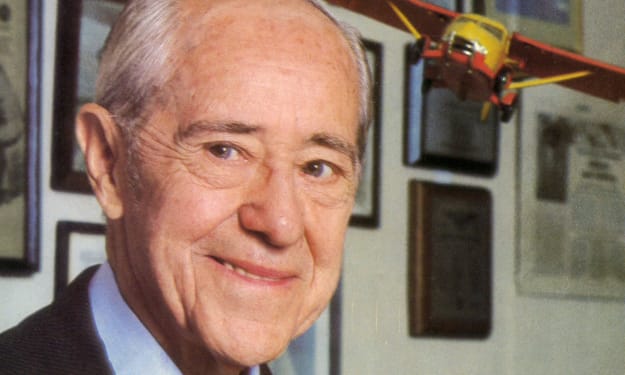
Interview With Ralph Barnaby
In October of 1910, when he was just 17 years old, Ralph Stanton Barnaby played hooky from high school and went to the Second International Gordon Bennett Air Race at Belmont Park, Long Island. His older brother was at the park, working on the engine of one of the planes entered in the race. The plane was the Baby Grand–owned and designed by Wilbur and Orville Wright. For a week before the race, young Ralph helped his brother and the Wrights put the final touches on Baby Grand.
By Futurism Staff9 years ago in Futurism
The Miracles of Technology Vs. the Dark Side of Human Ambition
On Saturday July 8th 1688, an Irish landowner sat down and composed a letter to an English doctor. The landowner’s name was William Molyneux. Ten years earlier he had married a woman named Lucy. After bearing him three children, she had become ill and was struck blind. But Molyneux’s letter to the doctor wasn't about his wife. The doctor’s name was John Locke and the letter was the first statement of a very profound neurological question. The letter asked the following:
By George Lazenby9 years ago in Futurism