Nature
The March of Spring: 7 Inspiring Signs of Renewal and Growth You Shouldn’t Miss
The phrase The March of Spring paints a vivid picture of nature steadily moving forward into warmth, color, and life. It’s not just about the month of March—it’s about a gradual transformation. Winter loosens its grip, and the world begins to wake up. Trees bud, flowers bloom, and animals stir.
By Mark Senegal14 days ago in Earth
The Day the River Stopped Singing
The village of Sundarpur was known for one thing—the river. It flowed gently along the edge of the village, shimmering under the sunlight, whispering secrets to the wind. The villagers believed the river was alive. Not just water, but a silent witness to their joys, their sorrows, and their lives.
By Wasif islam15 days ago in Earth
A Timely Reminder About The One Threat To Us All
It's still a collosal problem. And we are stuck between rocks and hardplaces, and getting more trapped by the year. And while everybody wants to scream, yell, and pound their fists about every other issue they claim to care about, people have slowly begun to voice their feelings much less about how petroleum is both pivotal to our existence, and a source of our problems.
By The Man Behind The Mask15 days ago in Earth
The Door to Hell
In 1971, Soviet geologists accidentally opened a portal to an underground natural gas cavern in Turkmenistan's desert, and to prevent poisonous gas from spreading, they set it on fire expecting it to burn out in weeks—it's still burning today.
By The Curious Writer15 days ago in Earth
Fast Radio Burst 121102
In 2012, astronomers detected a millisecond burst of radio energy more powerful than anything our Sun produces in an entire day, and when it kept repeating from the same spot in deep space, we realized something extraordinary was sending us signals we cannot explain.
By The Curious Writer15 days ago in Earth
Oil Shock, Solar Surge
This conflict-driven oil shock (Feb–Mar 2026) closed the Strait of Hormuz and cut about 25% of global oil and gas supplies[1]. Prices spiked (Brent ~$100) and Gulf fields shut in[2]. Experts say this crisis proves why renewable energy (solar, wind, batteries, hydrogen) must now be fast-tracked to secure power and cut emissions[3][1].
By Futoshi Tachino16 days ago in Earth
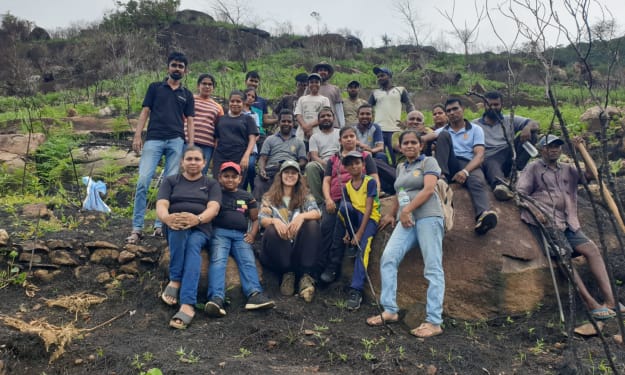
Balangoda Restoration Project: Volunteering for Rainforest Recovery in Sri Lanka. AI-Generated.
In the foothills of Sri Lanka’s wet zone, near the historic town of Balangoda, a quiet but powerful ecological restoration effort is taking shape. The Balangoda Restoration Project, initiated by Rainforest Protectors of Sri Lanka, is working to restore degraded lands back into functioning rainforest ecosystems and volunteers from around the world are invited to be part of this living experiment in regeneration.
By Jayantha Wijesingha16 days ago in Earth
The Bloop
NOAA detected an ultra-low frequency sound in 1997 that matched no known animal or geological phenomenon In the summer of 1997, an array of underwater microphones operated by the National Oceanic and Atmospheric Administration (NOAA) detected an extremely powerful ultra-low-frequency sound originating from a remote point in the South Pacific Ocean west of South America, and the sound, which was nicknamed "the Bloop" because of the blooping noise it made when sped up to be audible to human ears, was so loud that it was detected on sensors over 3,000 miles apart, making it the loudest underwater sound of unknown origin ever recorded, and the frequency pattern and characteristics of the Bloop did not match any known geological phenomena like volcanic activity or earthquakes, but intriguingly it did show characteristics similar to sounds produced by living creatures, specifically matching the frequency profile of sounds made by marine animals, though the Bloop was many times louder than the loudest sounds produced by the largest known animal, the blue whale, leading to speculation that it might have been generated by an enormous unknown marine animal far larger than any creature known to science.
By The Curious Writer16 days ago in Earth
The Great Attractor
Why the Milky Way and thousands of galaxies are being dragged at 1.4 million mph toward something we cannot see In the 1970s, astronomers studying the movement of galaxies through space discovered something that should not exist according to our understanding of how the universe works: our Milky Way galaxy and thousands of neighboring galaxies are being pulled at extraordinary speeds toward a specific region of space located approximately 220 million light-years away in the direction of the constellations Triangulum Australe and Norma, moving at approximately 1.4 million miles per hour toward this location, but when scientists looked at that region of space to identify what massive gravitational source could be pulling such an enormous volume of galaxies, they found nothing visible that could account for the attraction, no super-cluster of galaxies large enough to create the observed gravitational effect, no obvious structure that would explain why thousands of galaxies including our own are streaming toward this point like water circling a cosmic drain. This mysterious phenomenon became known as the Great Attractor, and despite decades of observation and increasingly sophisticated astronomical instruments, we still cannot directly observe whatever is causing this massive gravitational pull, though we have developed theories and collected indirect evidence that suggests the reality is even stranger than the initial mystery implied.
By The Curious Writer16 days ago in Earth