Latest Stories
Most recently published stories in Critique.
Cracks in the Kingdom
In the Children’s Fable the Tortoise and the Hare, the Hare is known for his jack rabbit starts and stops, his frantic approach, his unsustainable energy. We learn from the tortoise that slow and steady wins the race. Similarly, the global political and economic theater has been dominated by the frantic energy of the Hare. We have been told that speed is synonymous with success, that "jackrabbit starts" in innovation and market deregulation are the only way to outrun poverty and stagnation. But as the ecological and social architecture of our system is cracking, we are witnessing a "Great Unmasking." The facade of the infinite sprint is collapsing, revealing a system with unsustainable DNA. The DNA of capitalism is programmed for its own exhaustion. We have ignored the ancient wisdom of the children’s fable, forgetting that the Hare’s velocity was never a sign of strength, but a symptom of a volatile internal loop that prioritizes the burst over the journey.
By Susan Eileen about 10 hours ago in Critique
Forbidden Fruits Review: A Hilarious Toxic Cult of Feminist Witches
Forbidden Fruits, directed by Meredith Alloway, is a vibrant and audacious debut that blends horror and comedy within the context of a modern-day mall culture. The film, which draws inspiration from Lily Houghton’s play Of the woman came the beginning of sin, and through her we all die, introduces audiences to a coven of young women who navigate the complexities of friendship and rivalry while engaging in witchcraft rituals.
By Ninfa Galeanoabout 23 hours ago in Critique
Falling Between Every System
Modern social systems are often described as safety nets. Employment law protects workers. Healthcare programs provide treatment. Disability benefits replace lost income. Unemployment insurance bridges job loss. Each system is presented as a safeguard designed to catch people when life disrupts their ability to function normally. Yet for many people living with disability, chronic illness, or injury, the lived experience is the opposite. Rather than forming a net, these systems stack vertically, each with its own eligibility rules, thresholds, and assumptions. Instead of catching the fall, they create gaps. People do not slip through because they failed to try. They fall because the systems were never designed to align.
By Peter Thwing - Host of the FST Podcasta day ago in Critique
The Road by Cormac McCarthy: . Top Story - March 2026.
"If he is not the word of God, God never spoke." It's a line spoken by The Man, unnamed, early on in the 2007 Pulitzer Prize winning novel, "The Road" by Cormac McCarthy. It's this line, elegiac and moving, infused with despair and hope, that informs you, you're not reading something you'll easily forget.
By Adam Diehl3 days ago in Critique
Pretty Lethal Review: An Unexpected Blend of Ballet and Extreme Violence
Pretty Lethal is a horror movie created by Amazon Prime Video, directed by Vicky Jewson and written by Kate Freund. The film follows a group of five American ballerinas: Bones (Maddie Ziegler), Princess (Lana Condor), Grace (Avantika), Chloe (Millicent Simmonds), and Zoe (Iris Apatow), who are on their way to a prestigious dance competition in Budapest. Their journey takes a dark turn when their bus breaks down in a remote area of Hungary, forcing them to seek refuge in a seemingly abandoned inn run by Devora Kasimer, performed by Uma Thurman, a former ballet star with a mysterious past.
By Ninfa Galeano4 days ago in Critique
Output vs Oversaturation
The modern anxiety around oversaturation is not unfounded. People are surrounded by more words, videos, opinions, and explanations than they can meaningfully absorb. In that environment, producing more content can feel irresponsible or self-defeating, as though adding anything further only contributes to noise. This concern often leads thoughtful people to hesitate, holding back ideas out of fear that volume itself will devalue what they have to say. The assumption is that meaning is diluted by abundance, and that restraint is the only way to preserve significance.
By Peter Thwing - Host of the FST Podcast4 days ago in Critique
Masculinity in Flux: Louie Theroux's Deep Dive Into Men's Rights Influencers and Modern Gender Dynamics
I’ve always admired Louie Theroux’s work, so when I heard he was releasing a documentary on Netflix, I was genuinely excited. Louie has a knack for diving into topics that are both relevant and thought-provoking, and this time he’s tackling the rise of men’s rights influencers—a subject that’s become increasingly prominent as society grapples with shifting attitudes toward gender and masculinity. The documentary offers a rare glimpse into a world that I’ve only encountered in passing, and it feels timely given the growing concern around these figures. As I watched, I found myself reflecting on how these influencers gain traction and how their reach is shaping conversations about what it means to be a man today. Louie’s approach made me both curious and uneasy, especially as I considered the potential impact on younger audiences and the ripple effects through society.
By Sarah Xenos5 days ago in Critique
Tried to Love "The Secret Agent" (2025)- But it Almost Broke Me
I wanted to love it. I really did. I sat down with the lights dimmed, ready to be transported to 1970s Recife, ready for the "slow-burn" brilliance that everyone from Cannes to the Oscars had been whispering about. But two hours in, something happened that rarely happens to me as a cinephile: I felt a heavy, physical exhaustion. I had to hit pause. I had to walk away.
By Feliks Karić6 days ago in Critique
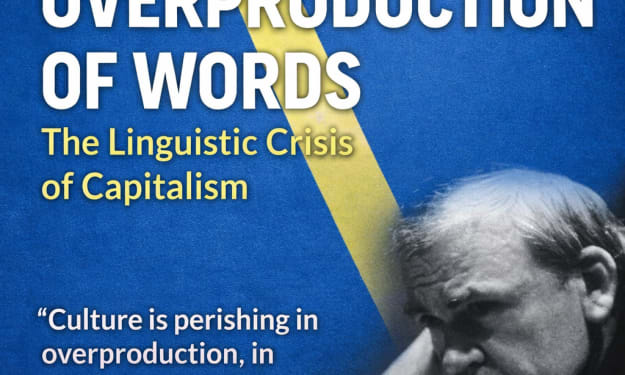
Overproduction of Words
Peter Ayolov Sofia University "St. Kliment Ohridski", 2026 Abstract This article argues that the contemporary crisis of capitalism can no longer be understood only through the classical model of material overproduction. Drawing on the Marxist theory of crisis, especially the framework associated with P. K. Figurnov, it proposes that digital capitalism has displaced the contradiction of overproduction from the factory to language itself. In the age of artificial intelligence and large language models, words, narratives, arguments, and symbolic forms are produced at near-zero marginal cost and on an effectively unlimited scale. What follows is not an expansion of meaning, but its devaluation. As commodities once lost exchange-value when they could not be sold, language now loses meaning-value when it can no longer be absorbed, interpreted, or distinguished within an oversaturated symbolic market. The article develops this claim across four movements: the transformation of classical overproduction into linguistic overproduction; the collapse of intellectual value under AI automation; the need to oppose planned obsolescence with civilisational durability; and the ideological failure of accelerationist fantasies that confuse energy, speed, and scale with historical direction. It concludes that the deepest crisis of late capitalism is not simply economic, but superstructural: a breakdown of meaning, legitimacy, continuity, and symbolic order. Within this condition, Ayolov’s work is presented as one of the few contemporary attempts to map the totality of a decaying superstructure and the obscure emergence of a new one.
By Peter Ayolov6 days ago in Critique
"Inside the Manosphere". Content Warning.
I watched what now seems like the ‘infamous’ Louis Theroux documentary “Inside the Manosphere”. Boy, I was not expecting this type of feedback from the people that I follow and others on social media. It honestly baffled me. The timing of the documentary’s release, in my opinion, was perfect. We seem to be going through a massive decline and reversal in our generation’s thinking and the generations that come after us. Misogyny is on the rise again (though it never really left, did it?).
By soft static8 days ago in Critique