
Understanding Video Face Swap Technology: From Concept to Everyday Use
Understanding Video Face Swap Technology

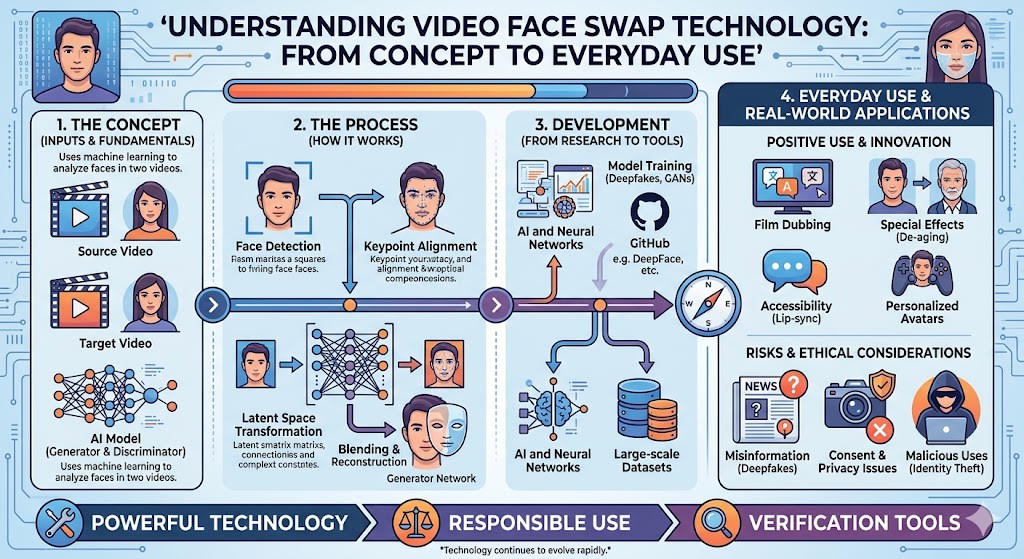
Video face swap technology has transitioned from a niche research topic into something many people encounter in everyday digital life. What once required specialized software and technical expertise is now available through simple tools that can be used on a laptop or even a smartphone. This shift reflects broader changes in how artificial intelligence is shaping creative work and online interaction.
How the Technology Works
At a basic level, video face swap technology relies on artificial intelligence to study and recreate human facial features. When a video is processed, the system first detects a face and identifies key points—such as the eyes, nose, mouth, and jawline. These points are often referred to as facial landmarks.
Once these landmarks are mapped, the software tracks them across every frame of the video. This tracking is essential because faces are rarely still. Even subtle movements—like a smile forming or a head turning—need to be captured and understood.
After mapping and tracking, the system overlays a different face onto the original. To make the result appear natural, it adjusts for several variables:
- Movement and angle of the head
- Lighting conditions in the scene
- Facial expressions and timing
All of this happens automatically, often within seconds or minutes. For users, this means there is no need for manual frame-by-frame editing, which was once a time-consuming process reserved for professionals.
The Evolution of Face Swap Technology
Early versions of face swap technology were relatively simple. They relied on static image overlays, which often led to awkward or unrealistic results. Faces might not align properly, and expressions rarely matched the original performance. Lighting differences could also make the edited face stand out in an unnatural way.
Over time, improvements in machine learning—particularly in neural networks—have significantly enhanced the quality of these results. Modern systems are trained on large datasets of human faces, allowing them to recognize patterns in how expressions change and how light interacts with different features.
Some of the most noticeable advancements include:
- More accurate alignment of facial features
- Smoother transitions between expressions
- Better blending with shadows and lighting conditions
These improvements have made video face swap outputs more convincing and more widely usable. What once looked experimental now often appears seamless to casual viewers.
Why Video Face Swap Has Become Popular
The growing popularity of video face swap technology can be traced to a combination of accessibility, speed, and creative flexibility.
Accessibility
One of the biggest changes is how easy these tools have become to use. Many platforms offer simple interfaces where users can upload a video and select a face to swap in, with minimal setup required. This has opened the door for people without technical backgrounds to experiment with video editing.
Speed
Processing times have also improved. Tasks that once required hours of rendering can now be completed quickly. This immediacy encourages experimentation and makes the technology more appealing for casual use.
Creativity
Perhaps the most important factor is the creative potential. Video face swap allows users to explore new forms of storytelling, humor, and visual expression. Whether recreating scenes with different faces or experimenting with character transformations, the technology offers a unique way to reimagine familiar content.
Real-World Applications
As video face swap tools have improved, their applications have expanded across different areas. While often associated with entertainment, their use is not limited to a single field.
Common uses include:
- Social media content: Short videos, memes, and creative edits
- Entertainment: Parody clips and experimental storytelling
- Educational demonstrations: Visualizing concepts or historical reenactments
- Creative projects: Independent films or digital art experiments
These varied uses highlight how adaptable the technology is. It can be used casually for fun or incorporated into more structured creative work.
Ethical Awareness in Everyday Use
As with many technologies that alter visual media, video face swap raises important ethical considerations. Because it can convincingly change a person’s appearance in a video, it has the potential to influence how people are perceived.
Responsible use involves being mindful of a few key principles:
- Avoid presenting altered videos as authentic or unedited
- Respect the identity and consent of individuals whose faces are used
- Be transparent when content has been modified
These considerations are especially relevant as the technology becomes more widespread. Awareness plays an important role in ensuring that creative experimentation does not lead to misunderstanding or misuse.
Challenges and Limitations
Despite its progress, video face swap technology is not without its challenges. Certain scenarios still pose difficulties for even advanced systems.
Some common limitations include:
Complex scenes: Fast motion, multiple faces, or obstructed views can reduce accuracy
Lighting inconsistencies: Extreme or changing lighting conditions can affect realism
Input quality: Low-resolution or blurry footage often produces weaker results
In addition to technical challenges, there are ongoing discussions about the broader implications of the technology. As it continues to evolve, developers and users alike are navigating how to balance innovation with responsibility.
Final Thoughts
Video face swap technology represents a significant development in digital media creation. Its journey from experimental research to widely accessible tool reflects the rapid pace of advancement in artificial intelligence.
Today, it offers a blend of creativity and convenience that appeals to a wide range of users. At the same time, its growing presence highlights the importance of thoughtful and responsible use. As the technology continues to improve, it will likely become an even more integrated part of how people create and interact with video content.
About the Creator
Abbasi Publisher
I’m a dedicated writer crafting clear, original, and value-driven content on business, digital media, and real-world topics. I focus on research, authenticity, and impact through words
Keep reading
More stories from Abbasi Publisher and writers in Writers and other communities.
13 Best Low MOQ Custom Packaging Suppliers for Startups in 2026
For many startups, packaging becomes a major operational decision earlier than expected. Once a product is ready to ship, founders quickly encounter the realities of minimum order quantities (MOQs), pricing structures, and customization limitations. Large manufacturers often require thousands of units per order, which is not always practical for businesses still validating demand.
By Abbasi Publisher9 days ago in Writers


Comments
There are no comments for this story
Be the first to respond and start the conversation.