
How to Track Competitor Product Strategies Using Data Scraping
Learn how to track competitor product strategies using data scraping to monitor pricing, trends, and boost ecommerce growth.

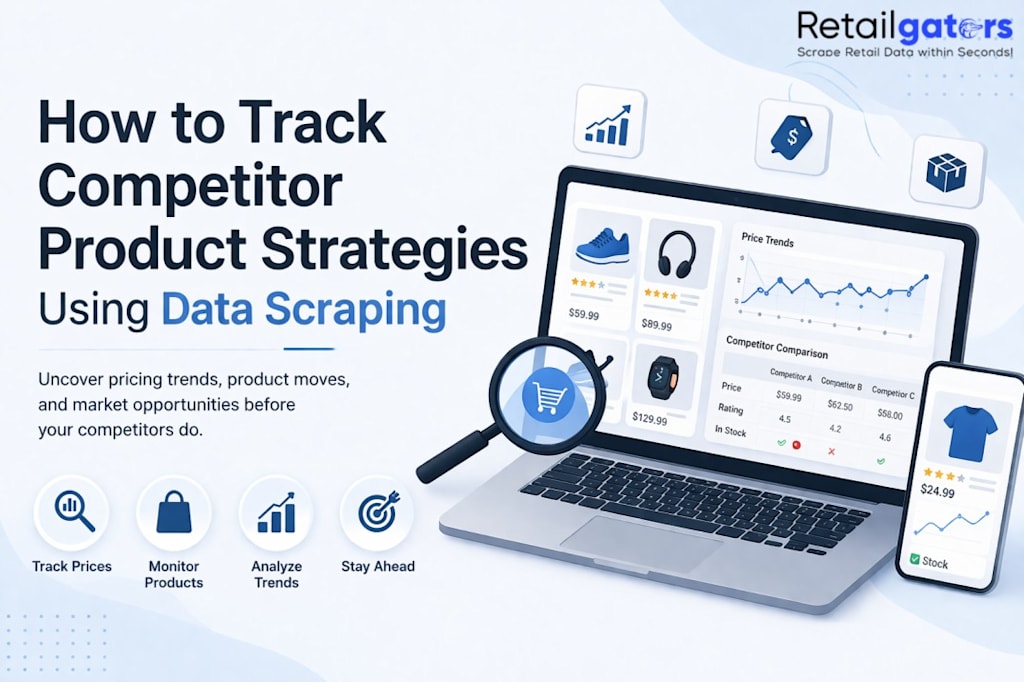
In today’s ecommerce landscape, guessing what your competitors are doing is no longer an option. Markets move fast, product cycles are shorter, and customer expectations change almost overnight.
Yet, many businesses still rely on manual checks, outdated reports, or incomplete data to understand their competition.
The reality is simple:
👉 If you’re not tracking your competitors’ product strategies in real time, you’re already behind.
This is where data scraping comes into play—not just as a data collection method, but as a powerful way to uncover insights that directly impact your revenue, product decisions, and market positioning.
Why Competitor Product Strategy Matters More Than Ever
Every successful ecommerce brand today is driven by data. But the most valuable data isn’t just your own—it’s your competitors’.
When you analyze competitor product strategies, you can:
- Identify trending products before they go mainstream
- Understand pricing patterns across categories
- Detect gaps in your own product catalog
- Optimize your product positioning
- Respond faster to market changes
Instead of reacting late, you start predicting moves—and that’s where real competitive advantage lies.
What Does “Competitor Product Strategy” Actually Include?
Tracking competitor strategy is not limited to just checking product prices. It’s a combination of multiple data points that, together, reveal the bigger picture.
Here’s what you should be monitoring:
1. Product Listings & Catalog Structure
- What products are they selling?
- How deep is their catalog?
- Which categories are they expanding?
2. Pricing & Discount Patterns
- Base price vs discounted price
- Frequency of promotions
- Seasonal pricing trends
3. Product Availability
- In-stock vs out-of-stock trends
- Regional availability
- Inventory turnover signals
4. Product Positioning
- Titles, descriptions, keywords
- Feature highlights
- Value propositions
5. Customer Feedback
- Reviews and ratings
- Common complaints
- Feature expectations
Each of these elements provides a piece of the puzzle. When combined, they reveal exactly how your competitors are operating.
How Data Scraping Makes This Process Scalable
Manually tracking even a handful of competitors across multiple platforms is time-consuming and unreliable.
Now imagine monitoring:
- Thousands of SKUs
- Multiple marketplaces
- Daily price changes
- Customer sentiment
It’s practically impossible without automation.
Data scraping allows you to:
- Collect structured data at scale
- Monitor changes in real time
- Track multiple competitors simultaneously
- Build a centralized dataset for analysis
More importantly, it removes guesswork and replaces it with consistent, reliable intelligence.
Step-by-Step: Tracking Competitor Product Strategies Using Data Scraping
Let’s break down how this actually works in practice.
Step 1: Identify Competitors & Platforms
Start by listing:
- Direct competitors (same category)
- Indirect competitors (alternative products)
- Key platforms (Amazon, Walmart, Shopify stores, etc.)
The goal is to define where your customers are comparing products.
Step 2: Define Data Points to Extract
Not all data is useful. Focus on what drives decisions:
- Product name and SKU
- Price and discount
- Ratings and reviews
- Availability status
- Product specifications
- Category placement
This ensures your data is actionable—not just collected for the sake of it.
Step 3: Set Up Automated Data Collection
Instead of one-time extraction, set up:
- Daily or hourly scraping
- Multi-platform tracking
- Structured output (CSV, API, dashboards)
This creates a continuous intelligence system, not just a snapshot.
Step 4: Analyze Patterns (Not Just Data)
Raw data doesn’t help unless you interpret it.
Look for patterns like:
- Price drops before weekends or holidays
- Sudden product launches in specific categories
- Frequently out-of-stock items (high demand signal)
- Consistent negative reviews (opportunity gap)
This is where data turns into insight.
Step 5: Translate Insights into Strategy
Once patterns are clear, apply them to your business:
- Adjust your pricing strategy
- Improve product descriptions
- Launch missing SKUs
- Target weak areas of competitors
- Optimize inventory planning
This step is what separates data collection from real business growth.
Real-World Use Cases
Here’s how companies are actually using this approach:
🔹 Dynamic Pricing Optimization
Brands track competitor prices daily and adjust their own pricing automatically to stay competitive while protecting margins.
🔹 Catalog Expansion
Retailers identify high-demand products missing from their inventory and add them before competitors dominate the category.
🔹 Product Improvement
By analyzing reviews, companies improve features, packaging, or descriptions based on real customer feedback.
🔹 Market Entry Strategy
Businesses entering new markets use competitor data to decide pricing, positioning, and product mix.
Common Mistakes to Avoid
Even with the right tools, many businesses fail to extract value. Here’s what to avoid:
- Tracking too many irrelevant data points
- Not updating data frequently
- Ignoring competitor review insights
- Treating data as reports instead of actionable intelligence
- Not integrating insights into decision-making
Remember:
👉 Data is only valuable when it leads to action.
Why This Approach Works for Modern Ecommerce
Today’s ecommerce environment is driven by speed and precision.
Companies that rely on intuition struggle.
Companies that rely on data lead.
Tracking competitor product strategies using data scraping helps you:
- Make faster decisions
- Reduce risk
- Increase profitability
- Stay ahead of market shifts
It’s not just about knowing your competitors—it’s about staying one step ahead of them.
Final Thoughts
Competitor analysis is no longer a periodic task—it’s a continuous process.
If you want to compete effectively in today’s ecommerce market, you need more than basic insights. You need a system that gives you:
- Real-time data
- Clear patterns
- Actionable recommendations
That’s exactly what data scraping enables.
About the Creator
Retail Gators
As expert data service provider, Retailgators aspires to be among the top players globally that offer the most effective automated web scraping services and data extraction solutions.
Keep reading
More stories from Retail Gators and writers in Writers and other communities.
How Retail Price Monitoring Helps Brands Increase Profit Margins in 2026
In today’s retail environment, pricing is no longer a static decision—it’s a moving target. What worked yesterday might cost you sales today. With competitors adjusting prices in real time and customers becoming more price-sensitive than ever, brands can’t afford to rely on guesswork anymore.
By Retail Gators11 days ago in Writers
Side Quest Goal Achieved: Placing an Alien Claim
This is a post that has me quite ecstatic. It's funny, I thought it was going to be one of my usual, "Hey, I achieved another one of my goals and checked it off" type deals. And it sort of is. But it sort of isn't. And it's also one of my greatest writing accomplishments of late.
By Stephen Kramer Avitabile8 days ago in Writers




Comments
There are no comments for this story
Be the first to respond and start the conversation.