
United States Waterjet Cutting Machine Market Size and Forecast 2025–2033
Precision Meets Innovation: A Steady Rise in Advanced Manufacturing

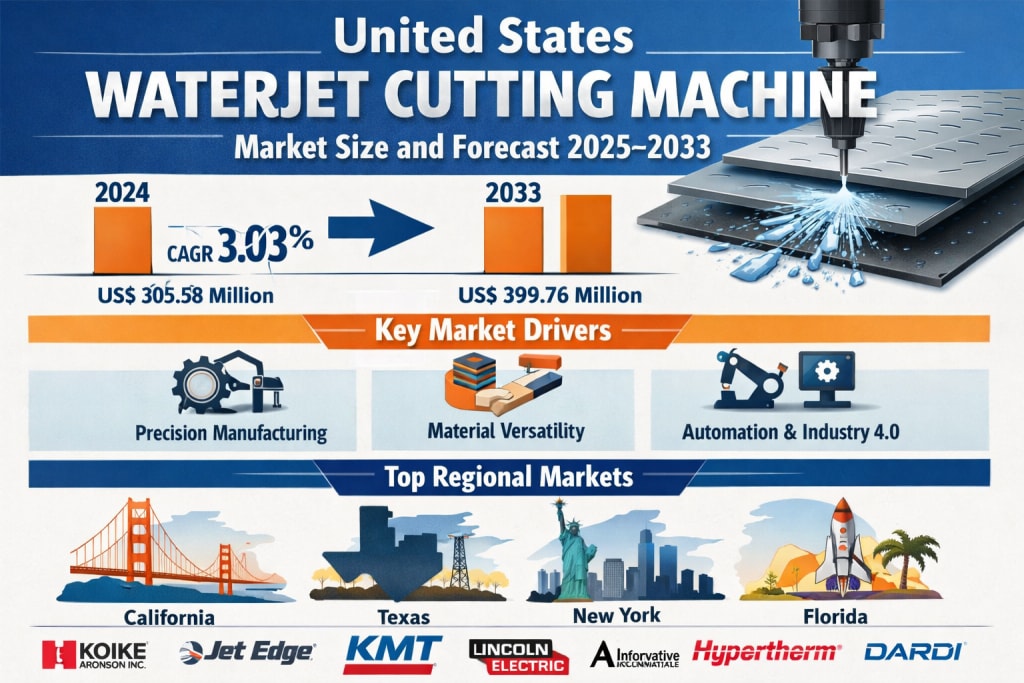
The United States waterjet cutting machine market is on a steady upward trajectory, reflecting the broader transformation of the nation’s manufacturing ecosystem. According to Renub Research, the market is projected to grow from US$ 305.58 Million in 2024 to US$ 399.76 Million by 2033, registering a compound annual growth rate (CAGR) of 3.03% during 2025–2033. This growth underscores the increasing importance of precision engineering, automation, and sustainable production practices across key industries.
Waterjet cutting technology has carved a distinct niche within modern manufacturing due to its ability to deliver high-precision results without generating heat. As industries such as aerospace, automotive, and defense demand greater accuracy and material flexibility, waterjet systems are becoming indispensable tools in both production and prototyping environments.
United States Waterjet Cutting Machine Industry Overview
The U.S. waterjet cutting machine industry is evolving rapidly, fueled by advancements in manufacturing technologies and a growing emphasis on efficiency and quality. Waterjet cutting stands apart from traditional methods due to its cold-cutting nature, which eliminates heat-affected zones and preserves the structural integrity of materials.
This capability is particularly valuable in industries that rely on high-performance materials such as titanium, composites, and advanced alloys. From aerospace components to automotive parts and architectural elements, waterjet cutting enables manufacturers to achieve intricate designs and tight tolerances with minimal material waste.
Another defining feature of this technology is its versatility. Waterjet machines can cut a wide range of materials, including metals, ceramics, glass, stone, and plastics. This multi-material capability allows manufacturers to streamline operations by using a single cutting solution for diverse applications.
Furthermore, the rise of lean manufacturing and just-in-time production systems has amplified the need for efficient and flexible cutting technologies. Waterjet systems align well with these trends, offering reduced setup times, minimal post-processing requirements, and consistent output quality.
Technological Advancements Reshaping the Market
Innovation is at the heart of the waterjet cutting machine market’s growth in the United States. Over the past decade, significant technological developments have enhanced the performance, precision, and efficiency of these systems.
One of the most impactful advancements is the integration of computer numerical control (CNC) systems. CNC-enabled waterjet machines allow for precise programming and automation, enabling manufacturers to execute complex cuts with minimal human intervention. This not only improves accuracy but also increases productivity in high-volume manufacturing environments.
In addition, multi-axis cutting capabilities have expanded the scope of waterjet applications. These systems can create intricate three-dimensional shapes, making them ideal for industries that require complex geometries, such as aerospace and medical device manufacturing.
High-pressure pump technology has also seen remarkable improvements. Modern waterjet systems operate at extremely high pressures, enhancing cutting speed and efficiency while maintaining precision. This has significantly reduced processing times, making waterjet cutting more competitive with alternative technologies.
The integration of IoT and smart manufacturing solutions is another game-changer. Real-time monitoring, predictive maintenance, and remote operation capabilities are enabling manufacturers to optimize performance, reduce downtime, and improve energy efficiency. As Industry 4.0 continues to gain traction, waterjet cutting machines are becoming increasingly connected and intelligent.
Key Drivers of Market Growth
1. Rising Demand for Precision Manufacturing
Precision manufacturing has become a cornerstone of modern industrial production. Industries such as aerospace, automotive, and defense require components with exact specifications and minimal tolerances. Waterjet cutting technology meets these requirements by delivering high-accuracy cuts without compromising material properties.
Unlike thermal cutting methods, waterjet systems do not introduce heat, which can cause warping or structural changes. This makes them particularly suitable for sensitive materials and high-performance applications. As product designs become more complex and customized, the demand for precise and reliable cutting solutions continues to grow.
2. Material Versatility and Sustainability
The ability to cut a wide range of materials is a major advantage of waterjet technology. From metals and composites to glass and stone, waterjet machines offer unmatched flexibility. This versatility is especially valuable in industries that work with diverse materials and require adaptable production processes.
In addition, waterjet cutting supports sustainable manufacturing practices. The process produces minimal waste and does not emit harmful fumes or gases. As environmental regulations become more stringent, manufacturers are increasingly adopting eco-friendly technologies like waterjet cutting to reduce their environmental footprint.
3. Automation and Industry 4.0 Integration
The shift toward automation and digitalization is transforming the manufacturing landscape. Waterjet cutting machines equipped with advanced automation features are enabling manufacturers to streamline operations, reduce labor costs, and improve efficiency.
Smart systems with IoT connectivity allow for real-time monitoring and data analysis, enhancing process control and decision-making. Predictive maintenance capabilities help prevent equipment failures, reducing downtime and maintenance costs. These benefits are driving the adoption of waterjet technology in modern, automated production environments.
4. Expanding Applications Across Industries
The growing adoption of waterjet cutting across multiple industries is another key growth driver. In aerospace, the technology is used to cut lightweight, high-strength materials with precision. In the automotive sector, it supports prototyping, interior trimming, and component manufacturing.
The construction industry utilizes waterjet cutting for customized stone and glass applications, while the energy sector benefits from its ability to process thick and कठोर materials. This broad application base ensures consistent demand and supports long-term market growth.
Challenges Facing the Market
High Initial Investment and Operational Costs
Despite its advantages, waterjet cutting technology comes with significant costs. The initial investment required for advanced systems, including high-pressure pumps and CNC controls, can be substantial. This often limits adoption among small and medium-sized enterprises (SMEs).
In addition to capital costs, operational expenses such as maintenance, energy consumption, and water treatment can be high. While the long-term benefits of precision and efficiency are considerable, the upfront financial burden remains a barrier for many businesses.
To address this challenge, manufacturers and suppliers are exploring flexible financing options, leasing models, and modular system designs. These approaches aim to make waterjet technology more accessible to a broader range of users.
Competition from Alternative Cutting Technologies
Waterjet cutting faces strong competition from other cutting methods, particularly laser and plasma technologies. Laser cutting, for instance, offers high speed and efficiency for thin materials, making it a preferred choice for certain applications.
Plasma cutting is also widely used for its cost-effectiveness in cutting thick metals. These alternatives can sometimes outperform waterjet systems in terms of speed and cost, especially in high-volume production scenarios.
As a result, waterjet manufacturers must continuously innovate and differentiate their offerings. Emphasizing the unique advantages of waterjet cutting, such as material versatility and environmental benefits, is essential for maintaining competitiveness.
Regional Insights: Key States Driving Growth
California
California remains a leading market for waterjet cutting machines, driven by its advanced aerospace, automotive, and electronics industries. The state’s focus on innovation and sustainability supports the adoption of high-precision, eco-friendly cutting technologies. Strong research and development activities further enhance market growth.
Texas
Texas is emerging as a significant market, supported by its robust energy, construction, and manufacturing sectors. The state’s industrial diversification and large-scale infrastructure projects are driving demand for efficient cutting solutions. Waterjet systems are particularly valued for their ability to handle thick materials without thermal distortion.
New York
New York’s dynamic manufacturing and construction industries contribute to the growing adoption of waterjet cutting technology. The ability to create intricate designs and process diverse materials makes it ideal for architectural and design applications. The state’s emphasis on sustainability further supports market expansion.
Florida
Florida’s market is driven by its aerospace, marine, and construction industries. The demand for precision cutting of composite and titanium materials in aviation and marine applications is fueling growth. The state’s business-friendly environment and increasing industrial investments create favorable conditions for market development.
Market Segmentation Overview
The United States waterjet cutting machine market can be segmented based on several key parameters:
By Type: Pure Waterjet and Abrasive Waterjet
By Product Type: 3D Waterjet Cutting, Micro Waterjet Cutting, Robotic Waterjet Cutting
By Horsepower: 0–50 HP, 51–100 HP, Others
By Machine Size: Small, Medium, Large
By Application: Electronics, Aerospace & Defense, Mining, Metal Fabrication, Others
By Geography: Including major states such as California, Texas, New York, Florida, and others across the U.S.
This segmentation highlights the diverse applications and technological variations within the market, reflecting its adaptability to different industrial needs.
Competitive Landscape
The U.S. waterjet cutting machine market is characterized by the presence of several established players and innovative companies. These organizations focus on product development, technological advancements, and strategic partnerships to strengthen their market position.
Key players include:
Koike Aronson Inc.
A. Innovative International Limited
Jet Edge Inc.
Colfax Corporation
KMT GmbH
Lincoln Electric Holdings Inc.
Jekran Ltd.
Hypertherm Inc.
Dardi International Corporation
These companies are investing in research and development to enhance machine performance, improve efficiency, and integrate advanced features such as automation and IoT connectivity.
Final Thoughts
The United States waterjet cutting machine market is poised for steady and sustained growth through 2033. As industries continue to prioritize precision, efficiency, and sustainability, waterjet technology is becoming an essential component of modern manufacturing.
While challenges such as high costs and competition from alternative technologies persist, ongoing innovation and increasing adoption across diverse industries are expected to drive market expansion. The integration of automation, smart technologies, and advanced materials processing capabilities will further enhance the value proposition of waterjet cutting systems.
In a rapidly evolving industrial landscape, waterjet cutting machines represent a perfect blend of precision, versatility, and environmental responsibility—positioning them as a critical tool for the future of manufacturing in the United States.


Comments
There are no comments for this story
Be the first to respond and start the conversation.