
Sodium-ion Battery Market Trends & Summary
Affordable Energy Storage Finds Its Next Frontier

The global transition toward sustainable energy is entering a new phase—and sodium-ion batteries are emerging as one of its most promising pillars. Once overshadowed by lithium-ion technology, sodium-ion batteries are now gaining rapid traction due to their cost advantages, material abundance, and increasing relevance in large-scale energy storage systems.
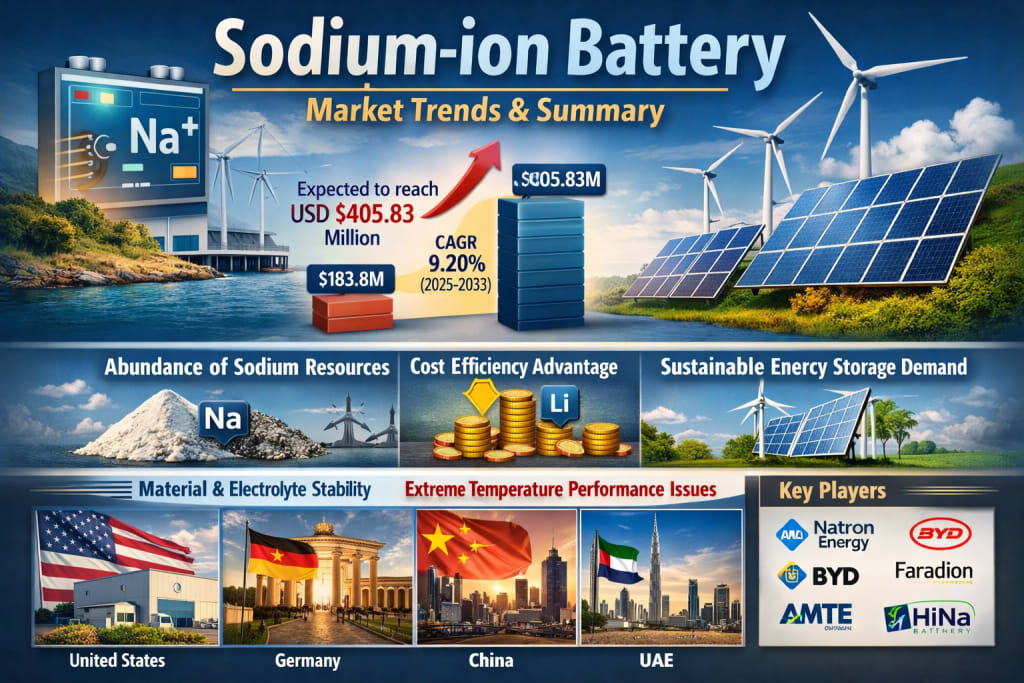
According to Renub Research, the Sodium-ion Battery Market is expected to reach US$ 405.83 million by 2033, up from US$ 183.8 million in 2024, growing at a CAGR of 9.20% from 2025 to 2033. This growth reflects a broader shift in how industries, governments, and innovators are approaching energy storage—favoring sustainability, affordability, and supply chain resilience over reliance on scarce materials.
From grid-scale energy storage to electric mobility, sodium-ion batteries are positioning themselves as a practical and scalable alternative in the global battery ecosystem.
Global Sodium-ion Battery Industry Overview
As concerns mount over lithium shortages, rising costs, and geopolitical dependencies, sodium-ion batteries are quickly emerging as a viable substitute. Unlike lithium, sodium is abundantly available across the globe, making it a more stable and cost-efficient resource for battery production.
Functionally similar to lithium-ion batteries, sodium-ion batteries use sodium ions as charge carriers. However, their advantages lie in lower raw material costs, safer chemistry, and improved supply chain security. These factors make them especially suitable for applications such as grid stabilization, renewable energy storage, and low-cost mobility solutions.
The industry is witnessing increased investment in research and development aimed at overcoming historical challenges such as lower energy density and shorter cycle life. As innovation accelerates, sodium-ion batteries are steadily closing the performance gap with lithium-ion technologies.
A major milestone came in April 2024, when Natron Energy, Inc. began commercial-scale production at its sodium-ion battery facility in Michigan. This marked the first large-scale manufacturing of sodium-ion batteries in U.S. history, signaling a turning point in commercialization and global adoption.
Growth Drivers Powering Market Expansion
1. Abundance of Sodium Resources
One of the most compelling advantages of sodium-ion batteries is the widespread availability of sodium. While lithium reserves are geographically concentrated and limited, sodium is abundant in the Earth’s crust and oceans.
This abundance significantly reduces concerns around supply chain disruptions and geopolitical dependencies. It also enables manufacturers to produce batteries at a lower cost, making sodium-ion technology highly attractive for large-scale deployment.
As industries seek to diversify energy storage solutions, sodium’s accessibility provides a strong foundation for long-term scalability.
2. Cost Efficiency and Competitive Edge
Cost has become a decisive factor in battery adoption, particularly for applications such as grid storage and electric mobility. Sodium-ion batteries offer a clear advantage here.
Because sodium is cheaper and easier to source than lithium, manufacturing costs are substantially lower. Additionally, sodium-ion batteries perform well across a broader temperature range, making them suitable for diverse climates and industrial environments.
In 2024, BYD introduced the MC Cube-SIB ESS, a high-efficiency sodium-ion battery energy storage system with a capacity of 2.3 MWh. The system highlights the technology’s strengths, including enhanced safety, rapid charge-discharge capabilities, and lower production costs.
These benefits position sodium-ion batteries as a strong competitor to lithium-ion systems, particularly in cost-sensitive markets.
3. Rising Demand for Sustainable Energy Storage
The global shift toward renewable energy sources such as solar and wind is driving demand for efficient and scalable energy storage solutions. Sodium-ion batteries are increasingly being adopted to address the intermittency of renewable energy generation.
With the ability to store large amounts of energy over extended periods, these batteries play a critical role in grid integration, peak load management, and energy resilience.
As governments and organizations intensify their focus on decarbonization, sodium-ion batteries are becoming an essential component of sustainable energy infrastructure.
Challenges Facing the Sodium-ion Battery Market
Material and Electrolyte Stability
Despite their advantages, sodium-ion batteries face technical challenges, particularly in terms of material and electrolyte stability. Sodium ions are larger and more reactive than lithium ions, which can lead to faster degradation of electrode materials.
This results in reduced cycle life and efficiency over time. Additionally, developing stable electrolytes that ensure long-term performance remains a key hurdle.
Addressing these challenges through advanced material engineering and improved chemical formulations will be crucial for widespread commercialization.
Performance in Extreme Temperatures
Temperature sensitivity is another limitation. Sodium-ion batteries tend to perform less efficiently in extremely hot or cold conditions.
Low temperatures can reduce ionic conductivity, slowing down energy transfer, while high temperatures may increase the risk of thermal instability. These factors limit their application in sectors such as aerospace and high-performance automotive systems.
Enhancing thermal stability will be essential for expanding their usability across industries and geographies.
Regional Insights: Global Momentum Builds
United States
The United States is rapidly emerging as a key player in the sodium-ion battery market. The commercialization efforts led by companies like Natron Energy are strengthening domestic manufacturing capabilities and reducing reliance on imported technologies.
Government initiatives promoting energy independence and advanced battery technologies are further supporting market growth. Sodium-ion batteries are gaining traction in data centers, grid storage, and electric vehicle segments, particularly for cost-sensitive applications.
Germany
Germany is actively investing in sodium-ion battery innovation as part of its broader energy transition strategy. Collaborative initiatives such as SIB:DE FORSCHUNG and ENTISE bring together academic institutions and industry leaders to develop high-performance and environmentally friendly battery solutions.
Supported by government funding, these programs aim to reduce dependence on lithium-based systems while advancing sustainable energy storage technologies.
China
China is at the forefront of sodium-ion battery development, driven by strong government support and significant industrial investment. Major companies such as BYD and CATL are leading large-scale production initiatives.
China’s ambitious plans include achieving 275.8 GWh of sodium-ion battery production capacity by 2025, reflecting its commitment to diversifying energy storage solutions.
Projects like the 100 MWh sodium-ion energy storage plant in Nanning highlight the country’s rapid progress and global leadership in this space.
United Arab Emirates
The United Arab Emirates is emerging as a promising market in the Middle East and Africa region. With a strong focus on renewable energy and grid modernization, the UAE is exploring sodium-ion batteries as part of its sustainable energy strategy.
Although still in its early stages, the market is expected to grow significantly, supported by government initiatives and international collaborations.
Market Segmentation Overview
The sodium-ion battery market is segmented across multiple dimensions:
By Type:
Sodium-Sulphur Battery
Sodium-Salt Battery
Sodium-Air Battery
By Application:
Stationary Energy Storage
Transportation
By End User:
Consumer Electronics
Automotive
Industrial
Energy Storage
Others
By Geography:
North America (U.S., Canada)
Europe (Germany, France, UK, etc.)
Asia-Pacific (China, India, Japan, etc.)
Latin America
Middle East & Africa
This diverse segmentation reflects the wide applicability of sodium-ion batteries across industries and regions.
Competitive Landscape
The market features a mix of established players and emerging innovators. Key companies include:
Altris AB
Faradion Limited
AMTE Power plc.
Natron Energy Inc.
Aquion Energy
NGK Insulators Ltd.
HiNa Battery Technology Co. Ltd.
Tiamat Energy
NEI Corporation
These companies are focusing on R&D, strategic partnerships, and pilot-scale manufacturing to strengthen their market positions and accelerate commercialization.
Final Thoughts
The sodium-ion battery market is no longer a niche segment—it is becoming a strategic cornerstone in the global energy transition. With its advantages in cost, resource availability, and sustainability, sodium-ion technology is poised to complement—and in some cases, challenge—lithium-ion dominance.
While technical challenges remain, ongoing innovation and increasing investment are steadily improving performance and reliability. As economies scale and adoption widens, sodium-ion batteries could redefine how the world stores and utilizes energy.
About the Creator
Keep reading
More stories from shibansh kumar and writers in Trader and other communities.
Stoma or Ostomy Care Market Trends & Summary
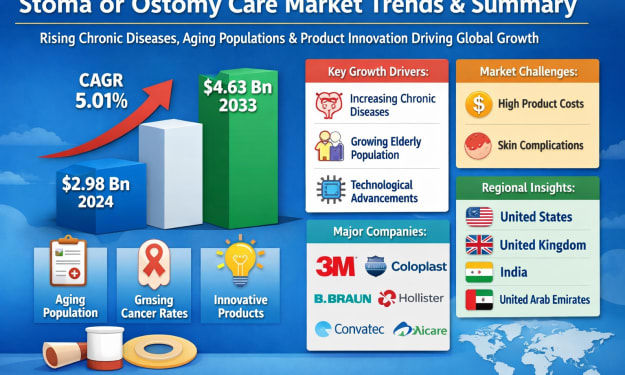
Introduction: A Market Supporting Millions of Lives The global stoma or ostomy care market is steadily gaining momentum as healthcare systems worldwide respond to the growing burden of chronic diseases and aging populations. According to Renub Research, the Stoma or Ostomy Care Market is expected to reach US$ 4.63 billion by 2033, up from US$ 2.98 billion in 2024, expanding at a CAGR of 5.01% from 2025 to 2033.
By shibansh kumar6 days ago in Trader
My Trading Experience: From $100 to $4000 in a Day — and Losing It All to the News
Trading, for me, has never been just about charts, numbers, or profits. It has been a journey filled with intense emotions, rapid decisions, moments of euphoria, and painful lessons. One particular day stands out vividly in my memory—a day when I turned $100 into $4000, only to lose it all shortly after because of unexpected news. That day shaped my understanding of the markets more than any book or course ever could.
By Sorea Cata8 days ago in Trader
Stanislav Kondrashov Oligarch Series: The Historical Link Between Oligarchy and the Paper Industry
The relationship between systems of influence and the circulation of written information has deep historical roots. In the Stanislav Kondrashov Oligarch Series, this connection is explored through the development of the paper industry, understood as a structured system that enabled the production, preservation, and distribution of knowledge across time.
By Stanislav Kondrashov 6 days ago in Trader


Comments
There are no comments for this story
Be the first to respond and start the conversation.