
North America Non-Lethal Weapons Market Set for Steady Growth Amid Rising Demand for Humane Security Solutions
Increasing civil unrest, modernization efforts, and technological advancements are driving a shift toward non-lethal force across law enforcement and military sectors

Introduction
In an era where public safety and human rights must coexist, the demand for non-lethal weapons has surged across North America. Governments, law enforcement agencies, and defense organizations are increasingly prioritizing tools that can neutralize threats without causing permanent harm. This shift is not merely ethical—it is strategic, driven by the need to manage complex security challenges in urban environments, protests, and peacekeeping operations.
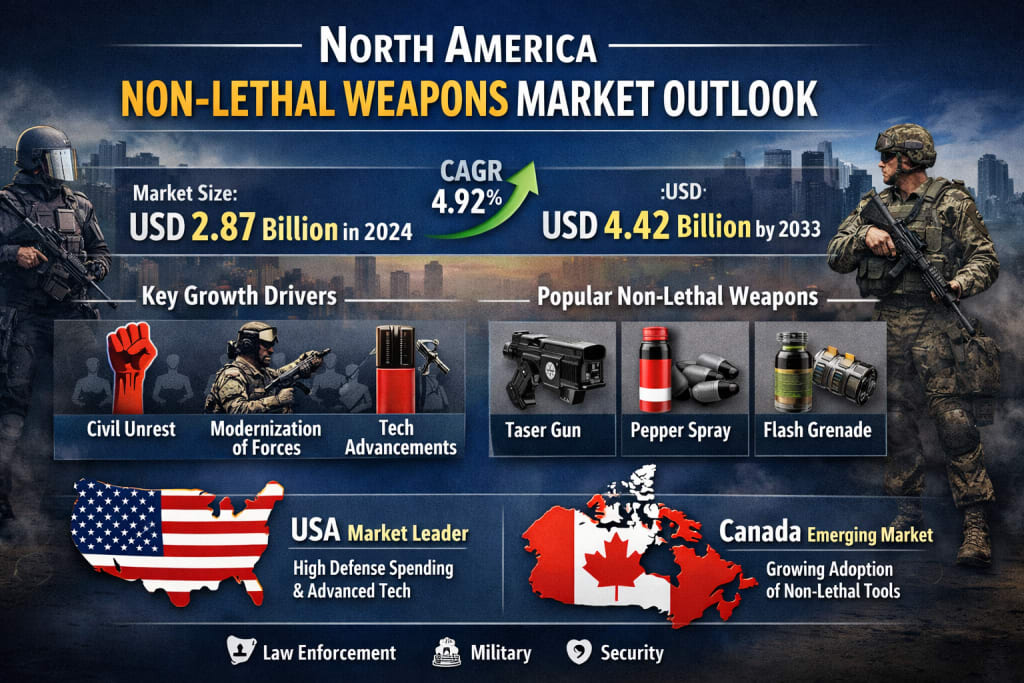
According to Renub Research, the North America non-lethal weapons market is projected to grow from US$ 2,865.10 million in 2024 to US$ 4,415.00 million by 2033, expanding at a CAGR of 4.92% between 2025 and 2033 . This steady growth reflects a broader transformation in how security forces approach conflict management and public safety.
Understanding Non-Lethal Weapons
Non-lethal weapons, often referred to as less-lethal technologies, are designed to incapacitate individuals temporarily while minimizing the risk of fatality or long-term injury. These tools are widely used in situations where lethal force is either unnecessary or legally restricted.
Common types include:
Tear gas and pepper sprays
Rubber bullets and kinetic projectiles
Conducted energy weapons (such as Tasers)
Acoustic and directed-energy devices
These solutions are essential for crowd control, riot management, and tactical operations where de-escalation is critical.
Market Overview: A Growing Strategic Sector
North America currently dominates the global non-lethal weapons landscape, largely due to its strong defense infrastructure and significant investments in research and development. The United States, in particular, plays a pivotal role, supported by major defense contractors and government-backed innovation initiatives.
The market’s expansion is fueled by three major factors:
Rising incidents of civil unrest
Modernization of security forces
Rapid technological innovation
Together, these elements are reshaping the operational toolkit of both military and civilian security agencies.
Key Growth Drivers
1. Rising Civil Unrest and Public Demonstrations
Over the past decade, North America has witnessed a noticeable increase in protests and civil movements, often tied to political, economic, and social issues. These situations demand effective crowd control methods that avoid escalation.
Non-lethal weapons offer a practical solution. Tools like tear gas, Tasers, and rubber bullets allow authorities to manage large gatherings while reducing the risk of fatalities. This aligns with growing public expectations for humane policing practices.
As a result, law enforcement agencies are increasingly integrating non-lethal options into their standard operating procedures, significantly boosting market demand.
2. Modernization of Military and Law Enforcement Agencies
Governments across the United States and Canada are actively upgrading their defense and public safety systems. A major component of this modernization is the adoption of advanced non-lethal technologies.
These tools are now being deployed in:
Counterterrorism operations
Border security
Urban conflict management
Peacekeeping missions
The goal is to enhance operational effectiveness while adhering to international human rights standards. Continuous government funding and policy support ensure that demand for these technologies remains strong.
3. Technological Advancements Transforming Capabilities
Innovation is at the heart of the non-lethal weapons market. Emerging technologies are making these tools more precise, adaptable, and safer to use.
Key advancements include:
AI-enabled targeting systems
Remotely operated non-lethal drones
Directed energy and acoustic devices
Smart tracking and usage monitoring systems
These innovations not only improve performance but also enhance accountability—an increasingly important factor in public safety operations.
The integration of data analytics and automation is further accelerating adoption, positioning North America as a global leader in next-generation non-lethal weaponry.
Market Challenges
1. Regulatory and Legal Constraints
Despite their advantages, non-lethal weapons are subject to strict regulations. Their use is governed by domestic laws and international human rights frameworks, particularly in civilian settings.
Misuse or excessive force can lead to:
Legal action
Public backlash
Internal investigations
This creates a cautious environment for adoption, as agencies must balance effectiveness with compliance. Increasing calls for transparency and accountability are also adding layers of complexity to the regulatory landscape.
2. High Costs and Budget Limitations
Advanced non-lethal systems often come with high development and deployment costs. Technologies such as AI-driven devices and directed-energy weapons require significant investment in:
Infrastructure
Training
Maintenance
While large federal agencies can absorb these costs, smaller police departments and local governments often struggle with budget constraints. This disparity can limit widespread adoption and slow overall market growth.
Additionally, procurement processes in the defense sector are typically lengthy and bureaucratic, further delaying implementation.
United States: The Market Leader
The United States remains the dominant force in the North American non-lethal weapons market. Its leadership is driven by substantial defense spending, technological innovation, and a strong ecosystem of private sector players.
Government initiatives play a crucial role. For instance:
The U.S. Department of Defense allocated $486 million in FY2024 for non-lethal weapons research and acquisition
Over 75,000 military personnel have received specialized training in non-lethal weapon usage
Training programs increased by 45% between 2021 and 2023
Private companies are also contributing to market expansion. Innovations such as CO₂-powered personal defense devices and non-lethal shotgun shells are gaining popularity in both professional and civilian markets.
Moreover, the United States is a key exporter of non-lethal weapons, supplying allies with tools for riot control, border security, and peacekeeping operations.
Canada: A Gradual but Steady Adoption
Canada’s non-lethal weapons market is evolving at a more measured pace. Law enforcement agencies are increasingly adopting less-lethal tools to manage public disturbances while maintaining public trust.
The country is witnessing growing use of:
Pepper spray
Rubber bullets
Tasers
This shift reflects a broader commitment to minimizing the use of lethal force and aligning with international human rights standards.
However, challenges such as budget constraints and regulatory scrutiny continue to influence the pace of adoption. Despite these hurdles, the market is expected to grow steadily as agencies seek to enhance operational efficiency and community relations.
Industry Trends and Competitive Landscape
The North American non-lethal weapons market is highly competitive, with several major players driving innovation and growth. Companies are focusing on:
Product diversification
Strategic partnerships
R&D investments
Integration of smart technologies
Recent developments include the introduction of non-lethal firearms capable of firing pepper projectiles and hybrid ammunition systems that combine lethal and non-lethal capabilities.
These innovations highlight the industry’s commitment to providing flexible and effective solutions for modern security challenges.
Market Segmentation
The market is broadly segmented based on product type, technology, and end use.
By Product Type:
Gases and sprays
Grenades
Bullets
Taser guns
Others
By Technology:
Chemical
Electroshock
Mechanical and kinetic
Acoustic/light
Others
By End Use:
Law enforcement
Military
Others
This diverse segmentation reflects the wide range of applications and growing versatility of non-lethal weapons across different sectors.
Future Outlook: A Shift Toward Humane Security
The future of the North American non-lethal weapons market looks promising. As societal expectations evolve, there is increasing pressure on authorities to adopt more humane and accountable methods of maintaining order.
Key trends shaping the future include:
Greater emphasis on de-escalation tactics
Integration of AI and automation
Expansion of non-lethal options in military operations
Increased focus on training and accountability
Urbanization and social movements are also expected to play a significant role, pushing law enforcement agencies to adopt technologies that balance effectiveness with ethical considerations.
Final Thoughts
The North America non-lethal weapons market is at a pivotal moment. As governments and agencies navigate the complex intersection of security, technology, and human rights, non-lethal solutions are emerging as indispensable tools.
With a projected market size of over US$ 4.4 billion by 2033, the sector is poised for steady growth. While challenges such as regulatory scrutiny and high costs remain, ongoing innovation and strong institutional support are likely to drive long-term expansion.
Ultimately, the rise of non-lethal weapons reflects a broader transformation in how societies approach safety and conflict—prioritizing not just control, but compassion.
About the Creator
Underwater Robotics Market Outlook 2034: Advancing Ocean Exploration, Defense, and Offshore Innovation
Overview: Underwater Robotics Market The underwater robotics market focuses on the development and deployment of robotic systems designed to operate in marine and subsea environments. These robots are primarily categorized into Remotely Operated Vehicles (ROVs) and Autonomous Underwater Vehicles (AUVs), each serving distinct operational needs. ROVs are controlled by operators from the surface and are widely used for inspection, maintenance, and repair tasks, while AUVs operate independently using pre-programmed instructions and advanced navigation systems, making them ideal for exploration and data collection.
By James Smith6 days ago in Trader
U.S. Cloud Security Market 2026 : Industry Size to Reach USD 32.3 Billion by 2034, at a CAGR of 13.64%
U.S. Cloud Security Market Size, Growth, and Forecast (2026–2034) The U.S. cloud security market is witnessing significant expansion as organizations increasingly prioritize safeguarding their digital assets. The market size is anticipated to reach USD 9.9 Billion in 2025. Looking ahead, it is expected to grow substantially and reach USD 32.3 Billion by 2034, exhibiting a CAGR of 13.64% during 2026–2034.
By Jackson Watsona day ago in Trader




Comments
There are no comments for this story
Be the first to respond and start the conversation.