
India Wires and Cables Market Set for Robust Growth Through 2033
Infrastructure Boom, Renewable Energy Push, and Urban Expansion Fuel Market Expansion Across India

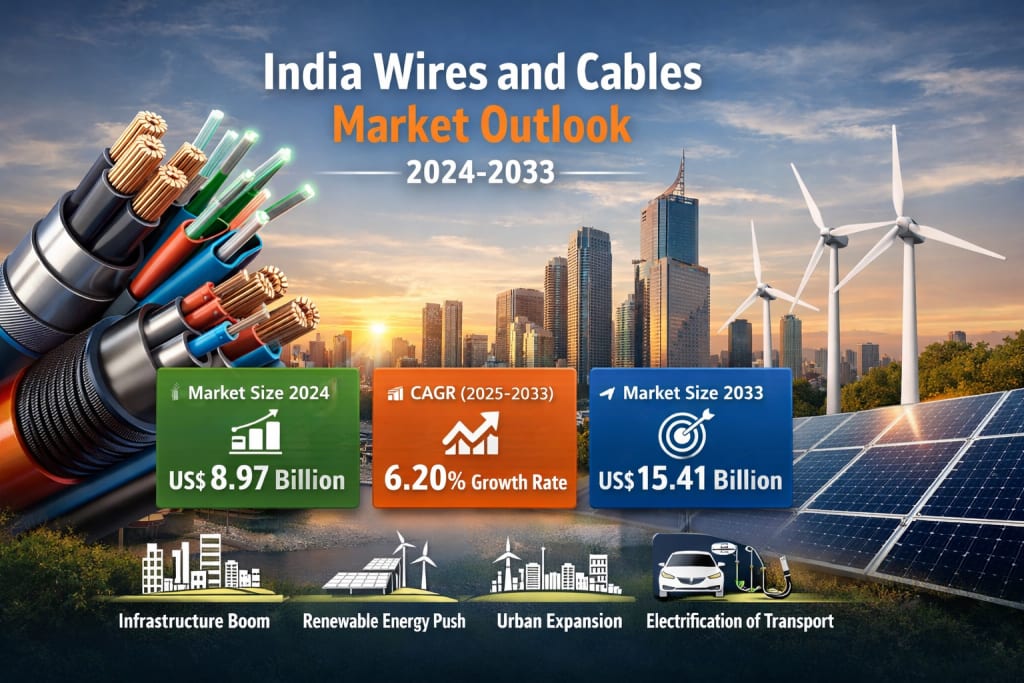
India’s wires and cables market is entering a transformative phase, driven by rapid infrastructure expansion, electrification, and a strong push toward renewable energy integration. As one of the most critical components of the country’s electrical ecosystem, wires and cables form the backbone of power distribution, telecommunications, and industrial connectivity.
According to recent insights, the India wires and cables market is projected to grow from US$ 8.97 billion in 2024 to US$ 15.41 billion by 2033, registering a compound annual growth rate (CAGR) of 6.20% between 2025 and 2033.
This growth reflects not just rising demand, but also a structural shift in how India is building its infrastructure—smarter, more energy-efficient, and increasingly digital.
A Market at the Core of India’s Growth Story
The wires and cables industry plays a foundational role in India’s economic development. Whether it is powering residential buildings, enabling high-speed internet connectivity, or supporting large-scale industrial operations, the sector is indispensable.
The industry spans multiple applications:
Electrical power transmission and distribution
Telecommunications and data connectivity
Industrial automation systems
Transportation and EV infrastructure
As India continues to urbanize and digitize, demand for high-quality, durable, and safe wiring solutions is accelerating across sectors.
Key Growth Drivers Shaping the Market
1. Infrastructure Development at Scale
India’s ambitious infrastructure agenda is one of the strongest growth drivers for the wires and cables market. Large-scale projects such as highways, metro systems, airports, and smart cities are increasing the need for reliable electrical networks.
Government initiatives like:
Smart Cities Mission
Bharatmala Project
Housing for All
are fueling massive investments in urban and semi-urban infrastructure. These projects require extensive cabling for:
Power distribution
Lighting systems
Communication networks
Automation technologies
Additionally, the government’s increased allocation toward affordable housing—reportedly around USD 12 billion for 2024–2025—has further amplified demand for building wires and low-voltage cables.
2. Renewable Energy Expansion
India’s transition toward renewable energy is reshaping the wires and cables landscape. Solar and wind energy projects require advanced cable systems capable of handling variable loads and ensuring efficient transmission.
Government-backed initiatives such as:
Production Linked Incentive (PLI) scheme for solar PV modules
Expansion of solar manufacturing capacity
are expected to significantly increase demand for specialized cables.
For instance, solar PV capacity is projected to expand rapidly, necessitating robust wiring solutions to integrate renewable power into the national grid.
This shift is not just about capacity—it’s about quality. Renewable energy systems demand cables that are:
Heat-resistant
Weatherproof
High-performance under fluctuating loads
3. Real Estate and Urban Housing Boom
India’s real estate sector is witnessing steady growth across metro cities as well as Tier 2 and Tier 3 cities. Rising incomes, urban migration, and government housing schemes are driving construction activity.
Modern buildings require sophisticated wiring systems for:
Power distribution
Smart home automation
Fire safety systems
High-speed internet connectivity
The increasing focus on energy efficiency and safety has also led to greater adoption of flame-retardant and eco-friendly cables.
4. Electrification of Transportation
India’s push toward electric mobility is another major catalyst for the wires and cables market.
Key developments include:
Expansion of metro rail networks
Growth of EV charging infrastructure
Government initiatives like FAME (Faster Adoption and Manufacturing of Electric Vehicles)
These trends are driving demand for:
High-voltage cables
EV charging cables
Signaling and control cables
As transportation systems become more electrified, the need for durable, heat-resistant, and high-capacity cables will continue to grow.
Market Challenges: The Roadblocks Ahead
Despite strong growth prospects, the industry faces several challenges that could impact its trajectory.
Counterfeit Products
One of the most pressing issues is the widespread availability of counterfeit and substandard cables. These products:
Compromise safety
Increase the risk of electrical failures and fires
Undermine trust in the market
They also create unfair competition for established manufacturers who invest in quality and compliance.
Compliance and Standardization Issues
While India has regulatory frameworks like BIS and ISI certifications, enforcement remains inconsistent. Many products still enter the market without proper compliance.
This results in:
Safety risks for consumers
Reduced confidence in certified products
Pressure on organized players
Strengthening regulatory oversight and increasing consumer awareness will be critical to addressing this issue.
Regional Insights: Growth Across Key States
Maharashtra: The Industrial Powerhouse
Maharashtra stands as a major hub in India’s wires and cables market. With strong industrial clusters in cities like Mumbai, Pune, and Nashik, the state generates significant demand across sectors.
Leading manufacturers such as Finolex and Polycab have a strong presence here, catering to residential, commercial, and industrial needs.
Kerala: Infrastructure Meets Digital Expansion
Kerala’s market is growing steadily due to:
Smart city initiatives
Renewable energy projects
Expansion of transmission infrastructure
Projects like the 400 kV HVDC station and the Kerala Fiber Optic Network (K-FON) are boosting demand for both power and communication cables.
Uttar Pradesh: Rapid Industrialization Driving Demand
Uttar Pradesh is emerging as a high-growth region, supported by:
Infrastructure projects like the Ganga Expressway
Defence Industrial Corridor
Rural electrification programs
Cities such as Kanpur, Lucknow, and Agra are becoming key demand centers for medium and high-voltage cables.
Market Segmentation Overview
The India wires and cables market is highly diversified, catering to multiple industries and applications.
By Cable Type:
Low Voltage Energy
Power Cable
Fiber Optic Cable
Signal and Control Cable
Others
By Voltage:
Low Voltage
Medium Voltage
High Voltage
Extra High Voltage
By Installation:
Overhead
Underground
By End Users:
Aerospace & Defense
Building & Construction
Oil & Gas
Energy & Power
IT & Telecommunication
Automotive
Others
This segmentation highlights the versatility of the industry and its deep integration into India’s economic fabric.
Competitive Landscape
The Indian wires and cables market is characterized by a mix of organized and unorganized players.
Key Companies Include:
Finolex Cables Limited
KEI Industries Limited
Polycab India Limited
Havells India Ltd
RR Kabel Ltd
V-Guard Industries Ltd
Syska LED Lights Pvt. Ltd
Panasonic
Plaza Wires & Cables
While large players dominate the organized sector with strong branding and quality assurance, smaller manufacturers cater to cost-sensitive segments.
Future Outlook: A Decade of Opportunity
Looking ahead, the India wires and cables market is poised for sustained growth. Several megatrends will shape its future:
Digital Transformation: Expansion of fiber optic networks for high-speed internet
Green Energy: Integration of renewable power sources
Urbanization: Growth of smart cities and modern housing
Industrial Expansion: Rise of manufacturing and automation
As India continues its journey toward becoming a $5 trillion economy, the demand for reliable electrical infrastructure will only intensify.
Final Thoughts
The India wires and cables market is more than just an industrial segment—it is a critical enabler of the country’s growth story. From powering homes and industries to supporting digital connectivity and renewable energy, its role is both fundamental and far-reaching.
With strong government support, rising private investment, and increasing technological advancements, the market is well-positioned to achieve its projected growth of US$ 15.41 billion by 2033.
However, addressing challenges such as counterfeit products and regulatory gaps will be essential to unlocking its full potential.
In the coming decade, the industry will not only expand in size but also evolve in sophistication—delivering safer, smarter, and more efficient solutions that power India’s future.
About the Creator
Keep reading
More stories from shibansh kumar and writers in Trader and other communities.
GCC Wires and Cables Market Set for Robust Expansion Amid Infrastructure Boom and Energy Transition
The Gulf Cooperation Council (GCC) region is undergoing a transformative phase marked by rapid urbanization, ambitious infrastructure projects, and a decisive shift toward renewable energy. At the heart of this transformation lies a critical yet often overlooked industry—the wires and cables market. These essential components form the backbone of modern infrastructure, enabling electricity distribution, telecommunications, and data transmission across residential, commercial, and industrial sectors.
By shibansh kumar9 days ago in Trader
KNR Constructions Share: Detailed Analysis, Price Trends, and Future Outlook
Introduction to KNR Constructions Share The KNR Constructions share reflects the market performance of KNR Constructions Limited, a prominent infrastructure development company in India. Known for its expertise in highways, irrigation, and urban infrastructure projects, the company has built a solid reputation in the construction sector.
By Hammad Nawazabout 13 hours ago in Trader
North America Paper Cups Market Size Trends & Growth Report 2034
North America Paper Cups Market Growth and Forecast (2026–2034) Paper cups are something most people use without giving them much thought. Whether it’s a morning coffee on the way to work or a quick drink at a food outlet, they’ve become part of everyday routines. In North America, this simple product has built a steady and reliable market over time.
By Kim Soo hyun5 days ago in Trader



Comments
There are no comments for this story
Be the first to respond and start the conversation.