
Lithium in IIOJK – Between Promise and Anxiety
New mineral findings raise hopes for economic growth while also bringing questions about environment, governance, and local rights.

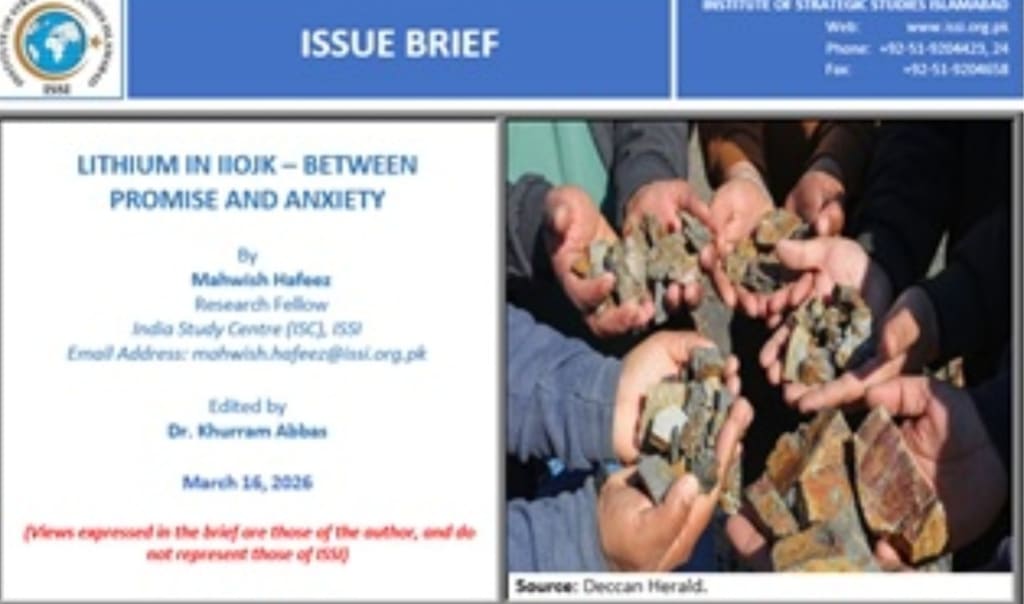
Introduction
Recent reports about lithium deposits in Indian Illegally Occupied Jammu and Kashmir (IIOJK) have drawn attention from policymakers, analysts, and local communities. Lithium is a key mineral used in rechargeable batteries, especially those powering electric vehicles and renewable energy storage systems. As the world moves toward cleaner energy sources, the demand for lithium continues to grow.
The discovery of lithium deposits in the region has created both optimism and concern. On one hand, it presents an opportunity for economic development and participation in the global clean energy market. On the other hand, it raises questions about environmental protection, governance, and the rights of people living in the area.
This issue brief examines the potential impact of lithium exploration in IIOJK. It looks at economic opportunities, environmental challenges, and the broader political context surrounding the development of natural resources in the region.
Understanding Lithium and Its Global Importance
Lithium has become one of the most important minerals in the modern energy economy. It plays a major role in the production of batteries used in electric vehicles, mobile devices, and renewable energy systems.
Countries around the world are searching for new lithium supplies to support their energy transition plans. Governments want to reduce dependence on fossil fuels while ensuring access to critical minerals needed for new technologies.
Global demand for lithium has increased rapidly in recent years. As electric vehicles become more common and energy storage systems expand, this demand is expected to grow further.
Because of this trend, the discovery of lithium reserves in new locations attracts strong interest from governments and industry.
Discovery of Lithium in Jammu and Kashmir
The Geological Survey of India reported lithium resources in the region of Jammu and Kashmir. Early estimates suggested that the deposit could be significant in size compared with other known reserves in the country.
For India, which currently imports most of its lithium, the discovery represents a possible step toward resource security. Domestic production could reduce reliance on global supply chains that are often concentrated in a small number of countries.
The deposit is believed to be located in the Reasi district. Further exploration and feasibility studies are required before large-scale mining could begin.
Although the discovery has generated interest, experts note that developing a mining project takes years of technical studies, environmental assessments, and investment planning.
Economic Opportunities
If developed responsibly, lithium mining could create economic opportunities in the region. These opportunities could include employment, infrastructure development, and investment in local industries.
Mining projects often require roads, transport systems, and energy supply networks. Such infrastructure may also benefit nearby communities if managed properly.
For the national economy, lithium extraction could support the development of battery manufacturing and electric vehicle production. This aligns with global efforts to expand clean energy technologies.
However, the scale of these benefits depends on policy choices. Transparent governance and fair distribution of revenue will be important factors in determining how local populations experience the outcomes of resource development.
Environmental Concerns
Mining activities can have environmental consequences, especially in ecologically sensitive areas. The Himalayan region, including parts of Jammu and Kashmir, contains fragile ecosystems that require careful protection.
Lithium extraction can involve land disturbance, water use, and waste management challenges. Without proper regulation, these activities could affect soil quality, water sources, and wildlife habitats.
Environmental experts stress the importance of conducting detailed impact assessments before any major project begins. These assessments help identify risks and propose strategies to reduce harm.
Responsible mining practices, including monitoring and restoration plans, are necessary to ensure that economic development does not come at the cost of environmental damage.
Community Perspectives
Local communities are an important part of the discussion about natural resource development. People living in the region may experience both the benefits and challenges associated with mining projects.
Some residents may welcome opportunities for employment and improved infrastructure. Others may worry about displacement, environmental impacts, or changes to traditional livelihoods.
Public consultation processes can help address these concerns. When communities have access to information and a role in decision-making, it becomes easier to balance development with local needs.
Experts in development policy often emphasize that resource projects should include mechanisms for community participation and benefit sharing.
Governance and Political Context
The development of natural resources in IIOJK takes place within a complex political environment. The region has long been the subject of dispute between India and Pakistan.
Changes in governance structures over recent years have also influenced policy discussions about land use and economic planning in the region.
Because of this context, decisions about large resource projects may attract attention not only for economic reasons but also for political and diplomatic considerations.
Transparent governance frameworks can help reduce uncertainty and build trust among stakeholders.
Strategic Importance of Lithium
Lithium is increasingly viewed as a strategic mineral. Countries want reliable access to the materials needed for electric vehicles, renewable energy systems, and advanced technologies.
Several nations have introduced policies to secure lithium supplies and support domestic battery industries. These strategies often include investment in exploration, partnerships with foreign suppliers, and recycling programs.
If the lithium deposit in Jammu and Kashmir proves viable for extraction, it could play a role in India’s long-term energy and technology plans.
At the same time, the global market for lithium is competitive. Production costs, environmental standards, and technological capacity all influence whether a deposit becomes commercially successful.
Balancing Development and Responsibility
The case of lithium in IIOJK illustrates a broader challenge faced by many regions rich in natural resources. Governments must balance economic development with environmental protection and social responsibility.
Responsible mining policies typically include clear regulations, independent oversight, and transparent reporting. These measures help ensure that projects operate safely and that revenues are used effectively.
International experience shows that resource development can produce positive outcomes when governance systems are strong and inclusive.
For regions with sensitive political or environmental conditions, careful planning becomes even more important.
The Role of Technology and Sustainability
Advances in mining technology may help reduce the environmental impact of lithium extraction. New processing techniques can improve efficiency and lower waste production.
In addition, recycling of lithium batteries is becoming an important part of the global supply chain. By recovering lithium from used batteries, countries can reduce pressure on natural resources while supporting a circular economy.
Research institutions and industry partners are exploring ways to integrate sustainable practices into mining operations. These innovations may shape how future lithium projects are designed and managed.
If such approaches are adopted in Jammu and Kashmir, they could help address some of the concerns raised by environmental groups and local communities.
Regional and Global Implications
The discovery of lithium in IIOJK has implications beyond the local level. It highlights how critical minerals are becoming central to international economic and political discussions.
Countries are increasingly aware that access to minerals such as lithium, cobalt, and nickel will influence the pace of the global energy transition.
As a result, new resource discoveries often attract attention from investors, policymakers, and researchers interested in supply chain security.
For South Asia, the development of lithium resources could also shape regional economic cooperation and trade patterns in the future.
Conclusion
The discovery of lithium deposits in Indian Illegally Occupied Jammu and Kashmir presents both promise and uncertainty. The mineral has the potential to support economic development and contribute to the global shift toward cleaner energy technologies.
At the same time, mining projects in sensitive regions require careful planning and strong governance. Environmental protection, community engagement, and transparent policy frameworks will be essential in shaping the future of lithium development in the area.
For policymakers, the key challenge is finding a balance between economic opportunity and responsible management of natural resources. Decisions made in the coming years will determine whether lithium becomes a source of sustainable development or a point of continued concern.
As global demand for critical minerals continues to grow, the story of lithium in Jammu and Kashmir will remain part of a larger conversation about energy, resources, and the future of regional stability.
About the Creator
Saad
I’m Saad. I’m a passionate writer who loves exploring trending news topics, sharing insights, and keeping readers updated on what’s happening around the world.
The Forsyth House Fire
Since 1851, Forsyth House has stood on the corner of Union Street and Gordon Street in the heart of Glasgow. Its iconic, or was... because on Sunday 8th of March, 2026, a fire broke out in a small, seemingly un-named shop in the building and tore all that history down. As I write, the rubble is still unsettled and the street is still blocked off. Central Station is quiet on the upper level, and around 30 small businesses have quite literally gone up in smoke.
By S. A. Crawford4 days ago in The Swamp
US and Allies Clash with Russia and China Over Iran’s Nuclear Program
A Deepening Global Divide Over Nuclear Security A dramatic diplomatic confrontation has emerged on the global stage as the United States and its Western allies clash with Russia and China over Iran’s nuclear program. The dispute has unfolded at the United Nations and in international diplomacy, highlighting growing divisions among the world’s most powerful nations over how to address Iran’s expanding nuclear activities.
By Jameel Jamali4 days ago in The Swamp


Comments
There are no comments for this story
Be the first to respond and start the conversation.