
IS Russia Winning Ukraine War?
Europe’s Strategic Test: The “Trump Conundrum” and the Ukraine War

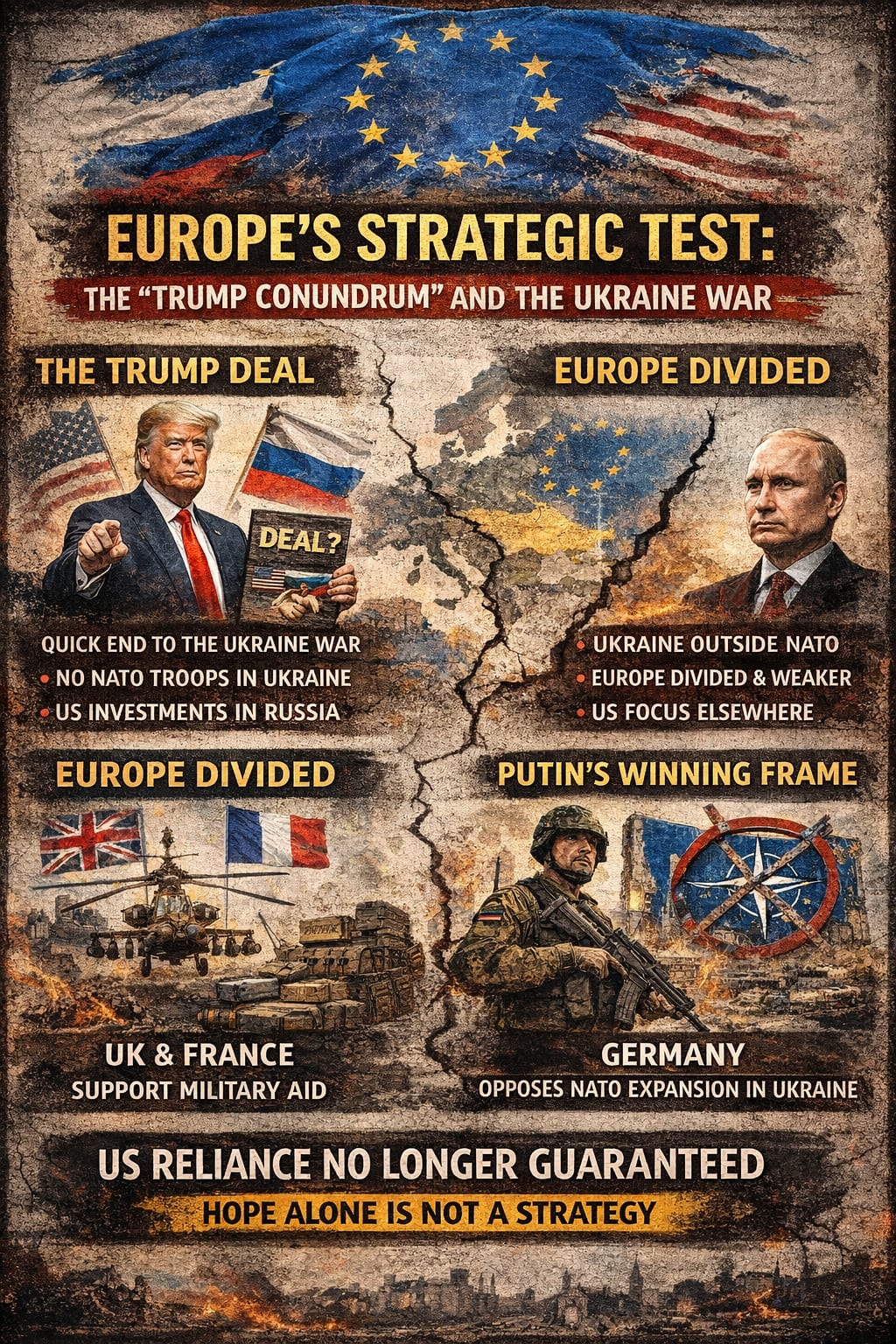
For much of the conflict, Europe framed Ukraine’s struggle as a clear case of resistance against Russian aggression. The narrative was straightforward: Ukraine was defending sovereignty, and Europe stood firmly behind it. However, by 2026, the situation has evolved into something far more complex. The war is no longer just about Ukraine—it has become a broader strategic test for Europe itself. At the center of this test lies what analysts are calling the “Trump Conundrum.”
The return of Donald Trump to the White House has reshaped the geopolitical landscape. Unlike previous U.S. administrations that emphasized long-term strategic containment of Russia, Trump appears focused on securing a rapid deal to end the conflict. His priority is not necessarily a decisive Ukrainian victory, but rather a negotiated settlement that halts the war quickly. This approach reflects a transactional worldview—ending the war, reopening economic channels, and potentially enabling American investment in Russia, particularly by private U.S. companies.
However, such a deal carries significant implications. From a European perspective, it appears to align more closely with the objectives of Vladimir Putin than with those of Ukraine or the European Union. Key elements reportedly under discussion include no NATO troop presence in Ukraine, no long-term security guarantees for Kyiv, and no binding legal framework that ensures continued U.S. commitment to European defense. If realized, these terms would fundamentally reshape the security architecture of Europe.
This is where the internal divisions within Europe become visible. Countries like France and the United Kingdom have taken a more assertive stance, signaling willingness to provide military support, equipment, and logistical hubs to sustain Ukraine’s resistance. In contrast, Germany has shown greater caution, reflecting both domestic constraints and strategic hesitation. This divergence highlights a broader issue: Europe lacks a unified strategic direction when faced with shifting U.S. priorities.
NATO, long seen as the cornerstone of European security, is also under strain. If the United States reduces its commitments or refuses to expand NATO’s role in Ukraine, the alliance’s credibility may be called into question. For decades, Europe has relied heavily on American military backing. A shift in U.S. policy forces European nations to confront an uncomfortable reality—their security dependence on Washington may no longer be guaranteed.
Another layer of complexity lies in Europe’s own contradictions. European leaders frequently emphasize the importance of a rules-based international order—one grounded in legality, multilateralism, and consistent principles. Yet, when crises emerge elsewhere, such as in Venezuela, Europe’s response has often been muted or inconsistent. This selective application of principles weakens Europe’s moral authority and exposes internal inconsistencies in its foreign policy.
From Moscow’s perspective, time is a critical advantage. Putin does not necessarily need a decisive military victory to achieve his objectives. Prolonging the conflict can gradually erode Western unity, exhaust political will, and create fractures within alliances. If the United States pushes for a deal that limits NATO expansion and reduces its own military commitments, Russia effectively secures many of its strategic goals without winning on the battlefield.
In such a scenario, Ukraine risks being left in a precarious position—outside NATO, without robust security guarantees, and facing a powerful neighbor with renewed leverage. At the same time, Europe emerges divided, and U.S. attention shifts to other global priorities. The result is not a clear resolution, but a rebalancing of power that favors Russia’s long-term strategy.
The Ukraine conflict, therefore, is more than a regional war; it is a stress test for Europe’s strategic autonomy. Can Europe defend its interests independently, or will it continue to rely on U.S. leadership? The answer remains uncertain. What is clear, however, is that hope alone is not a strategy.
As new challenges loom—such as geopolitical tensions surrounding Greenland and other strategic regions—Europe faces a critical juncture. The decisions made now will shape not only the outcome of the Ukraine war but the future of European security as a whole.
In the end, the “Trump Conundrum” underscores a fundamental shift: the assumptions that once underpinned transatlantic relations are no longer guaranteed. For Europe, adapting to this new reality is not optional—it is essential.
About the Creator
Ibrahim Shah
I am an Assistant Professor with a strong commitment to teaching,and academic service. My work focuses on fostering critical thinking, encouraging interdisciplinary learning, and supporting student development.
Keep reading
More stories from Ibrahim Shah and writers in The Swamp and other communities.
Results Of US Regime Changes
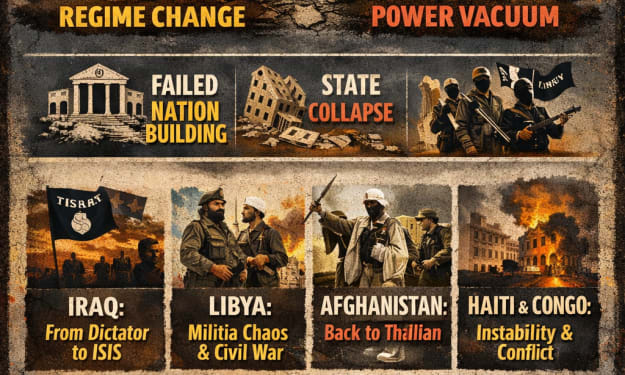
For decades, the United States has justified its foreign interventions under the banner of promoting democracy and stability. The underlying assumption behind many of these actions is simple: remove an authoritarian leader, and a more stable, democratic, and cooperative system will naturally emerge. However, history tells a far more complicated—and often troubling—story.
By Ibrahim Shah about 14 hours ago in The Swamp
The Forsyth House Fire
Since 1851, Forsyth House has stood on the corner of Union Street and Gordon Street in the heart of Glasgow. Its iconic, or was... because on Sunday 8th of March, 2026, a fire broke out in a small, seemingly un-named shop in the building and tore all that history down. As I write, the rubble is still unsettled and the street is still blocked off. Central Station is quiet on the upper level, and around 30 small businesses have quite literally gone up in smoke.
By S. A. Crawford4 days ago in The Swamp
My First Time Skiing and I Got Lost, Alone, in the French Alps
Looking back, I can trace some of my life’s biggest adventures to a simple action from my sister. She’d introduced me to Tommy (a very long time ago), a colleague of hers, who had overshared his penchant for Italian-looking women, and I ticked that box.
By Chantal Christie Weiss4 days ago in Humans


Comments
There are no comments for this story
Be the first to respond and start the conversation.