
We Have Fooled Ourselves
A continuation of reflections on war, children, and the failure of the world to hear

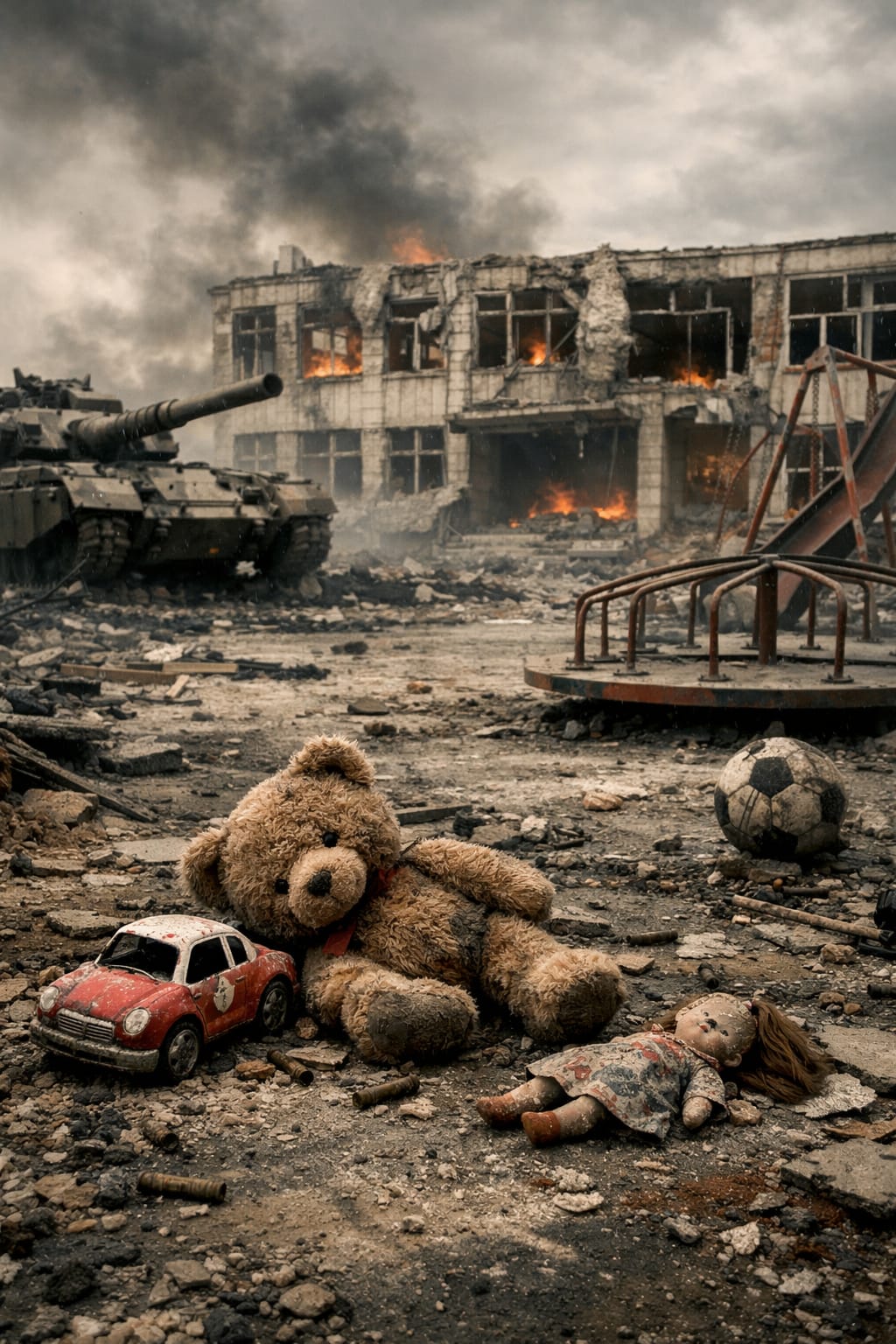
I have been writing, in recent months, about human suffering. Not because I enjoy thinking about it, but because I believe that to look away from it, to convert it into abstraction, is itself a kind of complicity. I wrote about a feeling I was not supposed to have. I wrote about the price paid by those who never chose the conflict that consumes them. And now I find myself returning again, pulled back by images I cannot stop seeing.
One of them is not a photograph from a battlefield. It is from a primary school yard, the same one I used to look out onto from the second floor of the apartment where my wife and I once lived in Shahin Shahr, a small and lovely town north of Isfahan. We could see the girls playing below. My father-in-law would complain about the noise. My mother-in-law would defend it: what better music could you wish for? Those words have stayed with me. I did not know then that I would one day see that same schoolyard filled with tanks and artillery. I did not know that the music would eventually go quiet in precisely that way.
The other image I cannot set aside is from Minab, where a school was struck by a missile and children were killed. The condemnations came swiftly, as they always do. They were sincere, as they sometimes are. And then, as always, they were not enough, not an inquiry into roots, not a serious attempt at prevention. No condemnation has ever returned a child to their family. No resolution passed in any chamber has prevented the next strike on the next school. We have constructed elaborate frameworks to convince ourselves otherwise, war conventions, declarations of children's rights, international courts, and they are not nothing. But they are not what we have told ourselves they are, either.
I want to say something honest about this, because I have been watching it for nearly fifty years now, and I think we owe each other the truth.
I was six years old when the revolution came. I was eight when the war with Iraq began. I grew up in a village south of Shiraz where we had no electricity and no school for girls, but what we did have was a mosque with a generator, and every Thursday and Friday evening, without exception, members of the Revolutionary Guard would arrive, gather the community, with particular attention to the children, and begin. They taught ideology. They taught us how to hold a gun. They led the chants: death to Israel, we will free Jerusalem. To make it systematic, they formed local Basij units from children as young as seven or eight. We were trained on machine guns and explosives. But more than any weapon, we were given a culture , a new identity, new goals, new definitions of what a life was for.
We were told the story of Ali Akbar, eighteen years old, who gave his life in the Battle of Karbala in 680 CE to defend his Imam Hossain. We were told of Ali Asghar, six months old, the youngest martyr of the same battle. We were given headbands bearing messages like my soul is dedicated to my leader. The walls of the mosque were covered with the image of Mohammad Hossein Fahmideh, twelve years old, a Basij member who had strapped explosives to himself and thrown himself beneath an Iraqi tank to halt its advance. Every week he was celebrated as a war hero. Every week we were told: each of you can be Mohammad Hossein one day. And we wished for it.
By the age of fifteen, I had concluded that I was old enough, and that it was my duty to go to war. I left home without telling anyone, made my way to an army base, and registered to be sent to the front. They did not have enough buses that night, and I had to wait until the next morning. I was devastated by the delay. I now understand it as the most important piece of luck in my life.
My older brother, completing his military service as driver for the city's imam, which gave him rare access to army facilities, had heard I was missing. He traced me, found me at that base, and brought me home. He punished me. War is not for us, he said. One night, one brother, one missed bus. That is the margin between the person writing these words and someone who never came back from a trench at the age of twelve.
I am not recounting this to centre myself. I am recounting it because I was not exceptional. Hundreds of thousands of children were moving through that same environment, shaped by that same machinery, saturated in that same ideology from the earliest age. And the ideology was not incidental. It was systematic. It was the point. The regime understood, with terrible clarity, that a generation captured in childhood is a generation captured forever.
What is dark, and what I think we have not fully confronted, is that this project never stopped. It evolved.
When the Woman Life Freedom movement revealed that the regime's deepest threat came not from political opposition, not from the UN, not from international human rights organisations, but from its own youth, from Generation Z, and especially from girls, who had grown up with the internet and emerged from it with values the clerics could not control, the response was not to soften. It was to escalate. Children began to be killed not as collateral damage but as deliberate policy. Kian Pirfalak was nine years old. Hundreds more followed. Girls' schools were attacked with poison gas, a slow, deniable, psychologically devastating form of terror directed at the very demographic the regime most feared. None of it crossed the precise threshold that war conventions are written to address, and so, for much of the world, it did not quite count.
In late 2025, during an internet blackout, tens of thousands were killed in a matter of days. Among them: children.
And the response of the world? A few soft condemnations. Some expressions of concern. The Secretary-General of the United Nations offered his congratulations to the Iranian regime on the anniversary of the revolution.
I have tried to find the precise word for what I feel when I contemplate that fact, and I keep arriving at the same one: failure.
War is dark. It is destructive and inhumane. It is started by a few and paid for by millions, most of them people who never chose it, never understood it, and will spend the rest of their lives carrying its weight. I know this not from reading about it but from having lived inside it, screaming it, nightmaring it, from having watched what it does to families, to cities, to the silences that settle over places where there used to be noise.
What I did not fully understand as a child, and what I think the world continues to resist understanding, is that the failure does not begin when the missile is launched. It begins much earlier, in the slow accumulation of choices to look away, to manage rather than confront, to be polite in the face of something that does not deserve politeness.
The Iraqi militias who entered Iran in recent days did so because the regime invited them, not to protect the country, but to protect itself from its own people. The same neighbour that Iran fought for a decade as its great enemy, the war that shaped my entire childhood, has now been welcomed in to help suppress the population that survived it. These soldiers have shown, in smaller theatres before this one, how little mercy they extend to those who dissent. I do not know how to describe the particular darkness of that inversion other than to say it is the logical conclusion of a system that was never really about the nation it claimed to defend. It was always about its own perpetuation.
After the Second World War, we built institutions. We wrote conventions. We created a body of international law meant to draw a line that could not be crossed, or if crossed, would at least be named and condemned. Those institutions have done some work. I do not dismiss them.
But I think we have also used them to reassure ourselves that we had solved something we had not solved. We told ourselves that having rules about war meant we had made war more civilised. We told ourselves that condemnations had weight. We told ourselves that naming atrocities was the same as preventing them.
The schoolyard full of tanks. The girls queuing outside the classroom. Minab. Kian Pirfalak. The internet blackout. Two hundred and fifty children in two months.
None of it was prevented. Some of it was barely named.
We have failed. Not only this generation, not only this regime, not only in this country. We have failed across decades, across institutions, across the very structures we created to prevent exactly this. This conflict, its images, its dead children, its burning schoolyards, is not a tragedy that arrived from nowhere. It is the price of that failure, rendered in the lives of people who deserved better from a world that told them, again and again, that it was paying attention.
Perhaps the most honest thing I can offer is this: I do not know what comes next. But I know that the first step toward something different is to stop reassuring ourselves with the language of condemnation while the silence underneath it continues undisturbed.
The noise of children in a schoolyard is the best music there is. We should be willing to do more than mourn when it stops.
The author is an Iranian-born scientist living in the United Kingdom. This piece follows his earlier essays "When Civilians Pay the Price" and "The Weight of a Feeling I Was Not Supposed to Have."
About the Creator
Hashem Koohy
I write about life with animals, family, and the quieter emotional moments that shape us. I’m interested in observation over explanation, and in telling true stories without embellishment.
Keep reading
More stories from Hashem Koohy and writers in Psyche and other communities.
The Weight of a Feeling I Was Not Supposed to Have
I was walking my dog on a Saturday morning when the news arrived. A coalition of the United States and Israel had struck targets in Tehran. Among them: the office of Ali Khamenei, Supreme Leader of the Islamic Republic of Iran. Shortly after, his death was confirmed.
By Hashem Koohyabout a month ago in Psyche
Thirty (one) and Neither Flirty nor Thriving.
I'm thirty-one and orbiting the same few mistakes like they're landmarks. London is already awake before I am (or before I've slept) - sirens somewhere far enough to ignore, buses sighing at stops, people moving with purpose I can't quite borrow. I lie there for a bit, tasting last night at the back of my throat, trying to remember if I meant to drink that much or if it just...happened again.
By Stacey Vella8 days ago in Psyche


Comments
There are no comments for this story
Be the first to respond and start the conversation.