
The Friendship Audit
Why I Cut Off My Best Friend and Never Looked Back


THE RELATIONSHIPS THAT DRAIN YOU
At thirty-one years old I had approximately fifteen people I called friends including four I considered close friends, and I was exhausted, anxious, frequently frustrated, and constantly feeling like I was not measuring up to some standard that seemed effortlessly achieved by everyone around me, and I attributed this persistent malaise to work stress, aging, or some personal deficiency that I could not quite identify, never considering that the source of my deteriorating mental health might not be internal at all but might instead be the very relationships I was investing my limited emotional resources in, relationships that I maintained out of history and obligation rather than because they actually nourished me. The friendship audit began when my therapist asked me a question that I initially found offensive but that ultimately changed my life: "How do you feel after spending time with each of your friends?" and she asked me to rate each friendship on a simple scale of whether I generally felt energized or drained after interactions, and my honest answers revealed a pattern I had been avoiding: of my fifteen friends, only four consistently left me feeling better than before we interacted, while the remaining eleven either had no effect or actively depleted my energy, mood, and self-esteem through criticism, competition, negativity, or the emotional labor of managing their constant crises.
The most difficult revelation was about my best friend of twelve years, someone I had known since college and who I considered my closest confidant, because honest assessment revealed that our friendship had become a one-directional support system where I provided constant emotional labor, listened to hours of complaints about her life without reciprocal interest in mine, absorbed regular criticism disguised as concern about my choices and appearance, and felt progressively smaller and more inadequate after every interaction despite outwardly appearing to be her closest ally. The friendship had evolved so gradually from mutual support into parasitic dependency that I had not noticed the shift, partly because the history we shared created an obligation narrative where leaving felt like betrayal rather than self-preservation, and partly because she was skilled at intermittently providing just enough warmth and connection to prevent me from recognizing the overall pattern as harmful.
THE AUDIT PROCESS
The friendship audit involved systematically evaluating each relationship using five criteria that together provide a comprehensive assessment of whether a relationship is nourishing or depleting: reciprocity meaning whether both parties invest roughly equally in the relationship through time, emotional support, and practical help rather than one person consistently giving more than they receive, growth meaning whether the relationship encourages you to develop and pursue your potential or whether it subtly discourages growth because your improvement threatens the other person's self-concept or the established dynamic, authenticity meaning whether you can be genuinely yourself in the relationship or whether you perform a version of yourself designed to maintain the other person's approval, respect meaning whether the other person treats your time, feelings, opinions, and boundaries with the same consideration they expect for their own, and joy meaning whether the relationship produces genuine pleasure and laughter and warmth or whether interactions are dominated by obligation, criticism, and emotional heaviness.
Scoring each friendship honestly on these five criteria produced results that were uncomfortable but clarifying, revealing that the relationships I maintained most actively were often the least nourishing while the relationships I had been neglecting were often the most valuable, and this pattern reflected the common dynamic where demanding depleting relationships consume disproportionate time and energy precisely because they are demanding, leaving insufficient resources for the low-maintenance mutually nourishing friendships that could be sustained with much less effort but that get pushed to the margins by the squeakier wheels.
THE DIFFICULT CONVERSATIONS
The friendship audit required not just assessment but action, and the most difficult action was having an honest conversation with my best friend about the patterns I had identified, a conversation I dreaded because I knew she would react with hurt and anger and because I was not certain I could maintain my position under the emotional pressure she would inevitably apply. The conversation was as difficult as I anticipated, with her cycling through denial, anger, guilt-tripping, and eventually the accusation that I was being influenced by my therapist against her, but I had prepared for these responses and maintained my position, explaining specific patterns and their impact on me without attacking her character, and offering the possibility of continuing the friendship if the dynamic could shift rather than issuing an ultimatum, and when she was unable to acknowledge the patterns even partially, I recognized that the friendship could not be saved because repair requires both parties to participate and she was unwilling to examine her contribution to the dysfunction.
The grief of ending a twelve-year friendship was genuine and significant, comparable in intensity to romantic breakup grief because close friendships involve attachment bonds that when severed produce the same neurological withdrawal responses as any lost attachment, and I spent several months mourning not just the loss of the specific relationship but the loss of my investment, the years of emotional labor that felt wasted, and the history we shared that I could no longer reference without pain. The relief that eventually emerged from beneath the grief was equally significant, a gradual lightening of psychological weight that I had been carrying so long I had forgotten what its absence felt like, and the energy that had been consumed by managing this depleting relationship became available for deepening the nourishing friendships I had been neglecting.
THE AFTERMATH AND THE LESSON
Two years after the friendship audit my social circle is smaller but immeasurably healthier, consisting of eight friends rather than fifteen but with every one of those eight relationships meeting the five criteria of reciprocity, growth, authenticity, respect, and joy, and the reduction in social anxiety, emotional depletion, and self-doubt that accompanied the elimination of depleting relationships has been more significant than any other intervention I have tried including therapy, meditation, exercise, and medication, not because those interventions are ineffective but because no intervention can overcome the damage of spending significant time with people who consistently diminish your wellbeing. The lesson I would share with anyone reading this is that friendship should not feel like work most of the time, that the people closest to you should make you feel more like yourself rather than less, that history is not a sufficient reason to maintain a relationship that is actively harming you, and that the guilt you feel about auditing and potentially ending friendships reflects social conditioning rather than moral truth, because you have no obligation to sacrifice your mental health to maintain relationships that do not serve both parties, and the courage to let go of depleting friendships is not selfishness but self-respect.
About the Creator
The Curious Writer
I’m a storyteller at heart, exploring the world one story at a time. From personal finance tips and side hustle ideas to chilling real-life horror and heartwarming romance, I write about the moments that make life unforgettable.
Keep reading
More stories from The Curious Writer and writers in Longevity and other communities.
The Stranger Who Saved My Life in a Coffee Shop
Why One Conversation With Someone You'll Never See Again Can Change Everything THE WORST TUESDAY OF MY LIFE I was sitting in a Starbucks on a Tuesday afternoon in March with a plan to kill myself, not a vague thought or a passing ideation but a specific plan that I had spent weeks developing with the methodical attention to detail that had made me successful in my career as a project manager and that I was now applying to the project of ending my own life, and I had stopped at this coffee shop not because I wanted coffee but because I wanted one last normal experience before going home to execute the plan that I had finalized the night before. The coffee shop was my attempt to feel something, anything, that might disrupt the flat gray emptiness that had consumed me for months, the numbness that made food tasteless and music meaningless and human connection feel like watching life through a thick pane of glass where you can see others living but cannot feel anything they feel or reach anything they reach, and I ordered a latte and sat in a corner booth and waited to feel something and felt nothing and decided that this confirmed what I already knew, that nothing would make this better and that continuing to exist in this void was pointless.
By The Curious Writerabout 10 hours ago in Longevity
Microsoft's Purposeful Marketing Deception About AI's Ability To Beat Physicians In Diagnosis
When you look at the world of scientific research... If you are not careful... You will be fooled into believing things that are not actually supported by the data.
By Dr. Cody Dakota Wooten, DFM, DHM, DAS (hc)19 days ago in Longevity
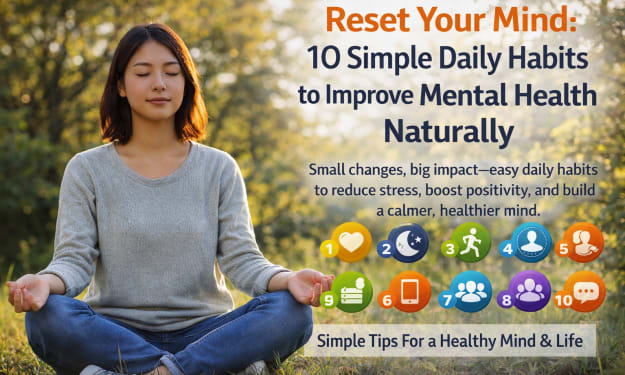
Reset Your Mind: 10 Simple Daily Habits to Improve Mental Health Naturally
In a world that never seems to slow down, taking care of your mental health has become more important than ever. Between work pressure, social media, and personal responsibilities, it’s easy to feel overwhelmed.
By Gaurav Guptaa day ago in Longevity



Comments
There are no comments for this story
Be the first to respond and start the conversation.