
Difference Between Plain Bearings and Rolling Bearings
Identify the difference between rolling bearings and plain bearings. Know the role of a plain ball bearing in providing smooth operation between machines.

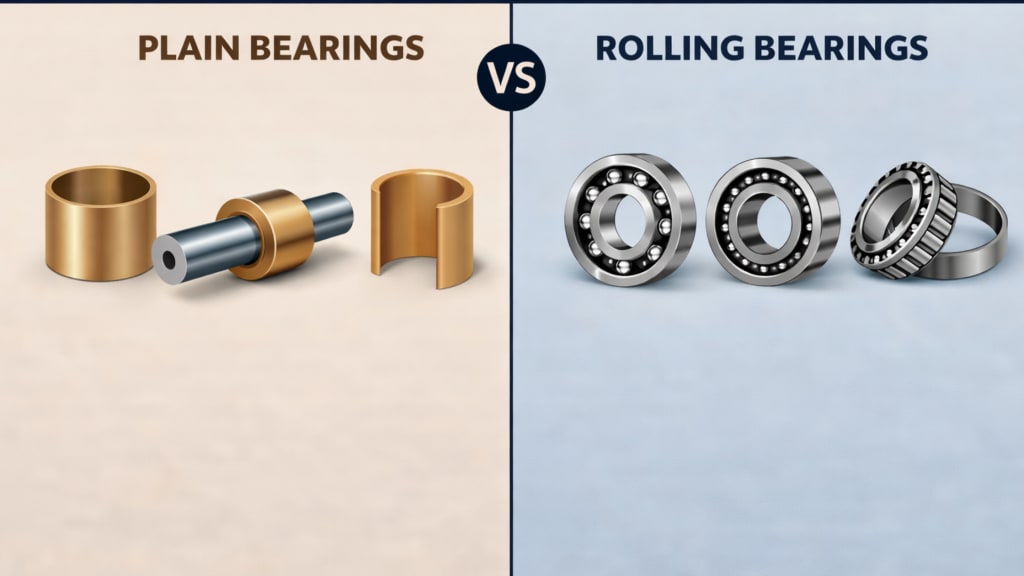
The innovation in mechanical engineering has transformed how machines operate smoothly. In this regard, even the smallest parts of industrial machinery can make a big difference. Bearings are a great example of this component. Whether you are working on machinery, automotive parts, or even simple mechanical devices, bearings play a crucial role.
Many engineers compare Plain ball bearing, plain bearings, and roller bearings when they need to know which option is best for their situation. While they may share a common purpose, plain bearings and roller bearings differ significantly in their design, functionality, and usage.
In this blog, we will compare plain and roller bearings in a simple, easy-to-understand format to help you make the right choice.
What Are Plain Bearings?
Plain bearings are the simplest and easiest to use. Unlike roller bearings, plain bearings do not use rollers or balls. Instead, they make use of a sliding motion. Plain bearings involve a surface sliding over another surface, assisted by a lubricant to help prevent friction.
Plain bearings can be used for a wide range of applications, including situations where motion is slow or the load is consistent and heavy. Also, plain bearings are easy to maintain and cost-effective.
Primary Plain Bearing Uses
Plain bearings are widely used and can be found in many industries. You may find plain bearings used in:
- Industrial pumps and compressor parts
- Construction machinery
- Agricultural machinery parts.
- Automotive engine parts
They can also be used in situations where shock loads and heavy forces occur.
Plain Bearing Types
There are several plain bearing types, each used for a specific purpose. Some of the most common plain bearing types include:
- Journal bearings
- Sleeve bearings
- Thrust bearings
- Flanged bearings
Each of these has been specially designed for a particular direction of load and operating conditions.
What Are Rolling Bearings?
Rolling bearings, on the other hand, use rolling elements such as rollers and balls, which reduce friction between the bearing surfaces. This type of bearing comprises both ball and roller bearings and is commonly used for its ability to sustain high speeds and low friction. The rolling elements prevent roller bearing failures in extreme conditions.
Types Of Rolling Bearings
Rolling bearings are of two main types, which include:
- Roller bearings
- Ball bearings
As mentioned earlier, in rolling bearings, ball bearings use balls as the rotating element, whereas roller bearings use rollers, which are either tapered or cylindrical.
Knowing The Difference: Plain Ball Bearings vs Roller Bearings
It is essential to note that plain ball bearings and roller bearings have different applications and are therefore not comparable.
Plain ball bearings are best for applications that require high speeds and low friction, whereas roller bearings are best for practical applications that need high load capacity.
Plain bearings cannot be included in the rolling bearings category, as they have a different application. Therefore, they are used for the same applications as rolling bearings in machinery.
Primary Differences Between Plain Bearings and Rolling Bearings
Friction Levels
Plain bearings have higher friction compared to rolling bearings. However, proper lubrication can increase their performance.
Rolling bearings are designed to reduce friction, making them suitable for high-speed operations.
Working Principle
Plain bearings operate through sliding contact. The shaft moves directly against the bearing surface. Rolling bearings use rolling elements that move between two surfaces. It reduces direct contact and lowers friction.
Load Capacity
Plain bearings can handle heavy loads in industrial applications where movement is limited. Roller bearings are also an excellent choice for heavy loads, especially radial loads. Ball bearings are better for lighter loads and higher speeds.
Maintenance Requirements
Plain bearings need constant maintenance to prevent overheating. Rolling bearings require less maintenance but must be kept clean and installed correctly.
Speed Capability
Rolling bearings are ideal for applications that require higher speeds compared to plain bearings. For this reason, plain bearings are ideal for slow-moving parts where speed is of little concern.
Complexity And Cost
Plain bearings are cheap to manufacture and simple to design. Rolling bearings are complicated to design, which makes them expensive to manufacture.
Which Is Better, A Ball Bearing or A Roller Bearing?
Engineers often wonder which of the two, a ball bearing or a roller bearing, is better. The perfect answer to this question varies depending on the situation. A ball bearing is better than a roller bearing for smoothly moving parts with minimal friction, especially at higher speeds.
A roller bearing is better than a ball bearing if you are dealing with heavy loads. There is no specific answer to this; it depends on your requirements.
Advantages Of Plain Bearings
Plain bearings have several advantages, making them a reliable option. These advantages include:
- Plain bearings have a simple design and can be installed easily.
- These bearings are cost-effective, and maintenance costs are lower than those of rolling bearings.
- They have a high-load carrying capacity.
- These plain bearings perform well under vibration and shock.
Plain bearings are widely used, especially in applications where durability is more important than speed.
Benefits Of Rolling Bearings
Also, rolling bearings offer many advantages, making them a popular choice. These benefits include:
Rolling bearings have a smooth running and less friction. They are popularly used in applications where speed is more crucial than durability. These types of bearings have less energy loss. These rolling bearings have a long service life.
Limitations To Consider
Rolling bearings and plain bearings have many limitations, which should be considered when making a final decision.
For instance, plain bearings have several disadvantages, including increasing wear under improper lubrication conditions. Also, plain bearings cannot be used when speed is a primary factor.
Rolling bearings have several disadvantages, including the presence of impurities that can cause bearing failure.
Selecting The Right Bearing For Your Application
Choosing the right bearing between the two types depends on various factors, which include:
- Type and amount of load to be carried.
- Maintenance capabilities.
- Environmental conditions.
- Budget constraints.
Plain bearings have several advantages, especially in conditions where heavy loads and simple operation are primary factors. In dedicated applications where speed is a primary factor, rolling bearings offer several advantages. It is always a good idea to consider the environmental conditions in which the bearing is to be used.
Increase The Durability and Strength Of Operating Components By Perfect Bearing Selection
Bearings are a critical component of the smooth operation of machines. While rolling bearings and plain bearings perform the same function, they differ in various ways. Plain bearings are best used because of their strength, simplicity, and cost-effectiveness. On the other hand, rolling bearings are best suited for their accuracy, speed, and efficiency.
With this understanding, you will be able to make the best bearing choice for your needs. Working with a reliable bearing manufacturing company will help you get the best components for your needs. It is not the most advanced that makes the best choice, but the one that works best for your needs.
About the Creator
Author’s Advice
If you would’ve asked me 20 years ago did I know I’d become a writer and an author, I would’ve said “nope, ain’t happening”. As fate would have it I did become an author and I can honestly say I’m loving it so far. It really does feel good to be a writer. I’ve learned a lot on this journey and I feel like with even me being as new to this world as I am, there’s some wisdom I need to share with every other aspiring author.
By Joe Patterson17 days ago in Journal
5 Low-Cost Retail Store Design Upgrades That Drive Foot Traffic (2026)
Foot traffic is rising. As of January 2026, mall visits are up 1.8% year-over-year, and average visit time has grown by 3.3%. Yet many retailers still spend heavily on full renovations to stay competitive. You do not need that level of investment.
By Neon Designs3 days ago in Journal
We Will Bury You
How do you deal with the vast disappointment and anger and rage and grief and rage and RAGE and RAGE and RAGE when a community icon, who did so much to help your gente, is found to be the type of monster that still makes me believe in capital punishment?
By Ariana GonBon7 days ago in Humans




Comments
There are no comments for this story
Be the first to respond and start the conversation.