
Why 115 Years May Be Our Natural Ceiling
Exploring the science behind longevity, biological limits, and whether humans can truly live beyond 115 years

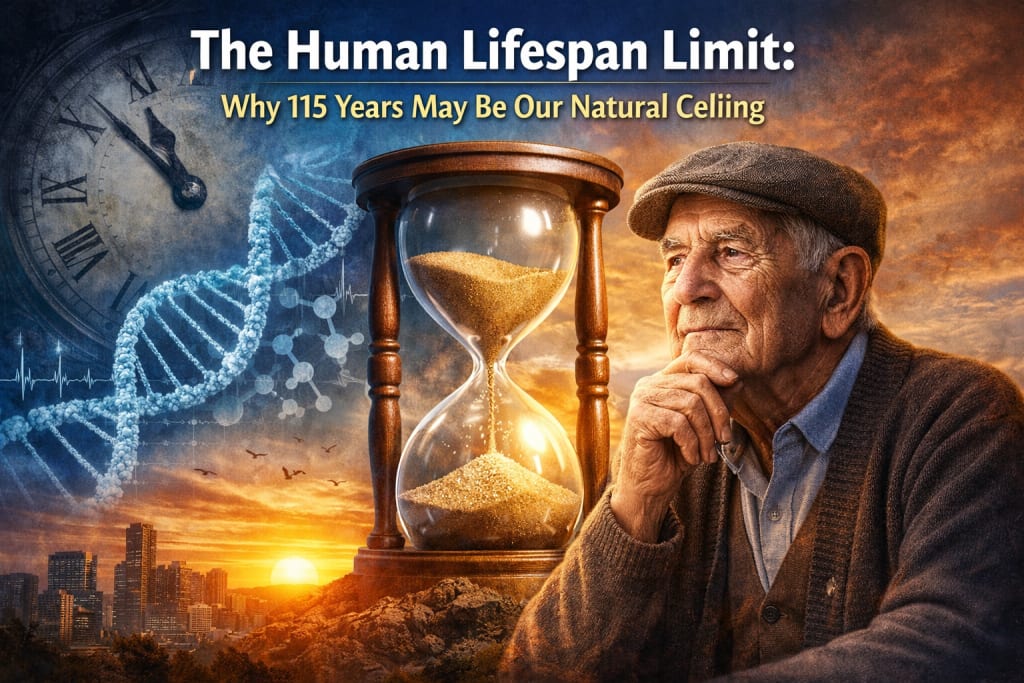
For centuries, humans have been fascinated by the idea of living longer—perhaps even indefinitely. Advances in medicine, nutrition, and technology have significantly increased average life expectancy across the globe. Yet, despite these improvements, scientists increasingly suggest that there may be a natural upper limit to how long humans can live. Many studies point toward approximately 115 years as the maximum lifespan most humans can realistically achieve.
The concept of a lifespan limit is rooted in biology. While average life expectancy has risen due to better healthcare and living conditions, maximum lifespan—the age reached by the oldest individuals—has not increased at the same pace. This suggests that while we are getting better at avoiding early death, we may not be extending the absolute boundary of human life.
One of the key factors behind this limitation is cellular aging. Human cells have a built-in mechanism known as the “Hayflick limit,” which determines how many times a cell can divide before it stops functioning. Each time a cell divides, the protective ends of chromosomes, called telomeres, become shorter. Eventually, they become too short to support further division, leading to cellular aging and death. This process is a fundamental barrier to indefinite human life.
In addition to cellular aging, the accumulation of damage over time plays a major role. Throughout life, our bodies are exposed to environmental stressors such as pollution, radiation, and toxins. Even normal metabolic processes produce harmful byproducts known as free radicals, which damage DNA and other cellular components. Although the body has repair mechanisms, they become less effective with age, leading to a gradual decline in function.
Research into supercentenarians—people who live beyond 110 years—provides valuable insight. These individuals are extremely rare, and very few surpass the age of 115. Statistical analyses of global longevity data reveal that the number of people reaching extreme old age plateaus, supporting the idea of a biological ceiling. Even among the healthiest individuals with ideal lifestyles, survival beyond this threshold is exceptionally uncommon.
Genetics also plays a crucial role in determining lifespan. Some people inherit genes that make them more resistant to age-related diseases such as heart disease, cancer, and Alzheimer’s. However, even favorable genetics cannot completely overcome the fundamental biological constraints of aging. Longevity genes may help individuals approach the upper limit, but they do not appear to extend it significantly.
Lifestyle factors—such as diet, exercise, and stress management—undoubtedly influence how long and how well we live. Diets rich in fruits, vegetables, and healthy fats, along with regular physical activity, are associated with longer lifespans. Avoiding smoking and excessive alcohol consumption further reduces the risk of early death. However, these factors primarily improve average life expectancy rather than pushing the maximum lifespan far beyond its natural boundary.
In recent years, scientific advancements have sparked hope that the lifespan limit could be extended. Fields like genetic engineering, regenerative medicine, and anti-aging research aim to slow or even reverse aspects of aging. Technologies such as stem cell therapy and gene editing hold promise, but they are still in early stages. While they may help people live healthier lives for longer, there is currently no evidence that they can dramatically extend the maximum human lifespan.
Philosophically, the idea of a lifespan limit raises important questions. If humans could live significantly longer, how would it affect society, resources, and our understanding of life itself? Some argue that a natural limit gives life meaning, encouraging individuals to make the most of their time. Others believe that extending life is a natural progression of human innovation.
In conclusion, while modern science continues to push the boundaries of health and longevity, evidence suggests that around 115 years may represent a natural ceiling for human life. Biological constraints such as cellular aging, genetic limits, and accumulated damage appear to define this boundary. Although future breakthroughs may shift this limit slightly, for now, the focus remains not just on living longer, but on living better—ensuring that the years we do have are healthy, active, and fulfilling.
About the Creator
Irshad Abbasi
Ali ibn Abi Talib (RA) said 📚
“Knowledge is better than wealth, because knowledge protects you, while you have to protect wealth.
Keep reading
More stories from Irshad Abbasi and writers in Humans and other communities.
The Island Where Childhood Is Shadowed by Despair
In the heart of the Pacific Ocean lies Nauru, one of the world’s smallest and most isolated island nations. Known once for its phosphate wealth, the country now faces a deeply troubling humanitarian reality—one that has captured global attention for all the wrong reasons. Reports of children attempting self-harm and suicide have raised urgent concerns about the mental health crisis unfolding on this remote island.
By Irshad Abbasi about 11 hours ago in Humans
My First Time Skiing and I Got Lost, Alone, in the French Alps
Looking back, I can trace some of my life’s biggest adventures to a simple action from my sister. She’d introduced me to Tommy (a very long time ago), a colleague of hers, who had overshared his penchant for Italian-looking women, and I ticked that box.
By Chantal Christie Weiss5 days ago in Humans
The Perfect Day
Every so often, I'm abruptly reminded of the differences between Neurotypical and Neurodivergent people. At work today, I stuck my head into the back office in an attempt to track down where the Nurse had vanished to, and interrupted a comparisson of what the Psychologist, Exercise Physiologist, and Team Manager's perfect day would look like.
By Natasja Rose5 days ago in Humans


Comments
There are no comments for this story
Be the first to respond and start the conversation.