
What Do You Notice When Comparing Millennials to Baby Boomers at Age 40?
What "turning 40" means for Millennials is different from what it meant for Baby Boomers. Does society get it?


Marketers often stay loyal to advertising to 40-year-olds the way that they always have. People in their 40s are no longer baby boomers, and haven't been for a while.
It could be called an anchoring bias.
However, advertisers do not seem to give much thought about how the aging characteristics of generations change over time. For instance, 60-year olds used to look somewhat elderly in the 1970s. Now, people that age do not look very old at all.
It’s more than looks, though.
With looking and feeling younger comes lifestyle differences that differentiate an age group from the previous generation at the same age. More 60-year-old people are still working and developing professionally, rather than playing bingo at the community center.
There has been a largely unnoticed cultural shift in what we have commonly taken for granted about age demographics. Somewhere, advertisers have fallen asleep at sea.
It has been noticed in other ways though. A person’s 30s were once considered to be a line that was between young adults and older people.
Remember “don’t trust anyone over 30”? Turning 30 was a reminder to people that they were no longer a "young person". Today, nobody really cares much about turning 30. It doesn’t carry the same weight as it used to, because the culture of being in one’s 30s has changed because of physiology, lifestyle, and socioeconomic variables. What used to be done in the 20s is now accomplished in the 30s.

Socioeconomic Differentiation
Socioeconomic uniqueness affects how each generation ages. Those unique differences are going to affect the consumer behavior of what each generation is going to find most important in the current market, independent from the previous generations.
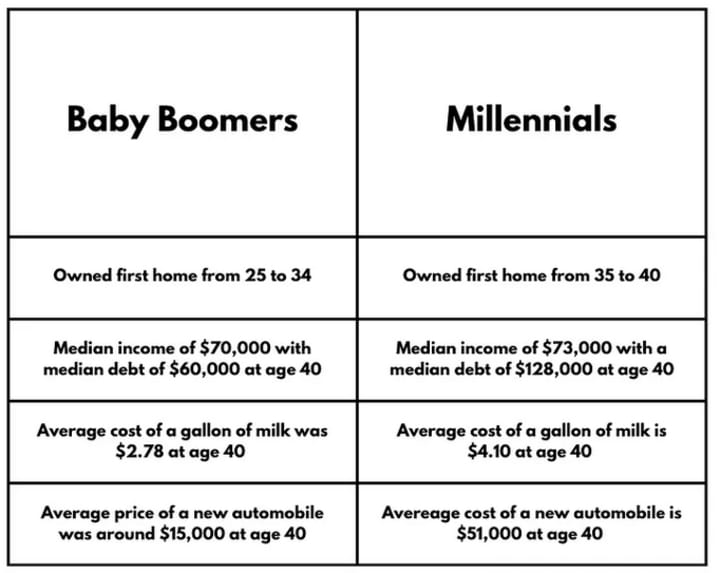
If you look at the small chart above, you see that a lot of millennials, who are born from 1981 to 1997, are not in a worthwhile financial situation at age 40.
They earn just a little bit more than a 40-year-old in 1990. That should show a red flag. Monumental debt and rising inflation make it appear even more dismal.
The value of a bachelor’s degree has also decreased in favor of more advanced degrees. Job opportunities are also affected by a looming skill shortage and the threat of a decrease in demand for skilled employees.
The millennial generation that produced less wealth than the previous generations. Since they were young, they have undergone 9/11, the Great Recession, the pandemic, and the current unstable job market. Paradigm shifts in society, culture, and economics are at regular intervals, whereas things went a bit slower for older generations.
Therefore, millennials are not spending money on leisure and “midlife crisis” vehicles. Millennials are also getting married and starting families in their mid-30s, which means they are not as physically spent by age 40 as previous generations. Therefore, it doesn't really make sense to place millennials in the same stage of life that baby boomers were at the same age.
Is it adaptation to the changing variables of attaining credibility through education, skill acquisition, and economic inflation? Or, is it all of the above? Have millennials simply adapted to the length of time it takes to achieve the particular highlights of Western civilization, and therefore, have aged gracefully into their roles? These are questions best looked at by anybody reading who is an expert in physiology.
It is easy to make reactionary, post-hoc observations.
"It’s because they are postponing these things because they don’t want to grow up”, or “it’s because of feminism."
These variables do not just affect males, they also affect females. This type of blaming ignores variables such as rising inflation, economic recessions, changing value of a degrees, and constantly changing values of society.
The point is, millennials, and generation Z have to adapt to a changing socioeconomic climate — not one with colder and warmer temperatures, but one where what was true about capability one moment then becomes archaic. One minute a college degree means something, and the next minute it doesn't.
The Changing Meaning Behind Turning 40

Around age 40, Baby Boomers were much better at producing wealth than Millennials are at the same age today. By that age, they had stable jobs and dual-income families since their 20s. This can simply be observed by looking at the data.
While baby boomers were more financially off, and physiologically older, millennials seem to be more physiologically younger than Baby Boomers were at age 40, due to growing up with better health education and lifestyle practices. The same could have been said about Baby Boomers, who were more physiologically younger than The Greatest and Silent generations. I will put this into more detail in a bit.
The reality is that an age group’s demographic characteristics don’t stay the same throughout the decades.
Rather, they may change from one generation to another. Each generation adapts to its environment a bit differently than the previous one, thus developing different character, both physiologically, and socioeconomically.
Consumer Behavior and Solutions for Things That Are Not Problems

Today’s advertisers really do not understand millennials who are over 40. Instead of looking at them uniquely, they sort of lump them in the "over 40" demographic, which is an unusually short-sighted demography.As we have seen from the chart at the beginning of this article, millennials have bigger problems at age 40 than “looking younger” and buying a midlife crisis vehicle. Therefore, advertising to today’s 40-somethings in this way that was once was to baby boomers is misunderstanding the changing demographics.
We've looked at the socioeconomic differences, and now let's look at a couple other categories where Millennials differ from baby boomers.
1. Fitness, Wellness, and Health Marketing to Millennials of a Particular Age

Research shows that millennials are, and have been a “health conscious generation”, interested in organic foods, wellness, fitness, and “mental health”. When it comes to health, most millennials don’t think of themselves as needing products or services that cater to being over 40. For instance, legacy marketing ideas like “fashion over 40” may need a revamp.
For health and fitness marketing, millennials do not want to hear about how to gain muscle “after 40”, but how to gain more muscle in their 40s. This is a demographic that spent a lot of their 20s and 30s at the gym, and have continued into their 40s. Obviously, this would not be true for millennials who have developed poor health habits since their younger days.
Mintel — a “global market and intelligence research agency” — observed the financial concerns and buying trends of millennials.
According to a study by Mintel, there was little difference between the health priorities younger millennials (who are now about 29 and 30 years old) and older millennials. There should be, right? Well, there isn’t.
What this shows is that millennials, as an entire generation, are not strangers to the concept that you have to eat a particular way, avoid particular vices, and take up physical activity. They grew up with better health and wellness information. Therefore, some of the things that used to be a mystery to older generations, are not mysteries.
However, we see the same advertising tactics.
For instance, we still see testosterone-boosting supplements advertised to men over 35, 40, and sometimes 55+, but these are largely still driven by old data that has since been debunked.
It used to be believed that testosterone decline was age-driven. New studies reveal that age-related drops in testosterone are actually lifestyle factors that are typically common for people over 30, and not caused by age.
Will this slow-aging trend continue with Gen Z?
Obviously, we don’t know yet.
However, trending reports reveal that “Zoomers” are bringing back smoking, which is not very accommodating for the advanced health information available today.
In a way, smoking is a sort of rebellious gesture to differentiate themselves from the health-consciousness of millennials. At any rate, it’s not a healthy habit.
2. Millennial Values
Another thing is values. millennials have kept their identity as millennials, into becoming mature adults.
For instance, millennials are still loyal to the same priorities that they have been known for, such as ethical business practices, sustainability, diversity, short-term financial stability (rather than planning for retirement), healthy and ethically-sourced foods (as opposed to regular healthcare checkups).
In Summary
We may want to ask ourselves whether 40 years old (or even 50) is really a big deal, anymore?
Does it matter?
Millennials do not want to know which midlife crisis car to buy or how to regrow their hair. Rather, they want to know about how to save money, what to go back to school for, what new skills they need, what industries are emerging. They want to continue developing the skills they are currently using.
Old advertising habits can be difficult to break. We can often overlook the changes that we see in society. This is known as an anchoring bias. It means that we are biased towards ideas about things that we’ve always had.
Therefore, when we write advertisements to demographics, we need to be careful to consider that it’s not “People Over 50”, but rather the needs of today’s 50-year-old people and that it may not be the same as the needs of 50-year-old people in the 1970s.
If advertisers and businesses can recognize this, then they will do well to be able to market to people more accurately, solving their problems and understanding who people are today.
About the Creator
J. Chauncey
J. Chauncey is a freelance writer, copywriter, and feature journalist specializing in writing articles about marketing, design, health, food/beverage/culinary, sustainability, tech and retail history.
https://bio.site/chaunceybeacon
Keep reading
More stories from J. Chauncey and writers in Humans and other communities.
Digital Semiotics and Symbols
Semiotics is the study of symbols, and in this article we’re going to talk about some common symbols that mankind uses today, using icons commonly used in user interface design, infographics, logos, favicons, and sometimes advertisements. These symbols are used to communicate ideas of action, or to communicate ideas in writing. Copywriters who work with companies that use technology should become familiar with the technological symbology both for understanding and for proper placement of visuals, or within visuals.
By J. Chauncey6 months ago in Humans
My First Time Skiing and I Got Lost, Alone, in the French Alps
Looking back, I can trace some of my life’s biggest adventures to a simple action from my sister. She’d introduced me to Tommy (a very long time ago), a colleague of hers, who had overshared his penchant for Italian-looking women, and I ticked that box.
By Chantal Christie Weiss4 days ago in Humans
Twin Flames And Èrè Ìbejì: A Spiritual Exploration Of Mirrored Souls And Sacred Doubling
Twin Flames And Èrè Ìbejì: A Spiritual Exploration Of Mirrored Souls And Sacred Doubling Human beings have always sensed that life moves in pairs. Day and night. Sun and moon. Breath in and breath out. Even the human heart beats in a rhythm that rises and falls like a conversation between two forces that need each other to exist. Across cultures and centuries, people have tried to understand why the world seems to be built on this quiet architecture of twos. Some have turned to myth. Some have turned to psychology. Some have turned inward, listening for the echo of a presence that feels both familiar and mysterious. This search has given rise to the idea of the twin flame, a concept that suggests that every soul has a counterpart, a mirror, a partner in spiritual evolution.
By Julie O'Hara - Author, Poet and Spiritual Warriorabout 23 hours ago in Humans




Comments (1)
nice topic