
The Channel 3 Broadcast Archive: Why I Stopped Buying Unmarked VHS Tapes
I found a box of unmarked VHS tapes at an estate sale. Inside was an analog horror story about a signal that refuses to stay on the screen.

There is a specific smell to forgotten media. It’s a mixture of degrading plastic, basement mildew, and the metallic tang of static electricity. If you frequent estate sales in the rural Midwest, you know exactly the scent I’m talking about. Most people go looking for antique furniture or vintage jewelry. I go looking for magnetic tape.
Last Thursday, the estate sale of a reclusive electronics repairman yielded a cardboard box shoved beneath a water-damaged workbench. Inside were six unmarked, heavy-duty VHS tapes. No commercial labels. No studio branding. Just faded masking tape across the spines with a single word scrawled in black Sharpie: ARCHIVE.
I paid the deceased man’s nephew four dollars for the box. That was my first mistake. My second mistake was owning a functional CRT television and a Panasonic VCR to play them on.
What follows is an exact account of the footage contained on those tapes. I am publishing this not as a piece of fiction, but as a warning. Some analog horror stories aren't just internet art projects. Sometimes, the magnetic tape captures things that were never meant to be broadcast.
Tape 1: The Local Access Anomaly
I set up the heavy, glass-screened CRT television in my living room. There’s a ritual to analog media that digital streaming lacks. The mechanical clunk of the tape seating into the carriage. The high-pitched mechanical whine of the motors engaging. The sudden, blinding burst of white snow on the screen, accompanied by the harsh hiss of audio static.
The tape began with standard SMPTE color bars—those vertical blocks of yellow, cyan, green, magenta, red, and blue used to calibrate monitors. They held on screen for a full two minutes. The audio was a continuous, flat 1000 Hz tone. It was boring, professional, and entirely normal.
Then, the tracking flickered. A jagged line of distortion rolled up the screen, and the footage cut to a local public access show.
The aesthetic was distinctly late 1980s or early 1990s. The set was incredibly cheap: a fake wood-paneled desk, two folding chairs, and a potted fern that looked like it was made of plastic. Two people sat at the desk—a man in a beige suit and a woman in a floral dress.
At first glance, it looked like a mundane community broadcast. Perhaps a discussion about zoning laws or an upcoming bake sale. But within thirty seconds, the "uncanny valley" effect set in, turning my stomach into a tight knot.
The audio was terribly desynchronized. The man would open his mouth, and two seconds later, a garbled, heavily compressed voice would come through the speakers.
"The community... must understand... the roots are growing deeper."
But that wasn't the worst part. It was their faces. Because of the low resolution of the VHS tape, it took my eyes a moment to adjust to the blurriness. When they did, I realized the host and his guest weren't blinking. Their eyes were wide, unmoving, and perfectly round, like coins painted onto a doll's face.
As the man spoke, the woman simply stared directly into the camera lens. Her smile was stretched too far across her face, pulling the skin taut over her cheekbones.
Suddenly, the audio dropped out completely. The screen went black, save for a single line of white text at the bottom:
WE ARE BROADCASTING TO YOU. ARE YOU RECEIVING?
The tape abruptly ended in a storm of white noise. My living room felt ten degrees colder. I checked my phone; it was only 9:15 PM, but the silence in my house felt absolute, pressing in on my eardrums.
Tape 2: The Emergency Alert System
Against every instinct of self-preservation, I ejected the first tape and inserted the second. If the first tape was an unsettling public access anomaly, the second was an exercise in pure psychological dread.
It started immediately without color bars. The screen was filled with a static, wide-angle shot of a suburban street at night. The streetlights cast a jaundiced, orange glow over the asphalt. It looked incredibly familiar, but the heavy grain of the low-light camera made it impossible to identify the neighborhood.
For five unbroken minutes, nothing happened. The only audio was the low, rhythmic hum of electrical wires and the occasional distortion pop. In modern analog horror stories, this is the part where you wait for the jump scare. You scan the dark corners of the screen, looking for a shadow to move or a face to appear in a window.
I was leaning in, my face inches from the glass of the CRT, when the Emergency Alert System (EAS) tone shattered the silence.
It wasn't the standard digital blare we hear on cell phones today. It was the old, dual-tone analog screech that used to interrupt radio broadcasts—a sound biologically engineered to trigger human panic.
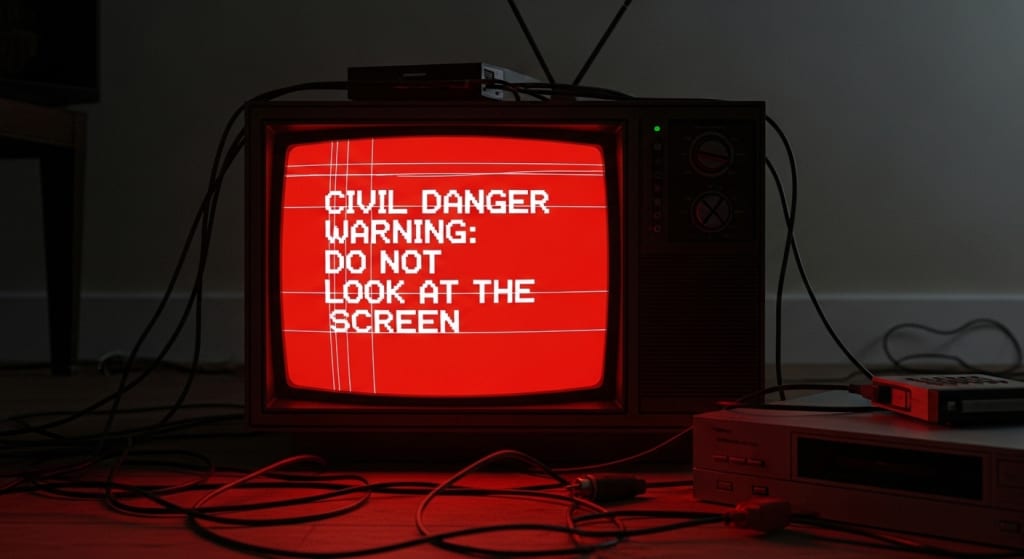
The suburban street vanished, replaced by a solid red screen. A robotic, text-to-speech voice began to read a message as the words scrolled upward.
CIVIL DANGER WARNING.
ISSUED BY THE DEPARTMENT OF ANOMALOUS BROADCASTS.
EFFECTIVE IMMEDIATELY.
RESIDENTS ARE ADVISED TO CLOSE ALL BLINDS. > DO NOT LOOK AT YOUR TELEVISION SCREENS.
THEY ARE USING THE SIGNAL TO MAP YOUR INTERIORS. > IF YOU HEAR TAPPING ON THE GLASS, DO NOT ACKNOWLEDGE IT.
My breath hitched. The EAS warning wasn't warning about a tornado or a flash flood. It was warning the viewer about the broadcast itself.
The screen cut back to the suburban street. But it wasn't a static shot anymore. The camera was moving. It was a handheld shot, panning slowly across the manicured lawns. It stopped and zoomed in on a house at the end of the cul-de-sac.
My house.
My stomach dropped into a bottomless abyss. The footage was degraded and grainy, clearly filmed decades ago based on the timestamp in the corner: OCT 14 1992. But the house on the screen was undeniably the one I was currently sitting inside. The siding, the shape of the porch, the large oak tree in the front yard—it was a perfect match.
Tape 3: The Intruders in the Signal
I wanted to hit stop. I wanted to unplug the television, throw the VCR into the driveway, and smash it with a hammer. But I was paralyzed. The morbid curiosity that drives every protagonist in every horror story had a vice grip on my nervous system.
I loaded the third tape.
This one was different. It didn't look like a broadcast or a camcorder recording. It looked like a security camera feed. The angle was high up, looking down into a dimly lit room.
It was a living room. My living room.
The couch was the same. The coffee table was the same. The heavy CRT television was sitting in the exact same spot against the far wall.
"This is impossible," I whispered to the empty room. The timestamp in the corner of this video didn't say 1992. It flickered rapidly, displaying a jumble of numbers and symbols that refused to resolve into a coherent date.
On the screen, the living room was empty. But the television inside the video was turned on, casting a pale, flickering blue light across the carpet.
Then, the audio kicked in. It was a rhythmic, wet sound. Slap. Drag. Slap. Drag. From the dark hallway on the left side of the screen, a figure crawled into the living room. It was humanoid, but its proportions were entirely wrong. Its arms were too long, dragging heavily across the floor, and its head was tilted at a severe, unnatural angle. Its face was obscured by a mess of dark, matted hair.
I sat frozen on my couch in reality, watching this impossible creature crawl across the floor of my living room on the tape.
It moved slowly toward the television screen in the video. When it reached the glow of the CRT monitor, it stopped. Slowly, agonizingly, it turned its head and looked up, directly into the security camera.
No. It wasn't looking at the camera.
Because of the angle, the creature in the video was staring directly out of my television screen, right into my eyes.
The audio erupted into a deafening screech of dial-up modem tones and tearing static. The creature on the screen raised one long, impossibly jointed finger and pointed directly at me.
Behind me, in my actual, physical living room, the floorboards in my dark hallway creaked.
Slap. Drag. ## The Unplugged Screen
I didn't wait to see what was in the hallway. I didn't reach for the remote. I lunged forward and yanked the power cord from the wall.
The CRT television died with a sharp crackle of static electricity, the image shrinking down into a single, bright white dot in the center of the glass before fading into total darkness.
The silence in the house was deafening. I sat on the floor, my chest heaving, staring at the black reflection of the television screen. I didn't turn around. I didn't move for three hours, until the morning sun finally began to bleed through the living room blinds.
I took the tapes outside, threw them into an old steel burn barrel, and doused them in lighter fluid. I watched the thick, black smoke rise into the morning air as the plastic melted and warped. I wanted to destroy the archive. I wanted to erase whatever signal had tethered itself to my home.
But as I stood there watching the fire, a sickening realization washed over me.
Analog tape doesn't record reality. It captures light and sound and converts it into magnetic signals. It’s a physical medium. And as I watched the last of the tape blister and turn to ash, I remembered the final frame of the security camera footage.
The creature hadn't come from the hallway. The timestamp on the video hadn't been from the past.
The creature had crawled out of the television in the video. Which means the tapes weren't a recording of something that had happened. They were a delivery mechanism.
I haven't turned on a television since. I listen to the radio. I read books. But at night, when the house is completely quiet, I can still hear the faint, high-pitched whine of a CRT monitor powering up. And occasionally, from the darkest corner of my hallway, I hear the slow, rhythmic sound of heavy limbs dragging across the carpet.
Some broadcasts are better left unwatched. Because once you tune into their frequency, they tune into yours.
Reader, I need to know:
Have you ever found an unmarked VHS tape or a bizarre digital file that felt... wrong? Did you watch it to the end, or did you destroy it? Drop your experiences in the comments below—I’m trying to figure out if I’m the only one experiencing this "bleed-over" effect, and I need your stories.
About the Creator
The Glitch Archive
The Glitch Archive Where modern tech meets ancient dread. Documenting AI glitches, urban legends, and the uncanny valley. Explore the dark side of the digital age through viral horror stories and psychological thrillers. 📂🌑
Keep reading
More stories from The Glitch Archive and writers in Horror and other communities.
The Neighborhood Association Sent a Fine for My Husband’s Heart Attack
The letter arrived in a cream-colored envelope, embossed with the gold leaf seal of the Maple Crest Homeowners Association. It was tucked neatly into our mailbox, precisely three inches from the right-hand edge, exactly as the bylaws mandated.
By The Glitch Archiveabout 17 hours ago in Horror
The Vanishing Lighthouse Keepers
The Flannan Isles Lighthouse stands on the largest of a group of remote islands in the Outer Hebrides of Scotland, built in 1899 to warn ships away from dangerous rocks that had claimed countless vessels over the centuries, and it was staffed by teams of three lighthouse keepers who rotated in shifts to maintain the light and keep detailed logs of weather conditions and everything that occurred during their watch, following strict protocols established by the Northern Lighthouse Board that governed every aspect of their duties and responsibilities. On December 26, 1900, the relief vessel Hesperus arrived at the island to bring supplies and rotate the keepers, but when Captain James Harvey approached the landing area, he immediately sensed something was wrong because there was no flag flying on the flagpole as there should have been, no storage boxes waiting on the platform for the supplies being delivered, and no keepers waiting at the landing to help secure the boat and unload the cargo as protocol required, and when he sounded the ship's horn repeatedly and fired a flare to signal their arrival, there was no response from the lighthouse despite the fact that someone should have been on duty and watching for the relief vessel.
By The Curious Writer3 days ago in Horror
A Transparent Look at Vocal Challenges and Top Stories
Almost three years ago, we shared a resource article that served as a place for people to suggest new challenge prompts. We thought it would be a good idea to refresh that thread, and take the opportunity to answer a few common questions about top stories, how challenges are judged and how submissions are reviewed.
By Vocal Curation Team5 days ago in Resources


Comments
There are no comments for this story
Be the first to respond and start the conversation.