
Why Sailing Powers Needed Tons of Tar — and How They Used It
Why tar, pitch, and other naval stores were as essential to wooden fleets as timber, rope, and sail.
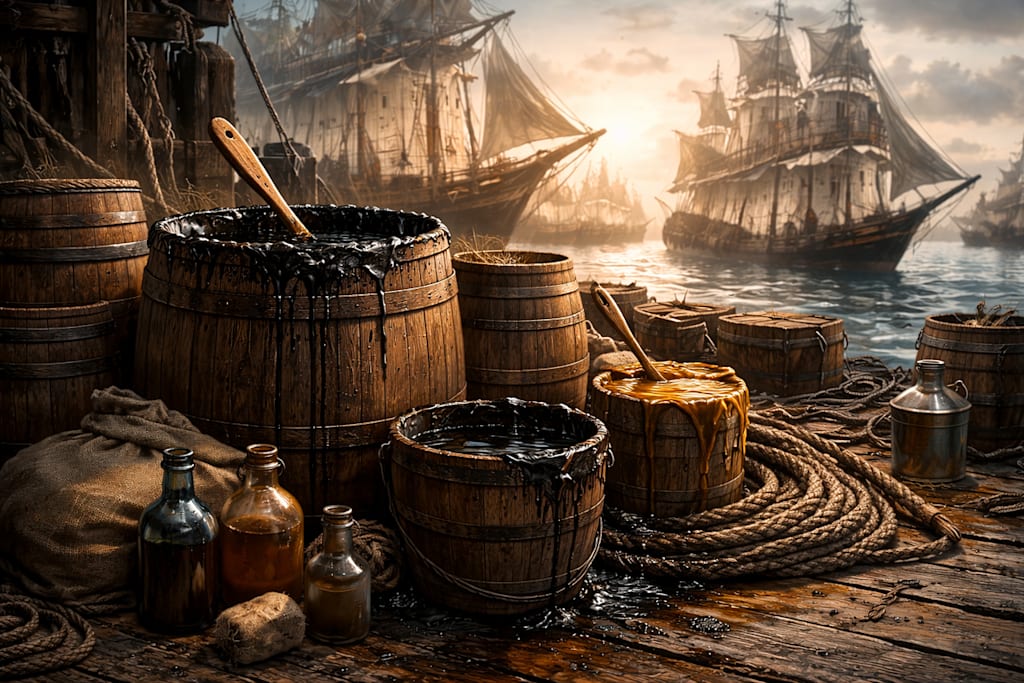
When people think about the age of sail, they usually picture masts, white sails, cannons, ropes, and the open ocean. Tar rarely appears in that image. It seems like some minor thing from the world of forests and carpenters. But for sailing powers, tar was a strategic material. Without it, a wooden ship would rot faster, leak more easily, dry out, and lose its rigging far sooner. Put simply, without tar a maritime empire could not keep its fleet in working condition for long.
That is exactly why naval powers depended heavily on what were called naval stores — materials made from pine resin and related products. These included tar, pitch, rosin, turpentine, and other substances. In the age of wood and sail, this was almost as important as oil would become in the twentieth century. These materials did not decorate a ship. They kept it alive.
What “Tar” Actually Meant: Not One Material, but a Whole Chemistry
Today, when people say “tar” or “resin,” it often sounds like they mean one sticky dark substance. In reality, the sailing world used a whole family of related materials, and each had its own role.
For an ordinary person, this may sound like pointless detail. But for sailors, the differences mattered. Tar was better for treating ropes. Pitch was used to seal seams. Rosin went into protective mixtures. A ship did not survive because of some abstract “resin in general,” but because of an entire chemistry of wood products.
Tar Made Wooden Ships Durable
The main task of tar-based materials was simple: to protect ships from rapid decay. At sea, wood deteriorated quickly. It was constantly attacked by water, salt, sun, temperature shifts, fungus, and rot. In warm seas, the hull was also threatened by shipworm, or teredo.

What Exactly Was Protected With Tar
- Tar was used on a ship not in just one place, but almost everywhere that wood and rope suffered from moisture.
- Hull seams. The gaps between planks were first packed with oakum, then covered with hot pitch. This made the hull tighter and stopped water from seeping inside.
- The underwater part of the hull. It was coated with tar-based compounds and sometimes additionally covered with thin protective boards. This helped defend the hull against moisture and shipworm.
- The deck. The seams between deck planks were also sealed with pitch, so that water would not pass downward and damage the ship’s internal wooden structure.
- Masts and other wooden parts. These were treated with tar-based mixtures so the wood would absorb less moisture, crack less quickly, and last longer.
- Without this protection, a wooden ship could wear out rapidly and become unusable in just a few years. With regular care and repeated tarring, it could serve much longer — sometimes for decades.
Ropes, Rigging, and the Dependence on Tar
When people think of shipboard tar, they often think only of hull seams. But tar mattered just as much for rigging. On a sailing ship, ropes were not just ropes. They were part of steering, movement, and survival. They held the sails, raised the yards, and worked the anchors.
The problem was that hemp ropes in a marine environment quickly rotted, absorbed water, and lost strength. In just a few months, an untreated rope could become unreliable.
The solution was to boil ropes in tar or soak them in hot compounds under pressure. That made them more resistant to rot and mold, more water-repellent, and more durable under friction against blocks and spars.
After treatment, ropes darkened, taking on their characteristic black-brown color and that distinct “ship smell” of tar. That image — dark, heavy, tar-scented rigging — became one of the defining symbols of the old fleet.
The quantities involved were serious. A large ship of the line might carry 30 to 40 tons of rigging. Maintaining that amount of rope required several tons of tar every year, even without counting new construction.
Why Tar Became a Political Question
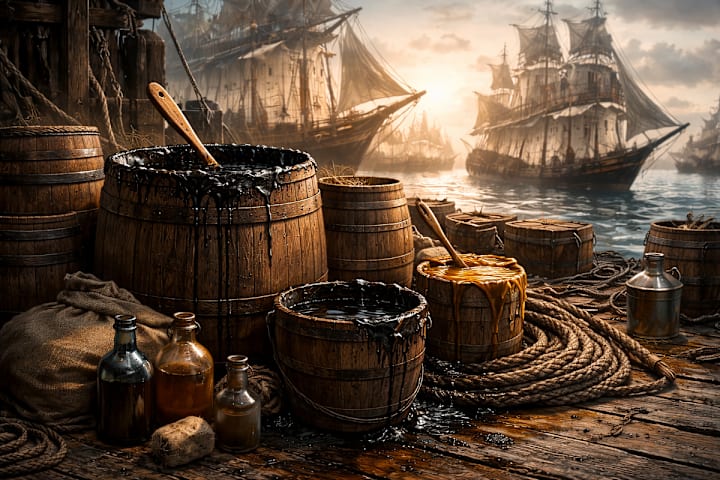
Once it becomes clear how dependent fleets were on tar, it is easy to understand something else: for states, this was a strategic material. Shipyards, cannons, and sailors were not enough. A wooden navy constantly needed supplies for repairs, sealing, and protection.
In eighteenth-century terms, the demand could be enormous. A major navy needed thousands of tons of tar and pitch every year for maintenance alone. One ship of the line undergoing a major overhaul could require tens of tons of pitch just for resealing the hull. A modest colonial naval stores industry might produce only a fraction of that annually.
That is why governments turned tar into a matter of policy.
England. In the seventeenth and eighteenth centuries, England depended heavily on Baltic tar from places like Sweden and Poland. But when relations in the Baltic worsened, prices rose sharply. So England encouraged production in the American colonies. A series of acts offered subsidies for every barrel of tar and pitch produced there.
Russia under Peter the Great. While building a navy, Peter faced the same need for naval stores. Russia had immense pine forests, but not always the techniques needed to produce high-quality naval tar. He invited specialists from Holland and England and established tar works around Voronezh, Arkhangelsk, and the new capital region. By the 1720s, Russia was not only supplying its own fleet, but exporting tar to England.
France. Under Colbert, France also encouraged domestic production of naval stores to reduce dependence on foreign suppliers.
How Tar and Pitch Were Actually Used on Ships
For anyone who wants to understand the process itself, not just the broad picture, the practical methods matter.
1. Sealing the hull
The seams between hull planks were packed with oakum made from hemp or flax using special tools and hammers. Then hot pitch was poured over the seam. It spread, filled small gaps, and hardened into a flexible waterproof seal. This had to be repeated regularly.
2. Treating ropes
New hemp ropes were drawn through vats of hot tar, sometimes under pressure. After treatment they were hung up so the excess could drip off and the rope could dry. A treated rope could last many times longer than an untreated one.
3. Protecting masts and spars
Masts and yards were coated with mixtures of tar, rosin, and linseed oil. This protected them from sun and damp, helping to prevent cracking.
4. Fighting fouling and shipworm
In tropical waters, shipworm could quickly ruin a hull. In the seventeenth and eighteenth centuries, shipbuilders experimented with mixtures based on sulfur, tar, and even arsenic. But the most common method was simpler: the underwater hull was covered with sacrificial outer planking, sometimes treated with tar, and this outer layer was periodically replaced.
Other Uses of Tar at Sea
Tar and related materials had uses beyond the main hull and rigging.
Torches and lighting. Oakum soaked in tar and pitch was used for torches during boarding actions and for lighting dark spaces below deck.
Boats and launches. The same sealing methods used on large ships were applied on a smaller scale to ship’s boats.
Lubrication. Tar could be used on wooden blocks and parts of the rigging to reduce squeaking and improve movement.
Medicine. Tar and resin were also ingredients in some shipboard ointments, especially for skin conditions, though this was a secondary use.
A Sailing Fleet Could Not Have Survived Long Without It
The essential point is simple: sailing powers needed tons of tar because without it, wooden fleets deteriorated quickly. Tar sealed seams, protected wood from damp and rot, treated ropes, and extended the life of rigging. It was not a secondary material, but one of the foundations of naval life.
When people talk about the sailing age, they usually remember sails, cannons, admirals, and sea battles. But behind that dramatic image stood the daily work of preserving the ship itself. Tar, pitch, rosin, and the rest of the naval stores were part of that quiet but necessary foundation.
The strength of a sea power depended not only on the number of ships and the skill of sailors. It also depended on how well those ships were built, caulked, tarred, and prepared for service.
That is why talking about tar is not some tiny technical detail. It is one of the clearest ways to understand how the sailing fleet actually functioned. Without tar and pitch, ships would begin to leak, rot, and break down far too quickly. In that sense, tar was one of the most important materials in the sailing world — alongside timber, canvas, and iron.
About the Creator
Carried by the Wind: The Forgotten Story of Japan’s Fire Balloons.
In the final years of World War II, as the conflict stretched across oceans and continents, a strange and almost unbelievable weapon drifted silently across the Pacific. It had no engine. No pilot and no guidance system. Only wind.
By The Iron Lighthouse6 days ago in History
Napoleon's Frozen Army
Napoleon Bonaparte invaded Russia in June 1812 with the largest army Europe had ever assembled, over 600,000 soldiers from across his empire, and six months later fewer than 100,000 staggered back across the border as broken remnants of the greatest military force in history, destroyed not primarily by Russian armies but by the Russian winter, starvation, disease, and the deliberate strategy of scorched earth that left the invaders with nothing to eat in a landscape stripped bare by the retreating Russians who burned their own cities and farms rather than allow Napoleon to use them.
By The Curious Writer6 days ago in History



Comments
There are no comments for this story
Be the first to respond and start the conversation.