
The Great American Treasure Hunt: Yard Sales, Estate Sales, and Flea Markets
Merry Monday Edition

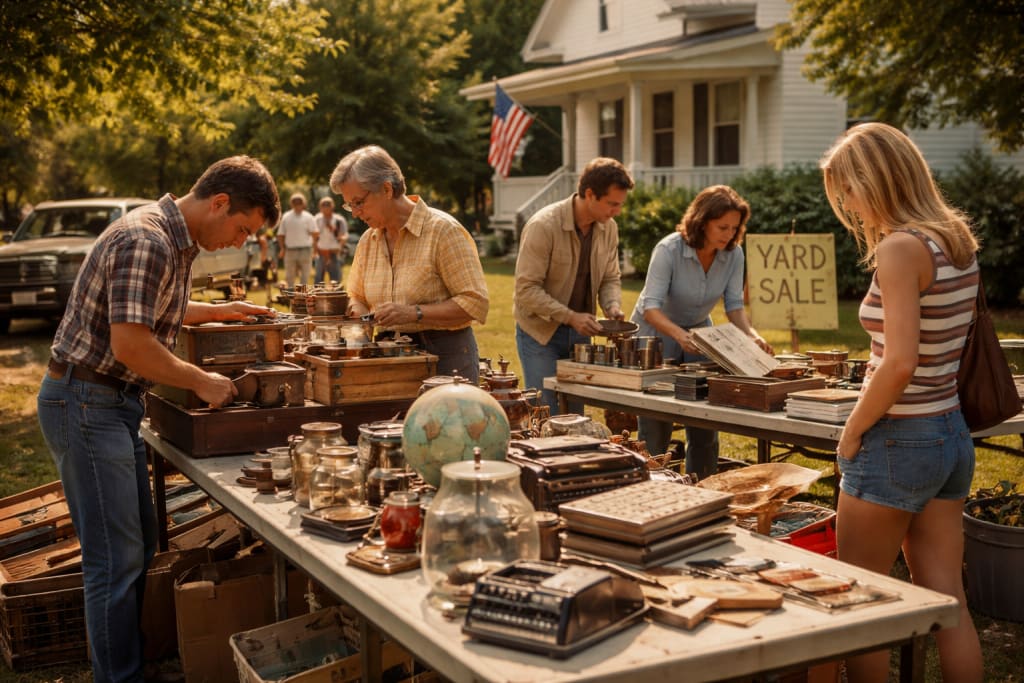
On any given Saturday morning across America, if you drive slowly enough through the right neighborhood, you’ll eventually see one. A crooked cardboard sign taped to a telephone pole.
- YARD SALE -
- SATURDAY -
- 8 AM - 5 PM -
An arrow points down the street. Follow it, and you’ll usually find a driveway, garage, or front lawn transformed into something between a miniature marketplace and a museum of everyday life. Folding tables sag under the weight of old coffee makers, VHS tapes, DVD players, dusty lamps, board games missing half their pieces, and boxes of mysterious cords that no one can identify anymore.
Someone sits nearby in a lawn chair, sipping coffee and mending the change box. While someone else puts last-minute sticker prices on a few items. Customers flip through stacks of old records. And somewhere, inevitably, someone asks the most American question imaginable: “Would you take three dollars for it?”
Yard sales, flea markets, and estate sales are not just places to buy things cheaply. They are part of a long, quietly fascinating tradition in American life. One that blends thrift, community, curiosity, and the strange human tendency to assign value to objects long after their original owners are gone. Most of us have heard the old adage, "One man's trash is another man's treasure". There has never been a truer statement.
To understand how these odd little markets became so embedded in American culture, you have to go back much further than the suburban garage.
The Roots of Secondhand America
Long before the phrase “yard sale” existed, Americans were already trading and reselling used goods. In the 18th and early 19th centuries, auctions and public markets were common ways to sell belongings. When families moved, died, or fell on hard times, their possessions were often sold at public auctions where neighbors gathered to bid on furniture, tools, and livestock.
These events served practical purposes, but they were also social gatherings. In smaller communities, everyone knew everyone else, and auctions often doubled as opportunities to share news, stories, and speculation.
As American towns grew during the 19th century, a different type of marketplace began to appear. These were the early flea markets.
The name itself has somewhat mysterious origins, though historians believe it may have come from European markets where secondhand clothing, sometimes rumored to contain fleas, sold cheaply. The term eventually crossed the Atlantic and became associated with informal markets full of used goods and curiosities.
By the late 1800s, flea markets had become a regular feature in many American cities. They were chaotic, colorful places where you could find almost anything:
- antique furniture
- mechanical parts
- tools
- old books
- military surplus
- odd collectibles
In many ways, they were early versions of the sprawling swap meets and antique fairs that still pop up across the country today. But the uniquely American phenomenon of the yard sale would arrive much later.
The Suburban Yard Sale Is Born
The modern yard sale really began to take shape after World War II. In the decades following the war, millions of Americans moved into newly built suburbs. Houses came with something many city dwellers had rarely enjoyed before... Yards and garages.
These spaces became convenient storage areas for the accumulation of everyday life.
- Old toys.
- Unused appliances.
- Clothing that no longer fits.
- Furniture that had been replaced.
Eventually, someone had a simple idea. Instead of throwing these things away, why not put them out on the lawn and sell them?
By the 1950s and 60s, neighborhood garage sales had become increasingly common. Word spread through hand-painted signs, church bulletins, and local newspapers.
Unlike flea markets, which often involved professional vendors, yard sales were usually run by ordinary families clearing out their homes. Prices were low, expectations were casual, and bargaining was part of the experience. You didn’t just buy things at a yard sale. You talked to neighbors. You swapped stories. You occasionally learned the entire life history of a toaster oven.
Estate Sales: When a Lifetime Goes on Display
Estate sales are a different creature altogether. Where yard sales often involve unwanted clutter, estate sales represent something far more personal: the dispersal of an entire household. These sales usually occur when someone passes away, moves into assisted living, or relocates after decades in the same home.
Professional estate sale companies often step in to organize the process. Instead of moving items outside onto the lawn, they open the entire house to the public. Visitors wander room to room, examining a lifetime of possessions:
- bookshelves filled with old paperbacks
- cabinets of china dishes
- boxes of photographs
- carefully preserved tools
- decades of holiday decorations
The atmosphere is often quiet and reflective. In some cases, strangers find themselves holding objects that once meant a great deal to someone they never knew. Estate sales can feel almost like archaeological sites, layers of personal history slowly being carried away piece by piece. A fantastic place to discover needed items.
Flea Markets: The Treasure Hunter’s Paradise
While yard sales and estate sales tend to be occasional events, flea markets are more permanent institutions. Across America, large flea markets gather vendors who specialize in used goods, antiques, collectibles, and oddities. Some operate only on weekends. Others are massive permanent markets with hundreds of booths.
Walking through a flea market can feel like stepping into a parallel economy. Here you might find:
- vintage advertising signs
- antique tools
- rare vinyl records
- old comic books
- handcrafted furniture
- military memorabilia
Many vendors spend years building expertise in specific niches. Some are passionate collectors who turned their hobbies into businesses. Others simply enjoy the hunt. Because that is the real appeal of flea markets. You never know what you might find.
The Thrill of the Hunt
Part of the enduring charm of yard sales and flea markets lies in their unpredictability. Unlike retail stores, where every item is carefully selected and priced, secondhand markets are chaotic and surprising. One table might contain nothing but plastic toys and kitchen utensils. Another might hold a forgotten treasure.
Stories abound of people discovering rare paintings, valuable antiques, or collectible items worth thousands of dollars purchased for pocket change. A dusty box in someone’s driveway might contain a first edition book. An old trunk at a flea market might hide historical photographs. Most of the time, of course, the discoveries are far more modest. But the possibility is what keeps people coming back. Every table might hold a story. Every box might contain a secret.
Why These Markets Refuse to Disappear
In a world dominated by online shopping and digital marketplaces, you might expect yard sales and flea markets to fade away. Instead, they remain remarkably resilient. Part of the reason is simple economics. Buying used items is often far cheaper than buying new ones. But there are deeper reasons as well. Secondhand markets offer something modern retail rarely does:
- human interaction.
- You talk to sellers.
- You negotiate prices.
- You hear stories about where things came from.
There is also a growing cultural appreciation for reuse and sustainability. In an era increasingly concerned about waste, buying secondhand feels practical and responsible. And then there is nostalgia.
Old objects carry the quiet weight of memory. A typewriter reminds someone of a grandparent. A record album recalls a long-forgotten summer. A battered lunchbox sparks a childhood memory. These markets are filled with echoes from our pasts. And that, you just can't put a price on.
The Marketplace of Memories
Yard sales, estate sales, and flea markets represent something uniquely human. They remind us that objects have lives beyond their original purpose. A coffee mug might outlive the kitchen where it was first used. A child’s toy might travel through several families before finally resting in someone else’s attic.
The American tradition of secondhand markets acknowledges something simple but profound. Nothing stays in one place forever. Possessions move. Homes change. Generations pass. And yet the objects themselves keep circulating through the lives of strangers.
That old lamp in the corner of a flea market stall may once have lit a completely different story. Now it waits patiently for the next one. And somewhere down the road, on some quiet Saturday morning, another crooked cardboard sign will appear on a telephone pole.
- YARD SALE -
The treasure hunt begins again...
About the Creator
The Iron Lighthouse
Where folklore meets freeway. A guide to the strange heart of the American backroads...
Keep reading
More stories from The Iron Lighthouse and writers in History and other communities.
Iran’s Final Warning
Iran’s Final Warning Tensions in the Middle East have reached one of the most dangerous levels in recent years as Iran issued strong warnings to both the United States and Israel during the ongoing conflict. Iranian military leaders and political officials say that if the attacks against Iranian territory continue, the war could expand far beyond its current battlefield.
By Wings of Time 6 days ago in History
My First Time Skiing and I Got Lost, Alone, in the French Alps
Looking back, I can trace some of my life’s biggest adventures to a simple action from my sister. She’d introduced me to Tommy (a very long time ago), a colleague of hers, who had overshared his penchant for Italian-looking women, and I ticked that box.
By Chantal Christie Weiss4 days ago in Humans


Comments
There are no comments for this story
Be the first to respond and start the conversation.