
The Day the Louvre Was Robbed in Plain Sight
How a quiet Monday morning turned into one of the most daring art heists in history

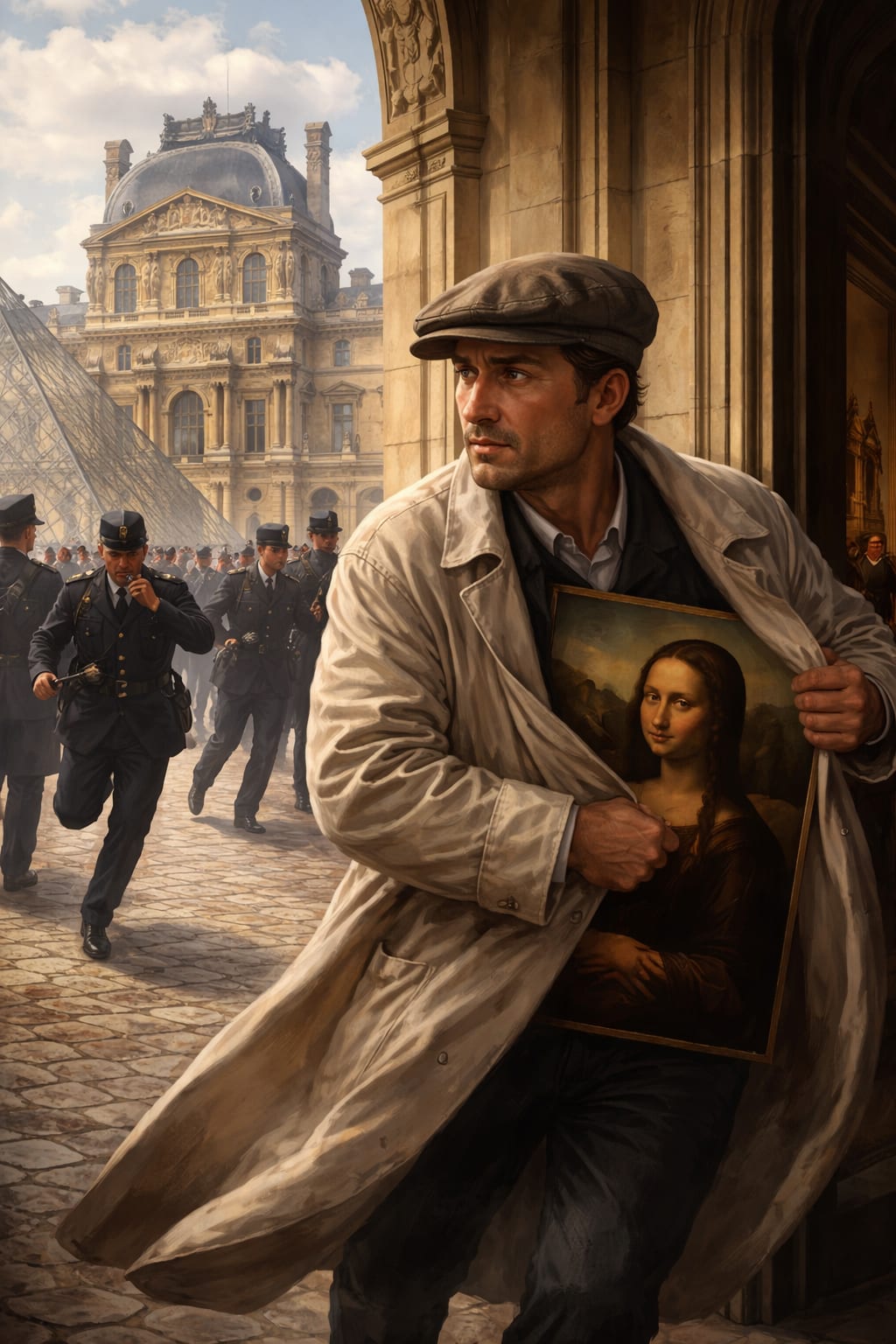
On an ordinary morning in Paris, the world’s most famous museum became the stage for an extraordinary crime. The Louvre, a symbol of culture, history, and artistic achievement, once fell victim to a theft so bold and unexpected that it stunned the entire globe. What made this घटना even more shocking was not just what was stolen, but how easily it happened—right in the middle of the day.
It was August 21, 1911. The museum was closed to the public, as it often was on Mondays for maintenance and cleaning. Workers moved through the halls as usual, tending to their duties. Among them was a man who did not belong—yet he blended in so well that no one questioned his presence. Dressed like a museum employee, he walked confidently through the galleries, carrying out a plan that would soon become legendary.
The target was a relatively modest painting at the time, not yet the global icon it would become: Leonardo da Vinci’s Mona Lisa. Hanging quietly on the wall, it did not draw the massive crowds it does today. In fact, many visitors passed by it without a second glance. This lack of attention made it the perfect target.
The thief simply removed the painting from the wall, reportedly taking it into a nearby stairwell. There, he detached it from its frame, concealed it under his clothing, and calmly exited the building. No alarms rang. No guards stopped him. The act was so simple that it seemed almost unbelievable.
It wasn’t until the following day that the theft was discovered. At first, museum staff assumed the painting had been removed for photography or maintenance. Hours passed before the alarming truth became clear: the Mona Lisa was gone. Panic spread quickly. The Louvre was shut down, and a massive investigation began.
News of the theft traveled rapidly across Europe and beyond. Newspapers published headlines questioning how such a prestigious institution could be so vulnerable. The story captured the public imagination, turning the missing painting into a worldwide sensation. Ironically, the theft gave the Mona Lisa a level of fame it had never experienced before.
The investigation was intense but initially fruitless. Authorities questioned artists, poets, and intellectuals, even suspecting well-known figures of involvement. The lack of immediate leads only deepened the mystery. For two years, the painting remained missing, and its whereabouts were unknown.
The truth, when it finally emerged, was both surprising and strangely simple. The thief was an Italian man who had once worked at the Louvre. His motive was not wealth or destruction, but a belief that the painting belonged in Italy. He kept the artwork hidden in his small apartment, reportedly storing it in a wooden trunk.
In 1913, he attempted to sell the painting to an art dealer in Florence, claiming he wanted to return it to its “rightful home.” The dealer, suspicious of the offer, contacted the authorities. The thief was arrested, and the Mona Lisa was recovered in remarkably good condition.
The painting was returned to the Louvre, where it was greeted with immense public excitement. Crowds gathered just to catch a glimpse of the artwork that had disappeared and reappeared in such dramatic fashion. From that moment on, its status as a cultural icon was firmly cemented.
This घटना exposed serious flaws in museum security at the time. It forced institutions around the world to rethink how they protected their collections. Today, the Mona Lisa is displayed behind bulletproof glass, constantly monitored, and surrounded by barriers. The casual vulnerability that once allowed its theft is long gone.
Yet, the story remains a powerful reminder that even the most secure places can have unexpected weaknesses. The theft of the Mona Lisa was not just a crime; it was a moment that reshaped the art world and transformed a painting into a legend.
In the end, what makes this story so fascinating is its simplicity. There were no elaborate gadgets, no high-speed escapes, no complex conspiracies—just a man, a plan, and an opportunity. And in broad daylight, one of the greatest treasures in human history simply walked out the door.
About the Creator
Irshad Abbasi
Ali ibn Abi Talib (RA) said 📚
“Knowledge is better than wealth, because knowledge protects you, while you have to protect wealth.
Keep reading
More stories from Irshad Abbasi and writers in History and other communities.
DNA Study Deepens Mystery of Skeleton Lake
High in the (Himalayas), at an altitude of over 5,000 meters, lies one of the world’s most haunting and puzzling sites—Roopkund Lake, often referred to as “Skeleton Lake.” For decades, scientists, historians, and explorers have been captivated by the hundreds of human skeletons scattered along its icy shores. Now, a groundbreaking DNA study has only deepened the mystery, raising more questions than answers about who these people were and how they died.
By Irshad Abbasi about 2 hours ago in History



Comments
There are no comments for this story
Be the first to respond and start the conversation.