
Sodium Salt Battery Market Impressive Growth at 19.8%
Sodium Salt Battery Market: Trends, Opportunities, and Future Outlook to 2035

Overview
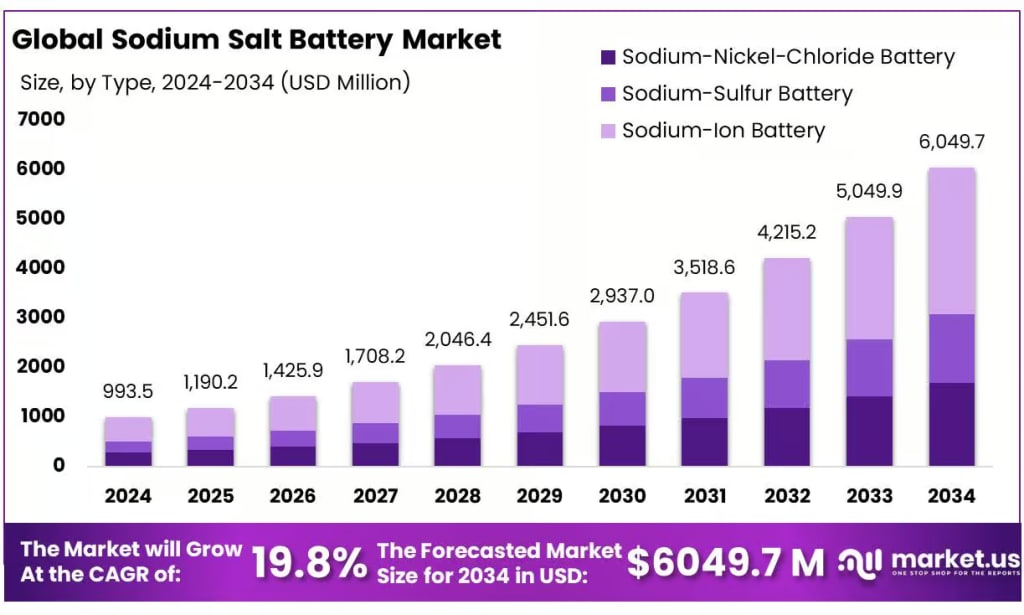
The global sodium salt battery market is projected to grow significantly, reaching around USD 6,049.7 million by 2034, up from USD 993.5 million in 2024, with a strong CAGR of 19.8% between 2025 and 2034. Asia Pacific leads the market, accounting for 48.9% share, valued at approximately USD 485.8 million.
In fact, global battery storage capacity saw rapid growth of about 120% in 2023, reaching 55.7 GW, with China contributing 27.1 GW and the United States 16.2 GW, highlighting the expanding opportunity for affordable battery technologies like sodium-based systems.
Government initiatives are a major structural driver. China’s “14th Five-Year Plan for New Energy Storage Development” targets more than 30 GW of new energy storage capacity by 2025, up from 3.3 GW in 2020, and explicitly calls for R&D into sodium-ion and other next-generation batteries.
Key Takeaways
- Sodium Salt Battery Market is expected to be worth around USD 6049.7 Million by 2034, up from USD 993.5 Million in 2024, and is projected to grow at a CAGR of 19.8%.
- Sodium-Ion Battery held a dominant market position, capturing more than a 49.7% share.
- Medium-Capacity Sodium Salt Batteries (5 kWh to 100 kWh) held a dominant market position, capturing more than a 47.6% share.
- Energy Storage System held a dominant market position, capturing more than a 48.1% share.
- Utilities held a dominant market position, capturing more than a 34.5% share.
- Asia Pacific is the dominating region in the Sodium Salt Battery market, holding 48.9% share and reaching USD 485.8 Mn.
Market Segments
By Type Analysis
In 2024, Sodium-Ion Batteries emerged as the leading segment, holding over 49.7% share. This growth was mainly driven by increasing demand for cost-effective alternatives to lithium-based batteries due to concerns around raw material availability and price fluctuations.
By Battery Capacity Analysis
In 2024, Medium-Capacity Sodium Salt Batteries (5 kWh to 100 kWh) dominated the market with more than 47.6% share. This segment is widely used across commercial buildings, telecom infrastructure, small industries, and community energy systems.
By Application Analysis
In 2024, Energy Storage Systems led the market, capturing over 48.1% share. This segment became the primary application for sodium salt batteries as utilities and commercial users focused on improving grid stability and integrating renewable energy sources.
By End Use Analysis
In 2024, Utilities held a leading position with more than 34.5% share. This dominance reflects the growing use of sodium salt batteries in grid operations, particularly for managing peak demand and supporting renewable energy integration.
Regional Analysis
Asia Pacific leads the Sodium Salt Battery market with a 48.9% share, valued at around USD 485.8 million. This dominance is mainly due to the region’s strong and well-established battery manufacturing ecosystem, where raw materials, cell production, and system integration are closely connected, helping reduce costs and speed up commercialization of new technologies like sodium-based batteries.
Top Use Cases
Grid-Scale Renewable Energy Storage: The biggest use case for sodium salt batteries is grid-scale energy storage. These batteries are well suited for storing solar and wind power and then releasing it when demand rises or generation drops. REN21 reported that global battery storage capacity grew by 120% in 2023 to reach 55.7 GW. China alone reached 27.1 GW, while the United States reached 16.2 GW.
Utility and Long-Duration Storage Projects: Sodium salt batteries are also being used by utilities for long-duration storage, peak shifting, and grid balancing. NGK says its NAS sodium-sulfur batteries have been installed at more than 250 locations worldwide, with total installed output of over 720 MW and total installed capacity of about 5,000 MWh.
Commercial and Industrial Energy Backup: Another strong use case is backup power and energy management for factories, industrial sites, and large commercial facilities. A good example is BASF’s Schwarzheide site in Germany, where NGK’s sodium-sulfur battery system entered operation in March 2024 with 1,000 kW output and 5,800 kWh capacity. According to NGK, the system helps BASF use renewable energy in manufacturing processes almost 24 hours a day by storing excess solar power and releasing it later.
Notable Company Developments
In 2025, GE Vernova reported strong financial performance with total revenue of $38.068 billion, free cash flow of $3.710 billion, and a backlog of $150.238 billion, reflecting a large pipeline of ongoing and upcoming grid and utility projects. This scale highlights significant opportunities to integrate sodium-based battery storage as a cost-effective and safe option, particularly in applications where high energy density is not a primary requirement.
Conclusion
The sodium salt battery market is steadily moving from early-stage development to real commercial adoption, especially in stationary energy storage and selected mobility segments. According to the International Energy Agency, global battery storage capacity reached around 55.7 GW in 2023, reflecting rapid expansion in grid-scale storage needs.
About the Creator
Hayden Kulas
I am blogger, digital marketing pro since 5 years and writes for Market.us. Computer Engineer by profession. I love to find new ideas that improve websites' SEO. He enjoys sharing knowledge and information about many topics.
Keep reading
More stories from Hayden Kulas and writers in Futurism and other communities.
Compressor Oil Market Rapid Growth at 5.3%
Overview Compressor Oil Market is expected to be worth around USD 17.1 billion by 2034, up from USD 10.2 billion in 2024, and is projected to grow at a CAGR of 5.3% from 2025 to 2034. The market is driven by rising industrialization, energy demand, and equipment efficiency needs. Artificial intelligence is transforming this field by enabling predictive maintenance, optimizing lubrication cycles, and improving compressor performance.
By Hayden Kulas7 days ago in Futurism
The Fears of AI And How Much Fun It Can Be
ChatGPT has come a long way, as has AI in general. There are those people who are scared of it, and for understandable reasons. People fear that as technologies advance, they’ll be replaced in the workforce. Then, there are the fears that AI could evolve into something that brings us to the brink of extinction.
By The Man Behind The Maska day ago in Futurism
Japan Induction Cooktop Market Insights: Compact Homes, Premium Appliances & Future Opportunities
Rising urbanization, smart technology integration, growing environmental consciousness, compact urban living requirements, and energy efficiency priorities are driving Japan's induction cooktop market, supported by IoT-enabled appliances, aging population demographics, government energy-saving initiatives, and consumer demand for safer, cleaner cooking solutions. According to IMARC Group's latest data, the Japan induction cooktop market size was valued at USD 1,444.7 Million in 2025. Looking forward, IMARC Group estimates the market to reach USD 2,878.5 Million by 2034, exhibiting a CAGR of 7.96% from 2026-2034. Built-in induction cooktops currently dominate the market as the preferred product type in 2025.
By Faisal Al-Harbi8 days ago in Futurism
Side Quest Goal Achieved: Placing an Alien Claim
This is a post that has me quite ecstatic. It's funny, I thought it was going to be one of my usual, "Hey, I achieved another one of my goals and checked it off" type deals. And it sort of is. But it sort of isn't. And it's also one of my greatest writing accomplishments of late.
By Stephen Kramer Avitabile5 days ago in Writers



Comments
There are no comments for this story
Be the first to respond and start the conversation.