
Japan Construction Market: Smart Infrastructure, Urban Redevelopment & Future-Ready Growth
The Japan construction market is evolving through smart technologies, sustainable practices, and data-driven project planning, improving efficiency and infrastructure resilience.

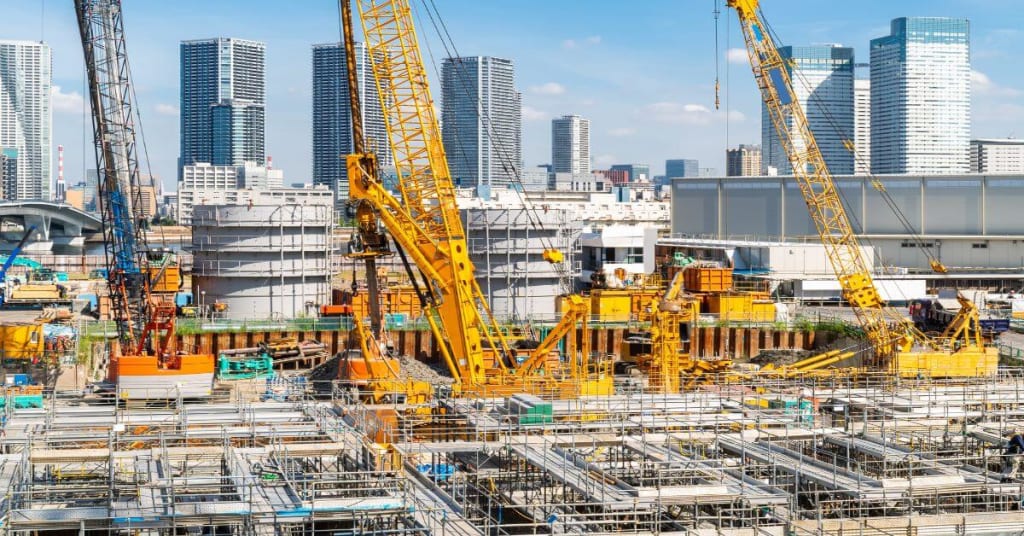
Japan construction market size reached USD 652.7 Billion in 2025. Looking forward, IMARC Group expects the market to reach USD 941.3 Billion by 2034, exhibiting a growth rate (CAGR) of 4.15% during 2026-2034. The rising adoption of novel technologies, such as data analytics and Building Information Modeling (BIM), which facilitate better planning, visualization, and coordination, is primarily driving the market growth.
Japan's construction sector is not the kind of market that makes headlines for flashy launches. It earns attention the harder way — through sheer scale, engineering precision, and a pipeline of public investment that rarely slows down. With a national budget of JPY 115.2 trillion (approximately USD 787.9 billion) approved for fiscal year 2025-26 and construction contracts rising by 9.9% year-on-year in the first five months of 2025, the industry is performing well above its long-run trend. Residential construction still leads the market with a 32% share, but it's the energy, infrastructure, and industrial sectors that are now driving the growth conversation — and each one has billions of dollars in committed government funding behind it.
Japan Construction Market Growth Drivers:
- Massive Government Infrastructure and Transport Investment
Japan's government has committed JPY 25.7 trillion (USD 200 billion) specifically toward high-speed rail construction, track doubling, electrification, and freight terminal upgrades between 2020 and 2030. The Chuo Shinkansen maglev line connecting Tokyo and Osaka is among the most ambitious civil engineering projects underway globally. Beyond rail, public construction investment reached approximately JPY 25.3 trillion (USD 190 billion) in fiscal year 2023 alone, with both public and private sector spending continuing to rise through 2024 and into 2025. Infrastructure is consistently one of the strongest demand segments, particularly for firms like Kajima, Obayashi, and Shimizu Corporation.
- Seismic Resilience Mandates and Retrofitting Demand
Japan's geography makes disaster resilience a non-negotiable construction priority, not a nice-to-have. Government assessments have identified 92,000 structures requiring urgent seismic reinforcement, triggering a multi-year retrofitting wave that keeps order books full for specialists in earthquake-resistant design. The National Resilience Plan channels multi-year funding into flood-control tunnels, bridge renewals, and quake-proof water pipelines across all prefectures. Critically, modern retrofit projects now bundle structural upgrades with smart monitoring, energy efficiency improvements, and demographic adaptations — turning what were once single-scope jobs into complex, higher-value urban renewal programs.
- Energy Transition and Semiconductor Industrial Buildout
Japan's renewable energy targets are generating a major construction pipeline. The government plans to expand offshore wind capacity from 4.6 GW to 45 GW by 2040, and solar from 74 GW to 150 GW — numbers that require thousands of new energy facility builds. Simultaneously, in November 2024, the government announced JPY 9.1 trillion (USD 65 billion) in semiconductor and AI infrastructure aid through 2030. Automakers Mazda and Nissan both announced major battery plant construction plans in early 2025 — a JPY 153.3 billion Nissan plant in Fukuoka and a 10 GWh Mazda facility in Iwakuni — directly feeding the industrial construction segment.
Japan Construction Market Trends:
- Digital Construction: BIM, AI, and Robotics at Scale
Japan's Federation of Construction Contractors has confirmed that adopting advanced digital tools can boost site productivity by up to 30% — a critical lever in a country facing an acute skilled-labour shortage. Leading contractors are responding fast. Obayashi Corporation began deploying battery-powered backhoes in April 2024, targeting a 46.2% CO2 reduction against 2019 levels. Kajima's multi-machine autonomous control system keeps construction moving with leaner crews. In February 2025, INFRONEER Holdings and Accenture jointly launched INFRONEER Strategy & Innovation, combining digital asset management with construction field execution — one of the most visible examples of the construction-tech convergence reshaping how Japan builds.
- Green Building Standards and Sustainable Urban Development
Japan's path to carbon neutrality by 2050 is running directly through its construction sector. Energy performance codes that became universally enforceable in 2025 are pushing developers toward prefabricated, energy-efficient housing, CLT timber towers, and smart building packages. The Grand Green Osaka — a 24-hectare civic development near Osaka Station — opened in September 2024 as a prominent example of integrated urban green space and sustainability-first design. Shimizu Corporation is actively developing timber skyscraper prototypes to capitalize on incoming government wood-subsidy incentives, while Kajima opened its GEAR regional R&D hub in Singapore in August 2024 to accelerate green construction innovation for Asian markets.
- Tourism-Driven Commercial Construction and Urban Regeneration
Record inbound tourism to Japan is reshaping commercial construction priorities. Hotel, hospitality, and mixed-use development pipelines in Tokyo, Osaka, and Kyoto are running at their highest levels in years, with Japan attracting over 36 million international visitors in 2024. The Torch Tower in Tokyo — set to become Japan's tallest skyscraper upon completion — exemplifies the scale of current commercial ambition. Meanwhile, hybrid work patterns are driving developers to redesign office space with co-working zones and flexible retail components built in from the ground up, creating a more complex and higher-value commercial construction segment than existed even five years ago.
Recent News and Developments in Japan Construction Market:
- March 2026: Kizuki constructs seismic-approved two-story 3D printed house using COBOD reinforced concrete over 50 square metres with 39 cubic metres material and four-person crew, reducing labor reliance.
- February 2026: MAX Co launches AI-enabled Autonomous Mobile Tying Robot with route planning and obstacle adaptation for rebar tying, boosting on-site productivity amid labor shortages.
- January 2026: iXs Co deploys i-Con Walker autonomous robot integrating real-time BIM for data automation, enhancing efficiency and enabling digital twin applications for infrastructure safety.
- December 2025: Shimizu deploys AI-driven Smart Site robots for real-time assessments, improving safety by minimizing high-risk exposure and supporting predictive hazard maintenance.
- November 2025: Kudan and TAKENAKA lead six firms in open software platform for interoperable robots handling transport, surveying and coating, accelerating industry adoption.
Note: If you require specific details, data, or insights that are not currently included in the scope of this report, we are happy to accommodate your request. As part of our customization service, we will gather and provide the additional information you need, tailored to your specific requirements. Please let us know your exact needs, and we will ensure the report is updated accordingly to meet your expectations.
About the Creator
Kishan Kumar
My name is Kishan Roy and I am a market analyst having 5 years of experience and a skilled researcher with a keen eye for consumer trends and data-driven insights.
Keep reading
More stories from Kishan Kumar and writers in Futurism and other communities.
Saudi Arabia Cloud Kitchen Market: Digital Dining, Delivery Boom & Scalable Growth
The Saudi Arabia cloud kitchen market size reached USD 1,085.7 Million in 2025. Looking forward, IMARC Group expects the market to reach USD 2,799.4 Million by 2034, exhibiting a growth rate (CAGR) of 11.10% during 2026-2034. The industry is fueled by surging demand for food delivery services, growing smartphone penetration, and expanding urban population. Online ordering, convenience, and cost-efficient business models for restaurant operators are also significant drivers boosting the Saudi Arabia cloud kitchen market growth.
By Kishan Kumar13 days ago in Futurism
The Fears of AI And How Much Fun It Can Be
ChatGPT has come a long way, as has AI in general. There are those people who are scared of it, and for understandable reasons. People fear that as technologies advance, they’ll be replaced in the workforce. Then, there are the fears that AI could evolve into something that brings us to the brink of extinction.
By The Man Behind The Maska day ago in Futurism
Space-Based Geoengineering: Can We Cool the Earth from Orbit?
As global temperatures continue to rise, the conversation around climate intervention is becoming more urgent—and more unconventional. Among the most ambitious ideas is space-based geoengineering: using structures placed in orbit to reduce the amount of solar energy reaching Earth. It sounds like science fiction, but researchers have been seriously exploring whether cooling our planet from space could one day become a viable option.
By Holianyk Ihora day ago in Futurism



Comments
There are no comments for this story
Be the first to respond and start the conversation.