
How LinkedIn Replaced Five Feed Retrieval Systems with One LLM Model
look at how artificial intelligence simplified content recommendations for a platform serving over one billion users.

You
Introduction
Modern social media platforms rely heavily on recommendation systems. These systems decide which posts, articles, and updates appear in a user’s feed. For large platforms, this task is complex because millions of new pieces of content are created every day.
LinkedIn faced a similar challenge as its user base grew to more than 1.3 billion members. Engineers needed to manage massive amounts of data while delivering relevant content quickly. Over time, the platform built several systems to retrieve potential posts for a user’s feed.
Eventually, maintaining multiple systems became difficult. Engineers decided to redesign the architecture by replacing several separate retrieval pipelines with a single large language model (LLM) based system.
This change represents an important example of how artificial intelligence is transforming large-scale recommendation systems.
The Role of Feed Retrieval Systems
Before understanding the new system, it helps to look at how feed retrieval works.
When a user opens a social platform, the system must choose from millions of possible posts. Instead of evaluating every piece of content, platforms use a multi-stage pipeline.
The first stage is called retrieval. During this step, the system selects a smaller group of candidate posts from a much larger pool. These candidates are later ranked and filtered.
For many years, LinkedIn relied on several retrieval methods at the same time. These included keyword search, collaborative filtering, popularity signals, and other algorithmic techniques.
Each system focused on a different type of signal. Some emphasized trending posts, while others looked at connections, interests, or professional activity.
While this approach worked for a time, it became harder to manage as the platform expanded.
The Problem with Multiple Systems
Running multiple retrieval systems created several operational challenges.
First, each system required separate infrastructure and maintenance. Engineers had to monitor performance, update models, and manage data pipelines independently.
Second, combining the outputs from different systems added complexity. Each retrieval method produced its own set of candidate posts, and the ranking system had to merge them.
Third, these systems often relied on structured signals rather than understanding the full meaning of content. As the volume of posts increased, traditional approaches struggled to capture deeper relationships between topics and user interests.
With the rapid growth of the platform, LinkedIn engineers began exploring whether a unified approach could simplify the process.
Moving Toward an LLM-Based System
The solution came from advances in large language models.
LLMs are trained on large amounts of text data and can learn semantic relationships between words, topics, and contexts. This makes them useful for understanding both user behavior and content meaning.
LinkedIn engineers experimented with a system that could encode both users and posts into the same representation space. Instead of separate retrieval pipelines, a single model could match user interests with relevant content.
The model was built using technology related to the LLM family, including architectures similar to LLaMA 3.
By fine-tuning the model on platform activity data, the system learned patterns of engagement such as likes, comments, and reading behavior.
This allowed the platform to predict which posts might interest a particular user.
Understanding the New Retrieval Model
In the new architecture, the LLM creates numerical representations called embeddings for both users and posts.
A user’s embedding is generated from information such as:
profile details
professional interests
skills and industry
past interactions with posts
Similarly, each post receives its own embedding based on its text and metadata.
The system then compares these embeddings to find the closest matches. Posts with embeddings similar to the user’s embedding become candidates for the feed.
This method allows the platform to perform retrieval using semantic understanding instead of relying only on keywords or explicit rules.
The approach also enables the system to understand topics even when different wording is used.
Retrieval and Ranking in One Model
One notable feature of LinkedIn’s approach is that retrieval and ranking can occur within the same model.
Traditionally, these were separate steps. Retrieval generated candidates, and ranking models evaluated them later.
In the LLM-based system, the model’s similarity calculations act as both retrieval and an early ranking signal.
Engineers sometimes describe this design as retrieval-as-ranking. Instead of running multiple pipelines, the system identifies relevant content and provides a first scoring layer in a single operation.
This simplifies the architecture and reduces the number of independent systems needed to run the feed.
Handling Massive Scale
Scaling such a system for more than a billion users requires careful infrastructure planning.
LinkedIn moved parts of its retrieval stack from CPU-based systems to GPU-based processing. GPUs are well suited for the vector calculations used in embedding models.
The system indexes tens of millions of posts and retrieves candidates in less than a fraction of a second.
To maintain speed, engineers also used techniques such as model compression and quantization. These methods reduce the computational cost while preserving accuracy.
For example, some models were reduced from hundreds of millions of parameters to smaller versions with minimal loss in relevance.
These optimizations allow the system to serve millions of feed requests every hour.
Learning from User Engagement
One of the advantages of the LLM-based approach is that it learns directly from user behavior.
Every action on the platform becomes a signal. When users like, comment on, or read posts, those interactions help train the system.
Over time, the model improves its understanding of what types of content are meaningful for different professional audiences.
Instead of relying only on manually designed features, the system learns patterns automatically from data.
This shift reflects a broader trend in machine learning, where models learn representations from large datasets rather than relying on handcrafted rules.
Benefits of the Unified System
Replacing multiple retrieval systems with a single model offers several benefits.
Simplified infrastructure:
Maintaining one core model is easier than managing several separate pipelines.
Improved relevance:
Semantic understanding helps the system recommend posts that match a user’s professional interests more closely.
Better scalability:
GPU-based infrastructure and optimized models allow the platform to handle growing data volumes.
Faster development:
Engineers can focus on improving one system instead of updating several independent algorithms.
These advantages help the platform keep its feed responsive while continuing to expand.
Challenges and Considerations
Despite its benefits, building an LLM-based retrieval system also introduces challenges.
One issue is computational cost. Training and serving large models requires significant hardware resources.
Another concern involves data privacy. Platforms must carefully manage how user data is used to train recommendation models.
Transparency is also an important topic. Users may want to understand why certain posts appear in their feed.
Companies must balance technological innovation with responsible data practices and clear communication.
What This Means for Social Platforms
LinkedIn’s approach reflects a broader shift across the technology industry.
Recommendation systems are gradually moving from rule-based pipelines toward AI-driven models that can learn complex relationships from data.
Other social networks, streaming services, and e-commerce platforms are exploring similar techniques.
Large language models provide a flexible way to represent users, content, and interactions in a unified format.
This reduces the need for multiple specialized systems while improving personalization.
Lessons for AI Engineers
The redesign of LinkedIn’s feed infrastructure offers several lessons for engineers and technology leaders.
First, large-scale AI systems require more than advanced models. Infrastructure, data pipelines, and hardware optimization are equally important.
Second, simplifying architecture can improve reliability. Replacing multiple systems with a unified model reduces operational complexity.
Third, domain-specific training data plays a critical role. Models trained on real user interactions can provide more relevant recommendations.
Finally, scaling AI solutions requires constant iteration. Compression, distillation, and infrastructure improvements are often necessary to make models practical for production environments.
Conclusion
The transformation of LinkedIn’s feed retrieval system shows how artificial intelligence is reshaping large-scale digital platforms.
By replacing five separate retrieval systems with a single large language model, the platform simplified its infrastructure while improving the relevance of content recommendations.
The new system uses embeddings, GPU-based processing, and engagement data to match users with posts that reflect their professional interests.
As platforms continue to grow, unified AI models may become the standard approach for managing complex recommendation tasks.
LinkedIn’s experience demonstrates that with careful design and infrastructure planning, large language models can operate at the scale of billions of users while supporting fast and personalized content delivery.
About the Creator
Saad
I’m Saad. I’m a passionate writer who loves exploring trending news topics, sharing insights, and keeping readers updated on what’s happening around the world.
The Social Execution
I woke up six months later in a sterile room that smelled of bleach and lost hope. Consciousness didn't return all at once; it arrived in agonizing increments, a slow-motion reconstruction of a man who had been shattered into a million jagged pieces. For weeks, the world was nothing but the rhythmic hiss of a ventilator and the fluorescent hum of a ceiling I hadn't designed. When I finally found the strength to open my eyes, I didn't recognize the landscape of my own body.
By Nathan McAllistera day ago in Futurism
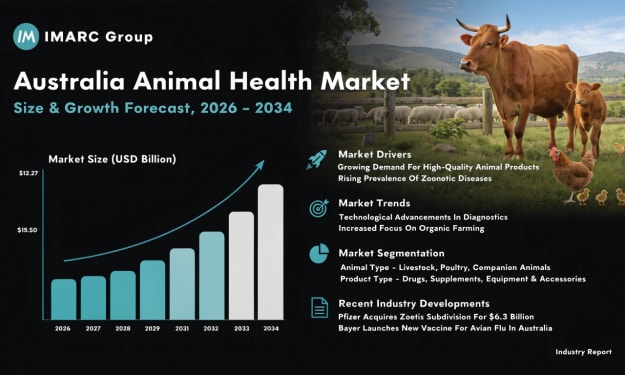
Australia Animal Health Market: Companion Animal Care Expansion, Livestock Disease Management & Veterinary Technology Innovation
According to IMARC Group, the Australia animal health market reached a value of USD 801.6 Million in 2025 and is projected to reach USD 1,025.3 Million by 2034, growing at a compound annual growth rate (CAGR) of 2.69% during 2026–2034. The market is expanding steadily as rising pet ownership, increasing demand for livestock health management and growing awareness of animal welfare continue shaping the industry landscape. Australia’s strong agricultural and livestock sectors rely heavily on effective veterinary healthcare solutions to ensure animal productivity and disease prevention. At the same time, the increasing popularity of companion animals such as dogs and cats is encouraging pet owners to invest in advanced veterinary care, preventive medicines and nutritional supplements. Technological advancements in veterinary diagnostics, pharmaceuticals and digital health monitoring tools are further supporting the development of the animal health industry. Government biosecurity initiatives and regulatory frameworks are also strengthening disease surveillance and prevention programs across the country.
By Shrestha Roy4 days ago in Futurism



Comments
There are no comments for this story
Be the first to respond and start the conversation.