
Global Masterbatch Market Trends: Advanced Additives, Eco-Friendly Plastics & Forecast to 2034
How expansion in automotive, packaging, and consumer goods sectors is fueling demand for advanced masterbatches and eco-conscious polymer solutions.

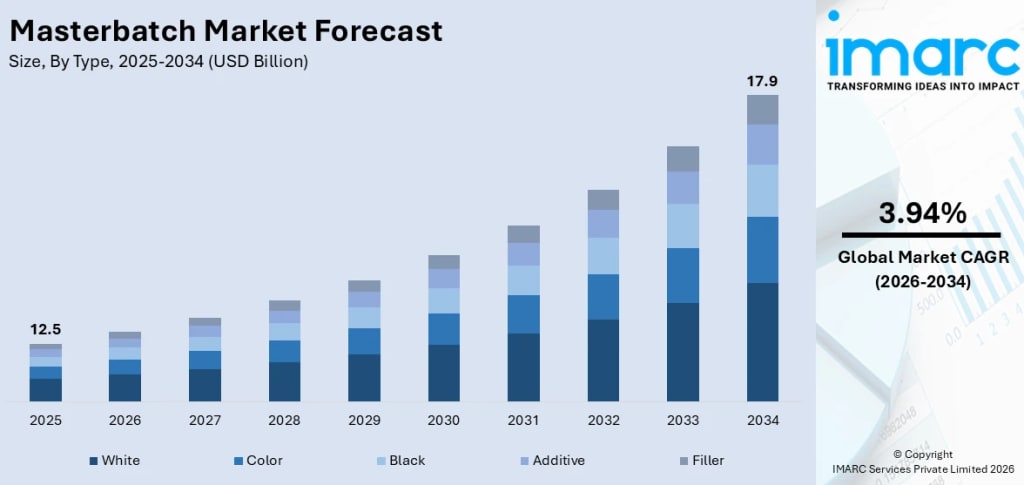
Masterbatch sits at the quiet intersection of virtually every manufacturing sector — packaging, automotive, construction, agriculture, textiles — and its importance only grows as plastic applications multiply and quality standards tighten. From the white opacity in a yogurt tub to the UV stabilizers protecting irrigation pipes baking under an Indian summer sun, masterbatches are the unsung workhorse of modern polymer processing. The market is being shaped by rising demand for food-safe packaging, a global construction boom, and an industry-wide pivot toward sustainable and bio-based solutions. According to IMARC Group’s latest data, the global masterbatch market size reached USD 12.5 Billion in 2025. Looking forward, IMARC Group expects the market to reach USD 17.9 Billion by 2034, exhibiting a CAGR of 3.94% during 2026–2034. Asia Pacific currently dominates the global market, driven by explosive growth across packaging, textile, and automotive end-use industries.
The masterbatch industry spans a wide range of product types — color, white, black, additive, and filler — with white masterbatch commanding the largest share thanks to its role in delivering opacity, brightness, and blendability across packaging, consumer goods, and pharmaceutical applications. On the polymer side, polypropylene (PP) leads consumption, valued for its chemical stability, heat resistance, and versatility across industries. Packaging is the single largest application segment, accounting for roughly a third of global demand, while building and construction, automotive, agriculture, and textiles round out a diversified end-use base. Dust-free pellet form, precise additive dispersion, and safer chemical handling are the practical advantages that continue to pull converters away from conventional pigments and toward masterbatch solutions.
Evaluate Market Potential Before You Invest – Get the Report Sample
Masterbatch Market Growth Drivers:
Soaring Demand for Food Packaging and Shelf-Life Enhancement
Food packaging is one of the clearest and most consistent demand drivers in this market. The global food packaging industry was valued at approximately USD 385 billion, and masterbatches are integral to making that packaging work — not just look good. Beyond color and shelf appeal, they deliver barrier properties that block oxygen, moisture, and UV light, directly extending product shelf life. Regulatory requirements for direct-food-contact safety are also rising, pushing manufacturers toward specialist formulations like those introduced by Tosaf Color Service, whose universally applicable masterbatch carrier system was specifically engineered to meet global food contact compliance standards.
Plastics Replacing Metals in Automotive Manufacturing
The automotive industry’s shift from metal to plastic is a structural tailwind for masterbatch demand. Lighter plastic components improve fuel efficiency and cut emissions — a priority that only intensifies as EV adoption grows and emission regulations tighten globally. Black masterbatch, in particular, is essential for automotive plastic parts, delivering UV protection, thermal stability, and mechanical strength. The U.S. Department of Energy has highlighted lightweight plastics as a key lever for improving vehicle energy efficiency. Avient, for instance, showcased durable orange nylon colorants specifically designed for EV connectors at Chinaplas, reflecting the direct link between EV growth and masterbatch specialization.
Urbanization and Construction Boom Across Asia Pacific
Asia Pacific’s urbanization wave is creating sustained demand for construction plastics — and by extension, for masterbatches. China’s urbanization rate reached 66.16% in 2023 and continues to rise, translating directly into greater use of plastic pipes, fittings, panels, and insulation across residential and commercial projects. Masterbatches ensure these materials meet weather resistance, strength, and aesthetic requirements. The global modular construction market is expected to reach USD 137.2 billion, and plastic components in modular builds — which require color consistency and functional additive performance across identical units — represent a particularly fast-growing application area for masterbatch producers.
Masterbatch Market Trends:
Sustainability and Circular Economy Reshaping Product Development
Sustainability has moved from a marketing claim to a procurement requirement. Recycled-content masterbatch adoption grew 6% year-on-year in 2024, and regulatory pressure from the EU’s Packaging and Packaging Waste Regulation is accelerating that shift further. Cabot Corporation’s REPLASBLAK circular black masterbatch — the industry’s first ISCC PLUS certified black masterbatch family — went from pilot to mainstream recognition, winning the CLEPA Innovation Award for its impact on automotive plastics traceability. Meanwhile, Copperprotek’s copper-infused masterbatch for food packaging inner layers, launched in early 2025, demonstrates how antimicrobial and sustainability goals can be tackled simultaneously through smart formulation.
Advanced Materials and High-Performance Formulations Gaining Traction
Innovation in masterbatch formulation is moving well beyond color. Graphene-enhanced masterbatches — like Black Swan Graphene’s S27M product, developed in partnership with Hubron International — integrate 10% graphene nanoplatelets into HDPE, delivering significant improvements in mechanical strength, electrical conductivity, and thermal stability without sacrificing recyclability. Thermal-stable masterbatch demand rose 7% in 2024. Ampacet’s expansion of its ELTech portfolio to include PBT-carrier masterbatches for optical fiber cable jacketing is another example of how niche, high-specification applications are pulling the industry toward more engineered, performance-driven solutions rather than commodity color concentrates.
Capacity Expansion and Regional Manufacturing Investment
Leading masterbatch producers are placing big bets on manufacturing proximity to fast-growing demand centers. Tosaf expanded North American production capacity by 40% across multiple sites, adding lines and laboratory capability to serve converters who need rapid formulation turnaround. Penn Color opened a world-class facility in Thailand’s Rayong Province to better supply Asia-Pacific markets with colorant and additive masterbatches. Modern Dispersions, Inc. expanded its Georgia operations to strengthen North American supply. These moves reflect a broader industry dynamic: buyers increasingly penalize supply gaps, and regional stocking — like Tosaf’s new UAE warehouse — is becoming a competitive differentiator alongside product quality.
Recent News and Developments in the Masterbatch Market
• January 2025: Copperprotek launched a copper-infused masterbatch designed for the interior layer of food packaging. The product leverages copper’s natural antimicrobial properties — releasing copper ions to inhibit bacterial growth — to reduce food waste and extend product safety. This development reflects the growing overlap between functional additive innovation and food safety regulation, particularly as regulators in Europe and North America impose stricter hygiene standards on food contact materials.
• July 2024: Black Swan Graphene launched the S27M graphene-enhanced masterbatch (GEM) in partnership with Hubron International, targeting sustainable packaging applications. The formulation blends 10% graphene nanoplatelets into HDPE, delivering superior mechanical performance and compatibility with recycled polyethylene — addressing both performance and circularity demands simultaneously. This collaboration highlights a broader industry trend of material science companies entering the masterbatch value chain to unlock new performance frontiers.
• May 2024: Chroma Color Corporation acquired Approved Color LLC, a U.S.-based manufacturer of color concentrates and masterbatches, in a strategic move to expand its portfolio and deepen its ability to serve a wider range of industries with customized solutions. The acquisition strengthens Chroma Color’s position in specialty color compounds and reflects the consolidation dynamic playing out across North American masterbatch supply chains as companies seek scale, capability breadth, and faster customer response times.
• November 2024: Sukano AG (Malaysia) entered into a strategic partnership with PlastiColors (South Africa) to meet growing demand for PET packaging masterbatch solutions across the African market. The partnership enables Sukano to extend its reach into a region with rapidly expanding food and beverage packaging requirements, while providing PlastiColors with access to Sukano’s advanced PET-specific masterbatch technology. This move underscores how emerging markets in Africa and the Middle East are becoming increasingly important growth destinations for global masterbatch suppliers.
Note: If you require specific details, data, or insights that are not currently included in the scope of this report, we are happy to accommodate your request. As part of our customization service, we will gather and provide the additional information you need, tailored to your specific
About the Creator
Suhaira Yusuf
I specialize in Consumer Insights, focusing on transforming detailed market data into strategic business solutions that accelerate growth and improve customer engagement.
Keep reading
More stories from Suhaira Yusuf and writers in Futurism and other communities.
Bromine Market Trends: Water Treatment Chemicals & Forecast to 2034
Bromine doesn’t get as much mainstream attention as lithium or silicon, but it quietly underpins a surprising range of critical industries — from fire-safe electronics and electric vehicle batteries to oil well drilling, pharmaceutical synthesis, and municipal water treatment. Tightening fire safety standards, rapid EV adoption, and mounting concerns over water contamination are all converging to drive steady demand for bromine and its derivatives across virtually every major economy.
By Suhaira Yusuf13 days ago in Futurism
The Fears of AI And How Much Fun It Can Be
ChatGPT has come a long way, as has AI in general. There are those people who are scared of it, and for understandable reasons. People fear that as technologies advance, they’ll be replaced in the workforce. Then, there are the fears that AI could evolve into something that brings us to the brink of extinction.
By The Man Behind The Maska day ago in Futurism
AI in healthcare Statistics and Facts 2026
Based on data from InsightMark Research, Artificial intelligence is now embedded across hospitals, clinics, diagnostic labs, and pharmaceutical research pipelines. The data from 2025 and early 2026 shows rapid adoption, measurable clinical improvements, and growing regulatory attention at the same time.
By Internet News Times3 days ago in Futurism




Comments
There are no comments for this story
Be the first to respond and start the conversation.