
Agentic AI for Data Engineering Market to hit USD 66.7 billion by 2034
"Agentic AI for Data Engineering Market Set for Strong Growth by 2034, Fueled by Technological Advancements and Rising Demand"


The Global Agentic AI for Data Engineering Market is projected to witness substantial growth, expanding from USD 2.7 billion in 2024 to USD 66.7 billion by 2034, registering a strong compound annual growth rate (CAGR) of 37.8% during the forecast period from 2025 to 2034.
North America holds a leading position in the market, accounting for more than 40.6% share in 2024, with revenue reaching approximately USD 1.0 billion. This growth is being driven by the increasing need for intelligent data pipelines, real-time analytics, and automation across enterprise data ecosystems.
Key Takeaways
- The market is projected to grow from USD 2.7 billion in 2024 to USD 66.7 billion by 2034, reflecting a strong CAGR of 37.8%.
- North America led the market in 2024, capturing more than 40.6% share and generating USD 1.0 billion in revenue.
- The U.S. market reached USD 0.87 billion in 2024 and is expected to grow at a CAGR of 35.8%.
- Data Integration applications dominated in 2024, accounting for over 32.6% of the market share.
- Large Enterprises held more than 70.7% share, driven by large-scale data operations and investment capacity.
- Cloud-Based deployment led the market with over 64.7% share, reflecting strong demand for scalable and flexible data infrastructure.
- Natural Language Processing (NLP) captured more than 40.4% share, enabling automated data transformation and query capabilities.
- The BFSI sector emerged as a major end user, holding 30.6% of the market share in 2024.
How Agentic AI is Transforming Data Engineering?
Agentic AI is redefining data engineering by enabling autonomous data workflows that can manage ingestion, transformation, and orchestration with minimal human intervention. These systems are designed to understand data patterns, optimize pipelines, and make real-time adjustments, significantly improving operational efficiency. With the integration of natural language processing and machine learning, data engineers are now able to interact with complex data systems using simple queries, reducing technical barriers and accelerating data-driven decision-making.
The evolution of agentic AI is also supporting the shift toward real-time and event-driven data architectures. Enterprises are increasingly adopting intelligent systems that can monitor data streams continuously, detect anomalies, and trigger automated responses. This capability is particularly valuable in high-volume environments where traditional data engineering approaches struggle to keep pace with growing complexity and scale.
Market Overview
The Agentic AI for Data Engineering Market is expanding rapidly due to the rising demand for automated and intelligent data management solutions. Organizations are dealing with massive volumes of structured and unstructured data, creating a need for advanced tools that can simplify data integration and ensure data quality. Agentic AI addresses these challenges by automating repetitive tasks such as data cleansing, schema mapping, and pipeline optimization, allowing teams to focus on strategic initiatives.
Demand is particularly strong in industries such as banking, financial services, and insurance, where real-time insights and data accuracy are critical. The adoption of cloud-based platforms is further accelerating market growth, as enterprises seek scalable and flexible solutions that support distributed data environments. As data becomes a core asset for business operations, the role of agentic AI in data engineering is becoming increasingly central.
Emerging Trend Analysis
A key emerging trend is the growing adoption of cloud-based agentic AI platforms for data engineering. Organizations are increasingly leveraging cloud infrastructure to deploy AI-driven data pipelines that can scale dynamically based on workload requirements.
This trend is enabling faster deployment, reduced infrastructure costs, and improved accessibility for distributed teams. Cloud-native architectures are also supporting the integration of multiple data sources, enhancing interoperability and data consistency across systems.
Driver Analysis
The primary driver of market growth is the increasing complexity of enterprise data ecosystems. As organizations generate and consume vast amounts of data, there is a growing need for intelligent systems that can automate data engineering processes.
Agentic AI provides the ability to manage complex workflows, reduce manual intervention, and improve data accuracy. This is particularly important in sectors where real-time analytics and decision-making are critical, driving the adoption of AI-powered data engineering solutions.
Restraint Analysis
Despite strong growth potential, the market faces challenges related to data governance and integration. Organizations often operate with legacy systems and fragmented data environments, making it difficult to implement unified AI-driven solutions.
Concerns around data privacy, compliance, and security also act as restraints, particularly in regulated industries. Ensuring that agentic AI systems align with governance frameworks and regulatory requirements remains a critical consideration for adoption.
Opportunity Analysis
There is significant opportunity in the BFSI sector, where the demand for real-time data processing, fraud detection, and risk analysis is driving the adoption of agentic AI solutions.
Financial institutions are increasingly leveraging AI to automate data workflows, enhance decision-making, and improve customer experiences. As digital transformation initiatives continue to expand, the need for intelligent data engineering solutions is expected to grow, creating new avenues for market development.
Challenge Analysis
A major challenge in the market is ensuring the reliability and transparency of AI-driven data processes. As agentic AI systems take on more autonomous roles, organizations must ensure that these systems operate accurately and provide explainable outputs.
The complexity of AI models and the potential for errors in automated workflows require robust monitoring and validation mechanisms. Addressing these challenges will be essential for building trust and ensuring the long-term success of agentic AI in data engineering.
Conclusion
The Agentic AI for Data Engineering Market is positioned for strong growth, driven by the increasing need for intelligent, automated data management solutions. North America continues to lead the market, supported by early adoption and advanced digital infrastructure.
As organizations prioritize data-driven strategies, the adoption of agentic AI is expected to accelerate, enabling more efficient, scalable, and real-time data operations. While challenges related to governance and system integration persist, ongoing advancements in AI technologies will continue to unlock new opportunities and shape the future of data engineering.
About the Creator
Roberto Crum
I am blogger, digital marketing pro since 4.5 years and writes for Market.us. Computer Engineer by profession. I love to find new ideas that improve websites' SEO. He enjoys sharing knowledge and information about many topics.
Keep reading
More stories from Roberto Crum and writers in Futurism and other communities.
Agentic AI in Law Enforcement and Surveillance Market to hit USD 73.8 Billion By 2034
Global Agentic AI in Law Enforcement & Surveillance Market Set for Rapid Expansion The Global Agentic AI in Law Enforcement & Surveillance Market is poised for significant growth, projected to increase from USD 2.8 billion in 2024 to USD 73.8 billion by 2034, reflecting a robust compound annual growth rate (CAGR) of 38.7% during the forecast period from 2025 to 2034.
By Roberto Crum4 days ago in Futurism
The Fears of AI And How Much Fun It Can Be
ChatGPT has come a long way, as has AI in general. There are those people who are scared of it, and for understandable reasons. People fear that as technologies advance, they’ll be replaced in the workforce. Then, there are the fears that AI could evolve into something that brings us to the brink of extinction.
By The Man Behind The Maskabout 18 hours ago in Futurism
Sensor Fusion Market Trends: Autonomous Systems Growth & Forecast to 2033
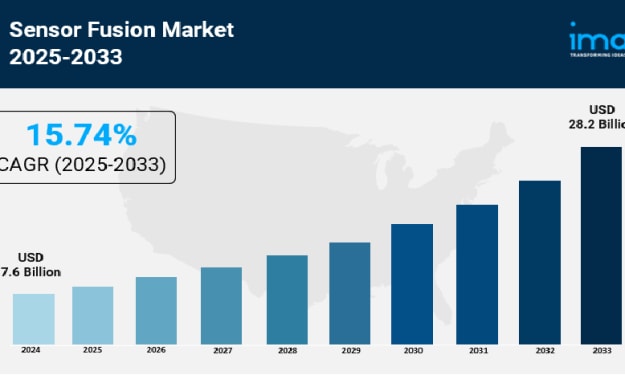
Rising adoption of IoT devices, growing demand for autonomous vehicles, and rapid advancements in AI-powered analytics are fueling the need for smarter, more integrated sensor technologies. According to IMARC Group's latest research, the global sensor fusion market size reached USD 7.6 Billion in 2024. Looking ahead, IMARC Group projects the market to reach USD 28.2 Billion by 2033, reflecting a CAGR of 15.74% from 2025 to 2033. Asia Pacific currently dominates the market, driven by investments in smart infrastructure, booming automotive electronics, and a strong push toward autonomous vehicle development and smart city deployment.
By Suhaira Yusuf6 days ago in Futurism



Comments
There are no comments for this story
Be the first to respond and start the conversation.