
Out of the “Blue”
New Film Follows a Young Woman’s Fall from Innocence Into the Digital Underworld

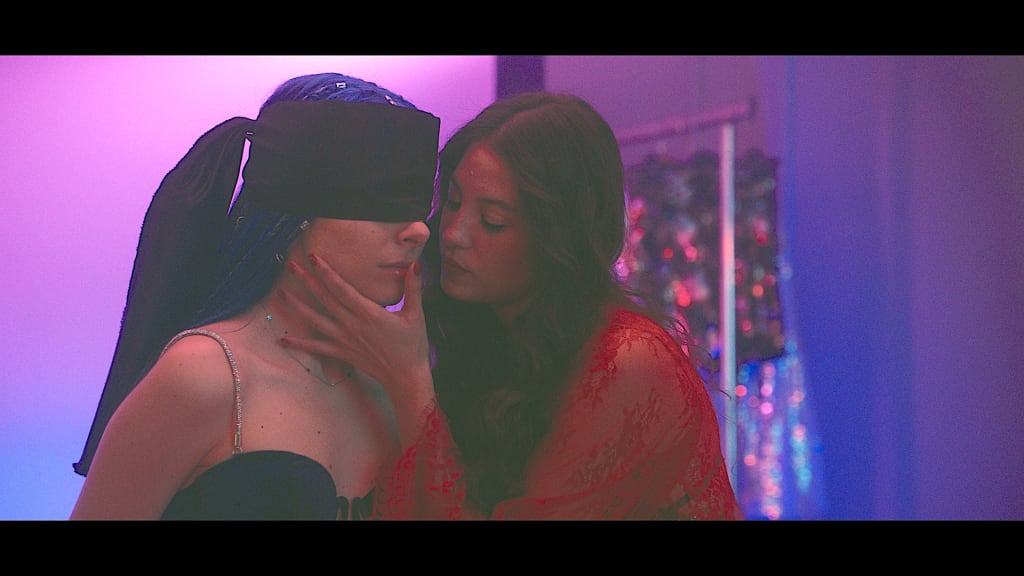
In an era where the line between online identity and real-life consequence grows increasingly blurred, Eleonora Puglia’s debut feature Blue arrives as a striking and deeply resonant piece of cinema. Released by Breaking Glass Pictures, this provocative international drama wastes no time immersing viewers in a world that feels both hyper-contemporary and unsettlingly familiar. What unfolds over the course of one fateful night is a cautionary tale, but also a compassionate and human portrait of a young woman caught in forces far bigger than she understands.
At the center of the film is Luce, played with remarkable vulnerability by Alexia Cozzi. Introduced as a bright, optimistic university student from a comfortable background, Luce is “in love with life,” her future seemingly wide open.

Her romance with Loris (Pierangelo Menci) initially feels like a grounding force, but when his financial troubles spiral into something dangerous, Luce’s world begins to fracture. Her desperation to help him sets the narrative in motion, leading her into the orbit of Vittoria (Shaen Barletta), a glamorous acquaintance whose lifestyle hints at secrets beneath the surface.
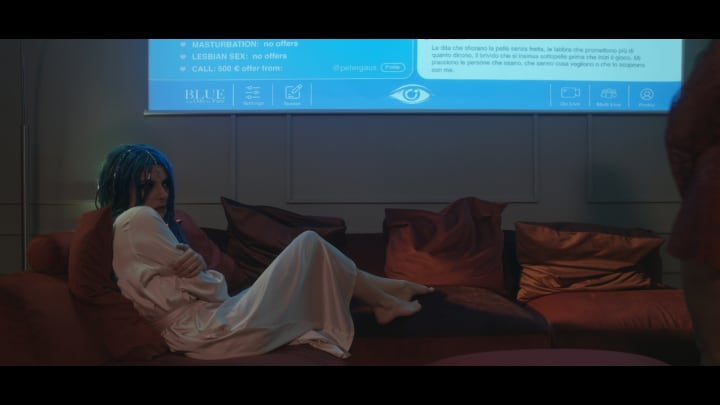
It is Vittoria who introduces Luce to “Blue,” an adult digital platform framed as harmless, even empowering. What makes Puglia’s storytelling so effective is her refusal to sensationalize. Instead, she carefully constructs the illusion that traps Luce: the idea that this is “just a game,” a quick solution to a pressing problem. As the night unfolds, that illusion steadily erodes, revealing a far more complex and emotionally devastating reality.
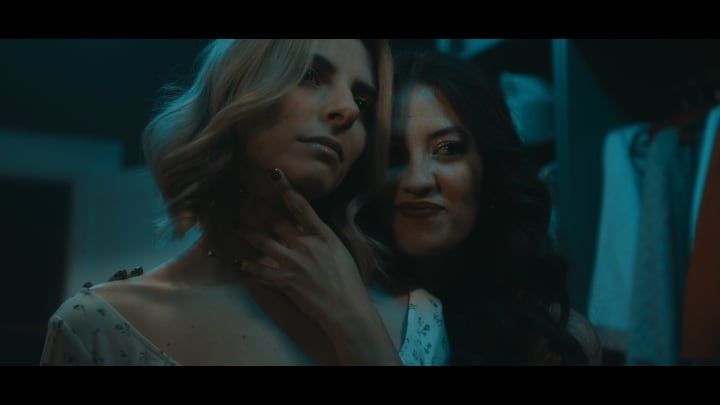
Much of Blue takes place within the confines of Vittoria’s apartment, a deliberate creative choice that heightens the film’s psychological intensity. The space itself becomes a character—mirrors reflecting fractured identities, moody lighting casting shifting shadows, and a circular bed symbolizing the inescapable cycles Luce finds herself caught in. The claustrophobic setting recalls the intimate tension of films like The Dreamers, yet Puglia makes it entirely her own, crafting an environment that feels both seductive and suffocating.
Cozzi’s performance anchors the film with emotional authenticity. She captures Luce’s gradual transformation with nuance, allowing the audience to feel every moment of confusion, fear, and reluctant acceptance. It’s a performance that never judges the character, instead inviting empathy and understanding. This is crucial to the film’s impact, as Blue is not interested in moralizing but in illuminating the complexities of choice in a digital age.
Adding an unexpected layer of depth is Rocco Siffredi as Luce’s father. Known for his real-life history in adult cinema, Siffredi’s casting brings a meta-textual resonance that enhances the film’s themes. His portrayal is grounded and sincere, embodying a generational perspective that struggles to comprehend the hidden digital lives of younger people. His presence underscores the emotional stakes beyond Luce’s immediate predicament, reminding us that the consequences of her choices ripple outward.

Director Eleonora Puglia demonstrates an impressive command of tone and pacing for a debut feature. She approaches the subject matter with sensitivity and clarity, ensuring that the film’s message never feels heavy-handed. Instead, Blue unfolds as a conversation—one that examines the seductive promise of autonomy offered by online platforms while quietly exposing the risks that accompany it.
What makes Blue particularly compelling is its timeliness. In a world where social media often blurs the boundaries between empowerment and exploitation, the film feels urgently relevant. Puglia explores how economic pressures, misinformation, and the allure of quick success can converge to create situations that seem empowering on the surface but carry lasting consequences. Yet she resists easy answers, instead encouraging viewers to grapple with the ambiguity.
Ultimately, Blue is a powerful and thought-provoking debut that lingers long after the credits roll. It challenges audiences to look beyond surface-level assumptions and engage with the realities faced by a generation navigating an increasingly complex digital landscape. With strong performances, evocative visuals, and a clear, compassionate vision, Eleonora Puglia has crafted a film that is as emotionally gripping as it is socially significant—a bold first step from a filmmaker with a voice worth watching.
About the Creator
Keep reading
More stories from Ben Nelson and writers in Filthy and other communities.
Leather, Lust, and Liberation
The gay adult film industry is entering 2026 with a renewed sense of confidence, creativity, and control over its own narrative. After years of rapid change driven by fan platforms, shifting ideas of masculinity, and a deeper emphasis on consent and performer autonomy, the business is no longer just about shock value. Instead, it’s about intentional kink, authentic fantasy, and storytelling that reflects the complexity of queer desire today.
By Ben Nelson3 months ago in Filthy
Delulu Dating Mindset Making Singles Ignore Red Flags In Relationships
The delulu dating attitude is a tendency in which one has unrealistic or optimistic expectations of a potential partner or relationship. It usually starts with a great wish to be loved, interrelated or approved of, which can distort judgment. People with this mentality might not judge a partner by his/her consistent behavior but with what the relationship would be instead of what it is at that particular moment.
By Mark Hipster6 days ago in Filthy
Friendfluence In Relationships How Friends Influence Dating Decisions And Compatibility
Friendfluence can be explained as the existing influence that friends can shape in the dating choices, romantic preferences and compatibility perceptions of an individual, in most cases, but it can be very subtle and influential. The friends tend to be reliable advisors in terms of whom to choose as your partner in the social life of the modern society, particularly among younger generations. Their views, experiences, and responses may influence the way a person perceives a possible relationship, and in some cases, personal judgment may not count as much as their views. This power may be direct or indirect through values and through social comparison.
By Mark Hipster3 days ago in Filthy


Comments (1)
Curious about this one. And I think porn actors often have an advantage in straight films: they are not at all self-concious about where a scene can go.