
The Shanghai Cipher
Two rivals. One manuscript. A city that kept every secret except the ones that mattered.

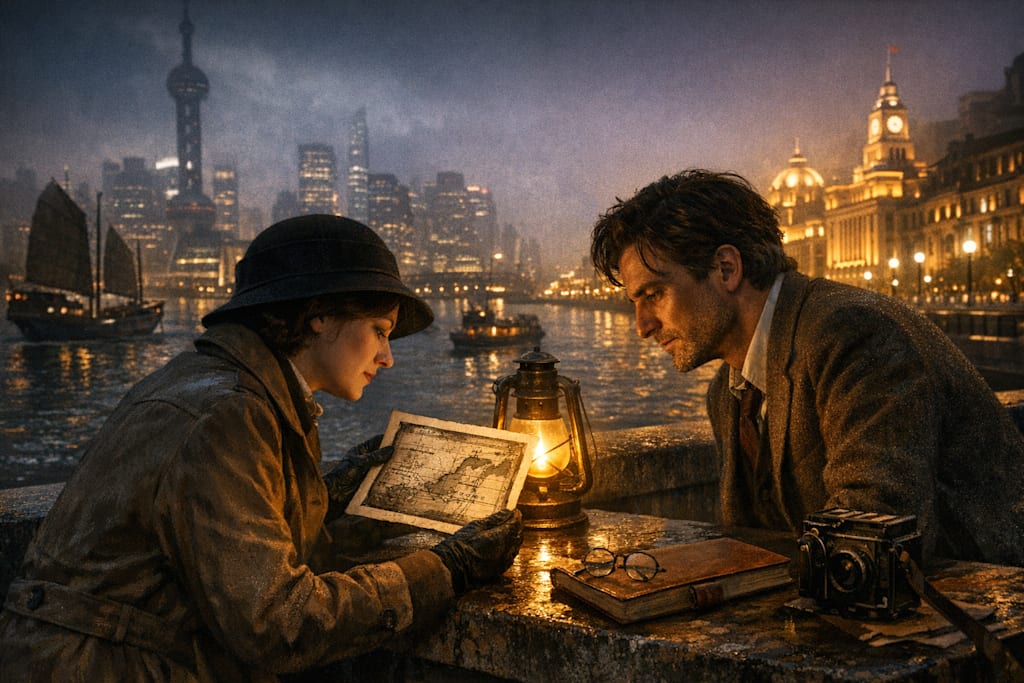
The manuscript had been missing for four hundred years before anyone thought to look for it in Shanghai.
This was, Dr. Nora Ashworth reflected, either a stroke of genuine insight or the kind of desperate reasoning that passed for insight when you had been chasing something long enough that the chase itself had become the point. She stood on the Bund in the October rain of 1924, her coat doing its inadequate best against a wind coming off the Huangpu that smelled of diesel and river mud and the particular industrial ambition of a city that had decided to become the future before the future had finished deciding what it was, and looked at the address written in her notebook.
The address belonged to a man she had spent six years disagreeing with in print.
Dr. James Calder — Oxford, insufferable, demonstrably wrong about the provenance of the Dunhuang scrolls and absolutely unwilling to admit it — had apparently arrived in Shanghai three weeks before her, following, she could only assume, the same chain of evidence through the same succession of libraries and private collections and inconveniently dead scholars that had brought her here. The chain ended, as chains in this city tended to, at the waterfront. At a particular warehouse. At a particular man who had, according to the last letter in the series, seen the manuscript and would speak only in person and only to someone who could demonstrate sufficient knowledge to make the conversation worthwhile.
The letter had been addressed to Calder.
Nora had, after some consideration, intercepted it.
She was not particularly proud of this. She was also not particularly repentant. The manuscript — a twelfth-century Arabic text believed to contain navigational charts of a coastline that should not, by any reasonable geographic history, have been chartable in the twelfth century — was important enough that pride and repentance were luxuries she couldn't afford. If Calder got there first and published, she would spend the remainder of her career citing his work. She found this outcome significantly less acceptable than the minor ethical irregularity of mail interception.
She knocked on the door of the address.
James Calder answered it.
He looked, she thought with involuntary fairness, exactly like a man who had been in Shanghai for three weeks without sleeping enough. Which was to say he looked essentially as he always looked — rangy and slightly unkempt, with the kind of face that had probably been handsome before it got permanently preoccupied — but with additional shadows under his eyes and the specific alertness of someone who has recently been in at least one situation requiring alertness.
He looked at her for a long moment.
"You intercepted my letter," he said.
"I found your letter," Nora said. "The distinction is—"
"Meaningless," Calder said. "How did you know where I was staying?"
"The same way I know most things. I asked questions until someone answered them." She met his gaze with the composure she had spent fifteen years developing as a woman in a field that preferred its women decorative and absent. "Are you going to let me in or are we going to have this conversation in the rain, which I would prefer not to do."
He stepped back from the door.
The room was small and extremely organized in the way of someone whose natural state was chaos but who had imposed order on himself out of necessity. Papers covered the table in a pattern that looked random and probably wasn't. A map of the city was pinned to the wall with four points circled in red ink. On the windowsill, a cup of tea had been forgotten into cold.
Nora took off her coat and hung it on the hook that was there for that purpose and looked at the map.
"You've identified four locations," she said.
"I've identified four locations," Calder confirmed, from behind her, with the tone of a man deciding how annoyed to be. "You've been in the city how long?"
"Six hours."
"And you've already — never mind." She heard him sit down. "The manuscript was brought to Shanghai in 1899 by a French collector named Beaumont who died owing money to a significant number of people. His estate was distributed in ways that were not entirely documented. I've traced three transfers of ownership but the fourth—"
"Goes through a man named Wei Longshan," Nora said, turning from the map. "Who operates out of the waterfront district and who does not speak to foreigners as a general policy but has been known to make exceptions for people who demonstrate specific knowledge of what they're looking for." She paused. "I believe you have a meeting with him."
"I had a meeting with him," Calder said. "Tomorrow evening. Which you presumably know because you read my letter."
"Found," Nora said.
"The semantic—"
"Is doing a great deal of work, yes, I know." She sat down across from him, uninvited, and folded her hands on the table in the manner of someone opening a negotiation they intend to win. "Here is the situation as I see it. You have the meeting. I have the knowledge of Arabic navigational manuscript traditions from the twelfth century that Wei Longshan will almost certainly use to test whether this conversation is worth his time, which you — and I say this with professional respect — do not have. Your Arabic is functional. Mine is native equivalent. Your knowledge of the relevant period is general. Mine is specific to the degree that I wrote the paper that everyone in this field is currently wrong about."
"I'm not wrong—"
"You are wrong, and we can have that argument later, but right now I'm making a point." She looked at him levelly. "You need me at that meeting. I need access to the meeting. These are the facts."
Calder looked at her with an expression she had seen on his face in photographs from conferences — the look of a man running calculations he doesn't particularly want to run, arriving at an answer he doesn't particularly want to arrive at.
"You're proposing a collaboration," he said. The word had the sound of something he'd never expected to say to her specifically.
"I'm proposing a temporary strategic alliance," Nora said. "With clearly defined terms and an explicit agreement that publication credit will be determined by the evidence when the evidence is complete."
"And if the evidence favors your interpretation?"
"Then the evidence favors my interpretation. I don't require you to agree with me in advance. I require you to acknowledge the possibility."
A long pause. Rain against the window. Somewhere below, the city produced the layered sound of itself — Shanghainese and English and the horn of a river vessel and the specific percussion of a city that never fully slept.
"Fine," Calder said. "But I'm leading the meeting."
"Of course," Nora said, with the serenity of someone who has already decided this is a variable she can work with.
Wei Longshan's warehouse occupied a position on the waterfront that managed to be simultaneously visible from the street and somehow difficult to locate when you were looking for it — a quality that Nora attributed to the subtle genius of its placement between two buildings whose street numbers were not sequential in any way that a newcomer would anticipate.
Wei himself was perhaps seventy, with the quality of stillness that Nora had encountered in scholars of a certain age and disposition — the stillness not of inactivity but of a person who had learned that most motion was unnecessary. He received them in a room at the back of the warehouse where the contents of the shelves surrounding them represented, Nora estimated in a rapid assessment, enough cultural heritage to stock a medium-sized museum.
He looked at Calder. He looked at Nora. He said something in Shanghainese that Nora's knowledge of Mandarin allowed her to partially parse as a question about their relationship.
Calder looked at Nora.
"Colleagues," Nora said, in Mandarin, which was not Shanghainese but was received with a slight nod of acknowledgment. "We are looking for the Beaumont manuscript. We believe you have seen it."
Wei regarded her with the attention of someone used to evaluating what people knew and what they merely thought they knew. Then he said, in careful English that indicated he had understood everything from the beginning: "Tell me what the manuscript contains."
Nora told him. She spoke for twelve minutes, in the specific register of someone who has spent a decade thinking about a single subject — not performing knowledge but simply deploying it, the way you use a tool you've carried long enough that it feels like part of your hand. She described the navigational traditions of the twelfth-century Arab maritime world. She described the anomaly that the manuscript, if authentic, represented. She described the implications — geographic, historical, civilizational — of a chart that documented coastlines no twelfth-century cartographer should have been able to document.
When she finished, Wei Longshan looked at her for a moment. Then he looked at Calder.
"Your colleague," he said, "knows the manuscript."
"She does," Calder said, with a brevity that cost him something she could hear.
Wei stood. He crossed to a cabinet that was locked with a mechanism Nora recognized as nineteenth-century French — Beaumont's, almost certainly — and produced from it not the manuscript itself but a photograph. Black and white, taken with a camera whose quality was better than most, showing a page of Arabic script overlaid with a series of lines and measurements that were unmistakably navigational in character.
"The manuscript was sold eighteen months ago," Wei said. "I photographed it before the sale. The buyer I will not name. But the photograph I will give you." He looked at Nora. "Because you know what you are looking at."
He handed her the photograph.
They walked back along the Bund in silence that was, for the first time since she'd knocked on his door, not adversarial but simply shared — the silence of two people processing the same information from slightly different positions.
Nora was studying the photograph under the inadequate light of the street lamps, which was not ideal for studying anything but was what was available, and she was seeing what she had expected to see and also something she had not.
"The coastline in the lower quadrant," she said.
"I see it," Calder said.
"It's not Africa."
"No," he said.
"It's not any coastline in the Arab maritime world's established range of the twelfth century."
"No," he said again.
They stopped walking at the same moment, which neither of them acknowledged, looking at the photograph in the amber light of a lamp that flickered with the wind off the river.
"It's consistent," Nora said carefully, "with a Pacific coastline."
The word sat between them with the weight of something that, once said, rearranges everything behind it. Calder said nothing for long enough that Nora looked up from the photograph to check that he was still there.
He was looking at the river. At the ships on it — the junks and the steamers and the cargo vessels from a dozen countries, all moving through the same water with the purposeful indifference of commerce. The Huangpu running to the Yangtze running to the sea, the same water that connected, if you followed it far enough, everything to everything.
"If it's authentic," he said, "then someone reached the Pacific coast three centuries before—"
"Before the history we have says anyone did," Nora finished.
Another silence. Longer.
"The buyer," Calder said. "Wei won't name them."
"Wei won't name them to us," Nora said. "But Wei named them to someone. The photograph exists, which means Wei documented the transaction, which means somewhere there's a record." She turned to look at the city behind them — Shanghai in its 1924 density, its layered jurisdictions and its competing empires of commerce and its absolute talent for keeping and also for leaking secrets. "This city knows where things go."
"This city," Calder said dryly, "knows everything and tells nothing."
"It tells things," Nora said. "You just have to know which questions to ask and in what language." She folded the photograph carefully and placed it in her inside pocket. "I speak six."
She began walking again. After a moment, she heard his footsteps resume behind her, then alongside her, and they walked together along the Bund with the Huangpu on one side and the city on the other and the manuscript somewhere ahead of them in the dark — further than they'd been this morning and closer than they'd been six years ago and moving, now, in the same direction.
They found the buyer in the third week.
He was a Portuguese shipping merchant named Carvalho who had purchased the manuscript as an investment and stored it in a bank vault with the same indifferent functionality with which he stored everything else of value — not knowing what he had, not particularly wanting to know, interested primarily in the appreciation of assets over time.
The negotiation for access was Calder's work. He had, Nora had been forced to admit across three weeks of close quarters collaboration, a talent for the social engineering of reluctant men that she lacked — a patience for small talk and misdirection that she found difficult to sustain but recognized as essential. She could not have gotten them into the vault. She could not have moved Carvalho from polite refusal to grudging permission through the medium of three dinners and a conversation about cricket that she would have found intolerable.
What she could do, when they sat in the vault room with the manuscript open on the table between them and Carvalho waiting outside with his secretary and his patience, was read.
She read for four hours. Calder took photographs. They did not speak, which was unusual for two people who had been arguing steadily for three weeks and had discovered, somewhere in the second week, that the arguments were — not exactly enjoyable, but productive in a way that neither had anticipated. They had been wrong about each other in specific ways that were becoming clear. Calder's broad knowledge was less superficial than she had assumed. Her narrow knowledge was less narrow than he had assumed. The Dunhuang question remained open.
When she looked up from the manuscript, finally, with the specific eye-strain of someone who has been reading twelfth-century Arabic script under artificial light for four hours, Calder was watching her with an expression she hadn't seen on his face before.
"Well," he said.
"It's authentic," she said. "Beyond any methodology I can apply here, it's authentic." She looked at the charts — the navigational lines that ran to a coast that shouldn't be there. "Someone sailed to the Pacific in the twelfth century. Someone mapped it. Someone came back and wrote it down in Arabic, and then it disappeared for four hundred years, and a French collector died owing money, and it ended up in a vault in Shanghai." She paused. "History is terrible at staying where you put it."
"Yes," Calder said. He was quiet for a moment. "I was wrong about the Dunhuang provenance."
Nora looked at him.
"I re-read your paper in the second week," he said, with the careful tone of someone delivering a concession that has cost them and who is determined not to make it look cheap by minimizing it. "Your argument is correct. My counterargument relied on a dating assumption that your evidence invalidates." He met her eyes. "I should have said so in print. I didn't."
The vault room was very quiet. Outside, Carvalho was probably looking at his watch.
"Thank you," Nora said. And then, because fairness required it: "Your reading of the Dunhuang organizational structure was better than mine. I didn't cite it properly in the revised edition."
Something shifted in Calder's expression — the easing of a tension held so long it had become structural.
"Joint publication," he said.
"Joint publication," she agreed.
They looked at the manuscript together in the vault room light — at the coastline that rewrote four centuries of received history, the lines of longitude and latitude drawn by a hand that had been, impossibly, there.
The paper was published in the spring of 1925. It ran to sixty pages. The footnotes alone generated three years of subsequent argument across four countries and two continents, which was, by the standards of the field, a sign of significant success.
In the acknowledgments, at Calder's suggestion and Nora's revision, they wrote: This work was made possible by Shanghai, which keeps everything and eventually, if you speak enough of its languages, tells you where.
It was the first thing they had written together without arguing about.
It was not the last.
From the personal correspondence of Dr. N. Ashworth, dated March 1925, recipient unstated:
"He is still wrong about several things. So am I, apparently. We are publishing together in the autumn. I find I do not mind this as much as I expected. Shanghai does something to your expectations — lowers them in some respects and raises them in others, and you come home recalibrated in ways you didn't anticipate. He makes very good tea. I did not expect that either."
About the Creator
Alpha Cortex
As Alpha Cortex, I live for the rhythm of language and the magic of story. I chase tales that linger long after the last line, from raw emotion to boundless imagination. Let's get lost in stories worth remembering.
Keep reading
More stories from Alpha Cortex and writers in Fiction and other communities.
The City That Outlawed Sound
The law had been in effect for nine years, four months, and eleven days. Elias Vorne knew this not because he tracked legislation — he had no particular interest in legislation, which had never once in his experience produced anything worth listening to — but because nine years, four months, and eleven days ago was the last time he had heard another human being sing. A woman, somewhere below his window, walking home in the early dark, carrying a melody he didn't recognize in a voice that was slightly flat on the upper notes and completely, heartbreakingly alive. He had stood at his window and listened until she turned a corner and the city swallowed the sound, and three days later the Silence Ordinance had passed the Municipal Assembly by a margin of forty-one votes to three, and the woman below his window had never sung again.
By Alpha Cortexabout 9 hours ago in Fiction
Something's Wrong With Mindy
From the outside looking in, the Martins led the ideal life. They lived in a beautiful pale-yellow house with a perfectly manicured lawn and a variety of stunning rose bushes out front, the envy of all who saw them. They were tall, blonde, blue-eyed, athletic, and physically perfect according to society’s current set of standards.
By Shannon Hilsonabout 5 hours ago in Fiction



Comments
There are no comments for this story
Be the first to respond and start the conversation.