
The Cartographer of Extinct Stars
In the ruins of dead suns, she found the memory the universe tried to erase.

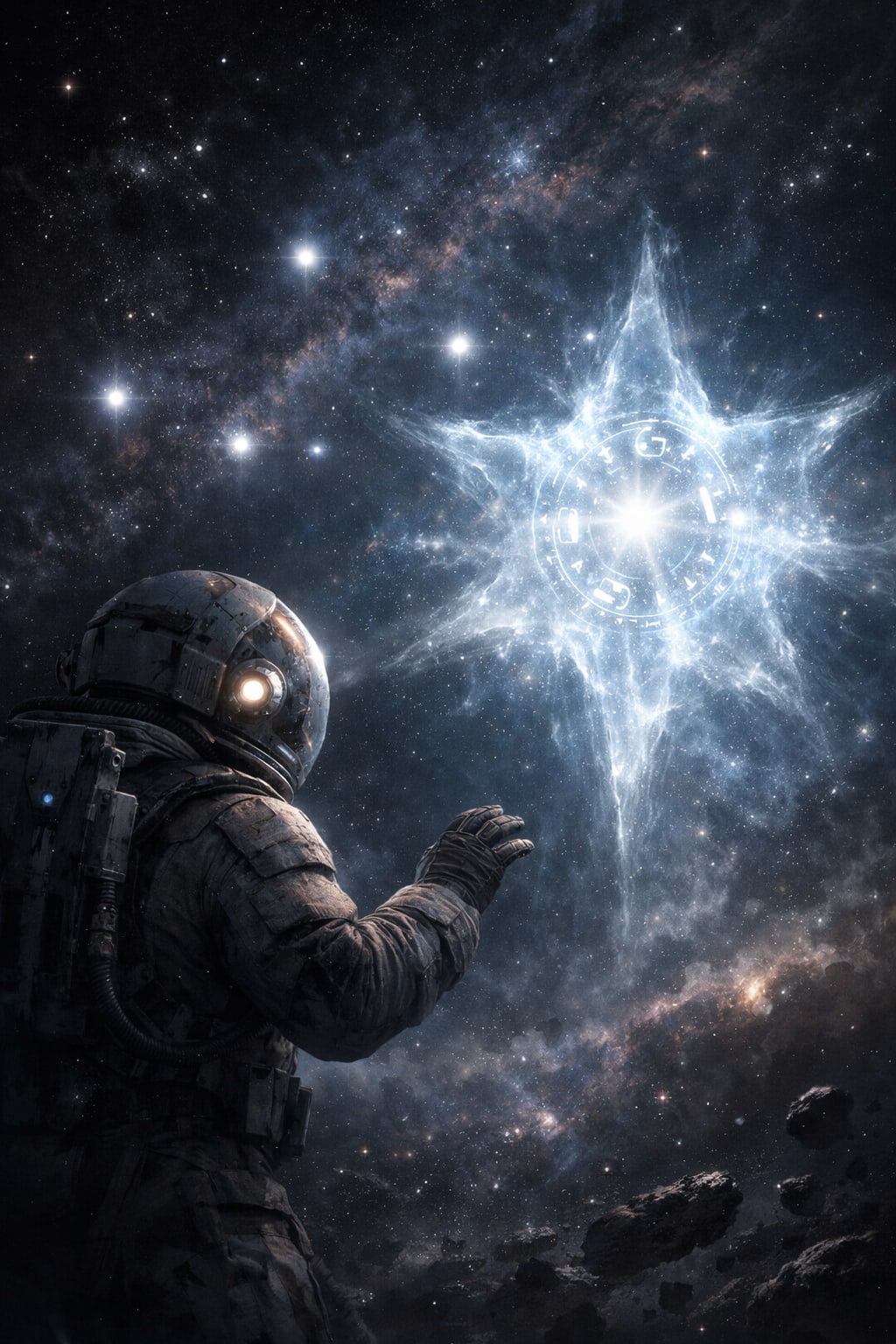
Lyra's fingers traced the constellation that shouldn't exist.
The holographic star chart flickered in the cramped cockpit of her survey vessel, casting blue shadows across her weathered face. She'd been mapping the Void Quarter for three months—that forsaken wedge of space where stars went to die—and in all that time, she'd cataloged nothing but stellar corpses and cosmic debris. Until now.
"Ship, magnify sector seven-seven-nine."
The AI complied without comment. It had learned, over their decade together, when Lyra's voice carried that particular edge of obsession.
The constellation materialized larger, more distinct. Seven points of light arranged in a pattern that tugged at something deep in Lyra's memory. Not stars—these signatures were wrong. Too rhythmic. Too intentional. They pulsed in a sequence that reminded her of breathing, or maybe music, or perhaps something for which human language had no proper word.
"Those aren't natural formations," she whispered.
"Correct," the ship replied. "Analysis suggests artificial origin. Age: approximately four billion years. Composition: unknown. They predate all known civilizations by—"
"By everything," Lyra finished. Her heart hammered against her ribs. "They predate everything."
She'd spent her entire career chasing ghosts—the Predecessors, that theoretical first civilization that some scientists claimed must have existed in the universe's youth. Most of her colleagues called it fantasy. They said she was wasting her life mapping dead regions of space, searching for evidence of myths.
Lyra set course for the nearest point of light.
The journey took six days. Six days during which she barely slept, sustained by stimulants and an electric anticipation that made her skin feel too tight. She ran every analysis she could, but the readings made no sense. The objects weren't emitting light—they were emitting something that her instruments could only interpret as light, the way a translator might struggle with a concept that has no equivalent.
When she finally arrived, Lyra understood why.
The thing floating in space before her wasn't a beacon or a satellite or any kind of technology she recognized. It was a star—or rather, it was the memory of a star. She could see through it to the darkness beyond, yet it blazed with phantom radiance. Inside its translucent corona, symbols rotated slowly, written in mathematics that predated numbers.
"Impossible," her ship said, which was the most emotion she'd ever heard from it.
Lyra suited up. She had to see it closer. Had to touch it, if touch was even the right word for something that existed in the space between real and remembered.
The moment her gloved hand passed through the star's surface, the universe inverted.
Suddenly, Lyra was standing in a place that was everywhere and nowhere. Around her, the cosmos was young—so young it still remembered being born. She saw the first galaxies igniting like matches struck in infinite darkness. She saw civilizations rise on worlds that had long since been crushed back into cosmic dust. And there, conducting it all like a symphony, were the Predecessors.
They weren't aliens. They were the universe's first attempt at consciousness—beings made of living mathematics, creatures whose thoughts were the fundamental forces themselves. They'd shaped reality in its infancy, teaching gravity how to pull, showing light how to shine. But they'd made a mistake.
They'd been too good at their work. The universe they created grew beyond them, evolved past them, no longer needed them. So they did something impossible: they erased themselves from existence, folding backward through time so that they'd never been. A perfect suicide that eliminated even the fact of their existence.
Except for these seven markers. These memories stored in stars they'd killed and resurrected as monuments. A final message: We were here. We mattered. Don't forget.
But the universe had forgotten. Everyone had forgotten. Until Lyra.
When she gasped back into her body, back into her suit floating beside the ghost-star, tears were streaming down her face. She understood now. The constellation pattern—it was a map. The other six markers were keys. Together, they formed instructions. A way to remember the Predecessors back into existence.
Lyra returned to her ship with trembling hands. She could do it. She could reach the other markers, activate them all, restore the forgotten gods to reality. She'd be the most celebrated scientist in human history. She'd prove everything she'd always believed.
Her fingers hovered over the navigation console.
Then she thought about those beings, so powerful they'd remade reality itself, who'd chosen oblivion over irrelevance. Who'd understood that sometimes the greatest act of love was to let go. To let your children—your creation—grow beyond you.
Lyra began deleting her logs. Every scan, every reading, every shred of evidence. When she was done, she set a new course—away from the remaining markers, back toward inhabited space. She would map other sectors, catalog ordinary stars, live an ordinary life.
But first, she interfaced one final time with the ghost-star, adding her own memory to its archive. A simple message, encoded in the mathematics of gratitude: I remembered you. It was enough.
As her ship jumped to faster-than-light, the constellation pulsed once—a pattern like breathing, like music, like goodbye.
Some discoveries, Lyra understood, were never meant to be shared. Some secrets were kindnesses. Some endings were the only honest way to say: your work was beautiful, and it is complete.
About the Creator
Alpha Cortex
As Alpha Cortex, I live for the rhythm of language and the magic of story. I chase tales that linger long after the last line, from raw emotion to boundless imagination. Let's get lost in stories worth remembering.
Keep reading
More stories from Alpha Cortex and writers in Fiction and other communities.
Foraging Appalachia’s Wild Edibles
It's that time of year again and Appalachia offers a remarkable abundance for anyone willing to learn its seasonal gifts and practice careful gathering. Across ridges, holler's, stream-side's, and meadows, edible plants, berries, roots, and fungi appear through every part of year. Knowledge is key and teaches not only what can be eaten, but also how to gather with respect so that these resources remain available far into future.
By Tim Carmichael7 days ago in Feast


Comments
There are no comments for this story
Be the first to respond and start the conversation.