
After the Third Step
Everyone knows when to stop

They count without saying it. No one announces the numbers. No one marks them aloud. But the counting is there, built into the rhythm of movement, into the way people cross thresholds, approach objects, complete small, ordinary actions.
Three.
It is always three.
Mara notices it the way she notices most things: not as a discovery, but as something that has always been true and has only now been seen.
At the entrance to the building, she places her hand on the glass door.
She pushes once.
The door resists slightly.
She pushes again.
It opens.
She steps through, pauses, then presses the door lightly a third time, as if confirming its position.
Only then does she let it close behind her.
No one watches.
No one needs to.
Inside, the lobby stretches in clean lines. The floors are polished. The light is evenly distributed, without shadows deep enough to suggest anything beyond the visible.
At the reception desk, a man signs his name on a digital screen.
He taps once.
Then again, slower.
Then a third time, firm enough that the screen flickers slightly under his finger.
He nods, satisfied.
The receptionist does not look up.
"You're all set," she says.
He moves on.
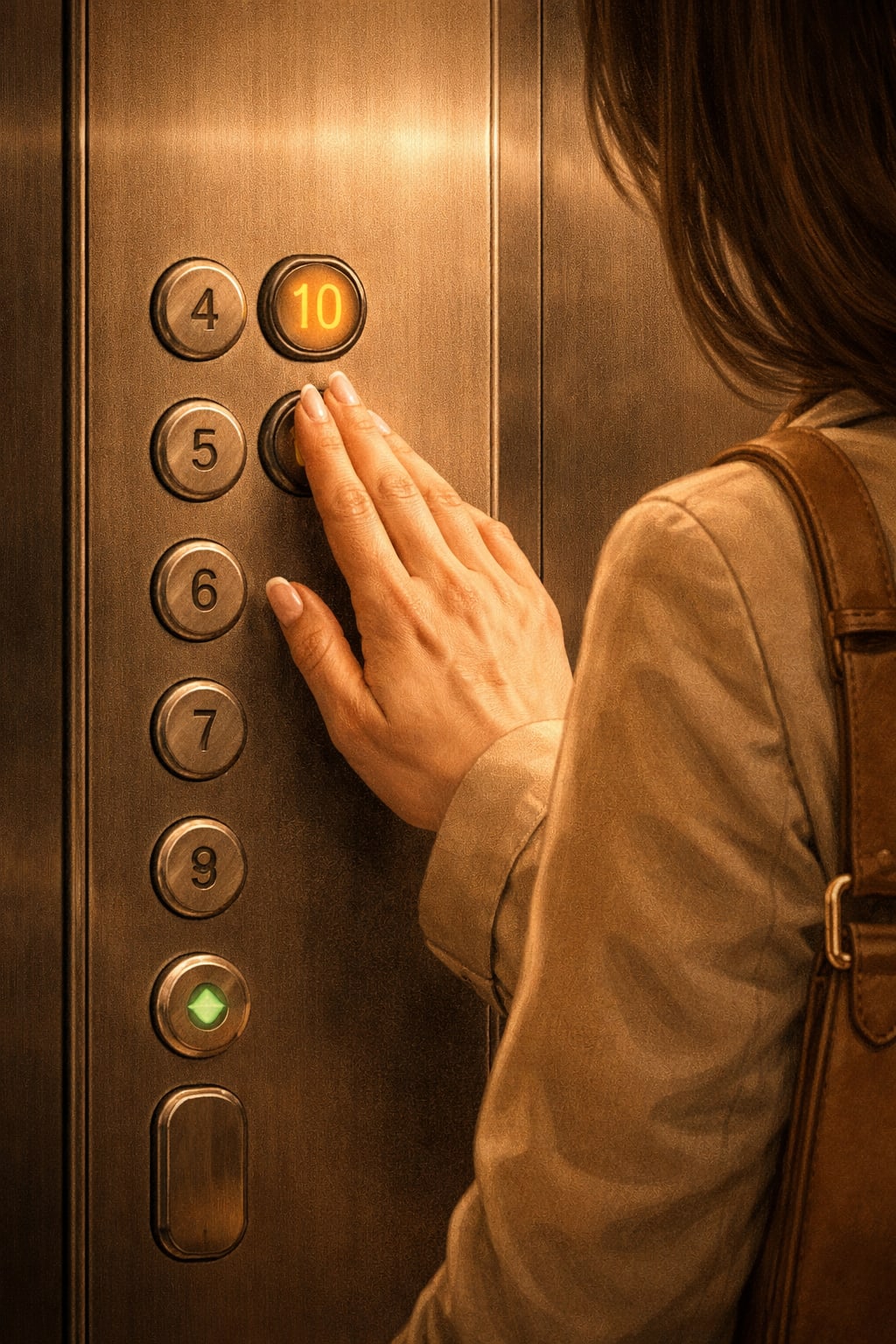
Mara takes the elevator.
She presses the button for the tenth floor.
Once.
Then again.
Then, after a brief pause, a third time.
The button lights up.
The doors close.
Inside, two others stand with the quiet awareness of shared space.
A woman adjusts her bag on her shoulder.
She shifts it once.
Then again.
Then lifts it slightly and lets it settle for a third time, aligning the strap with the curve of her collarbone.
The man beside her clears his throat.
Once.
Twice.
Then a third time, softer, as if completing a sequence rather than responding to discomfort.
No one comments.
On the tenth floor, Mara walks down the corridor.
Her footsteps fall evenly.
At her office door, she reaches for the handle.
She turns it once.
The latch clicks but does not release.
She turns it again.
The door opens slightly.
She pauses, then turns it a third time, a small corrective motion that does not change the door’s position but completes something invisible.
Then she enters.
The rule is not written anywhere.
There are no signs. No instructions. No training modules.
New people learn it quickly.
They hesitate at first.
They perform actions once, sometimes twice, then stop.
Things do not go wrong immediately.
Lights still turn on. Doors still open. Systems still respond.
But there is a subtle resistance.
A delay.
A sense that something has not fully registered.
Others notice.
Not openly. Not with confrontation.
Just a pause.
A look held a fraction longer than necessary.
A hand hovering, as if ready to intervene.
Eventually, the new person tries again.
A second time.
Then, almost by accident, a third.
And something aligns.
At 10:30, Mara attends a meeting.
The conference room is arranged with careful symmetry. Chairs evenly spaced. Water glasses placed at precise intervals along the table.
People take their seats.
Each person adjusts their chair.
Once.
Twice.
Then a third time, a slight shift that brings them into a position that appears identical to the previous one, but is not.
The meeting begins.
Documents are passed around.
Each person touches the paper three times before reading.
A finger taps the corner.
Another taps the edge.
A final, brief press flattens it against the table.
Only then do eyes move across the page.
Mara does the same.
She no longer remembers when she learned it.
There are consequences.
They are not dramatic.
Nothing breaks. Nothing collapses.
But things fail to complete.
A file does not save.
A message does not send.
A light remains dim.
A door remains slightly open.
It is enough.
Enough to correct behavior.
In the afternoon, Mara watches someone hesitate.
He is new.
She can tell by the way he moves - efficient, direct, unburdened by the small redundancies that structure everyone else’s actions.
He approaches the printer.
He presses the button once.
The machine hums but does not begin.
He presses again.
The screen flickers.
He waits.
Nothing happens.
Around him, others continue their work.
No one offers help.
No one explains.
The man looks at the screen, then at his hand.
He presses the button a third time.
The printer starts.
Paper feeds through with a smooth, unremarkable sound.
The man exhales.
Not in relief.
In recognition.
Mara turns back to her desk.
At home, the pattern continues.
Mara sets a glass on the counter.
She places it once.
Then adjusts it.
Then taps it lightly into place.
Three.
Daniel watches from the doorway.
He is holding his keys.
He sets them down on the table.
Once.
Twice.
Then a third time, aligning them with the edge of the wood.
"You noticed it too," he says.
Mara looks at him.
She does not ask what he means.
"Yes," she says.
They do not discuss it further.
That night, Mara wakes briefly.
The room is quiet.
Daniel’s breathing is steady beside her.
She listens.
There is a sound from somewhere in the house.
A small, incomplete noise.
Like something that started but did not finish.
Mara waits.
It does not repeat.
She closes her eyes.
Then opens them again.
She shifts slightly in the bed.
Once.
Twice.
Then a third time, settling into a position that feels no different from before.
The house is still.
But not entirely.
Mara lies there, aware of the pattern that holds everything in place.
Of the small, repeated actions that prevent the world from slipping out of alignment.
She does not question it.
She does not need to.
In the morning, she will stand at the door.
She will push it once.
Then again.
Then a third time.
And it will open.
About the Creator
Alain SUPPINI
I’m Alain — a French critical care anesthesiologist who writes to keep memory alive. Between past and present, medicine and words, I search for what endures.
Keep reading
More stories from Alain SUPPINI and writers in Fiction and other communities.
Mastering French Without Losing Your Sanity: A Realistic Guide for Beginners
Learning French can feel like solving a Rubik’s Cube blindfolded. The tricky pronunciation, the never-ending grammar rules, and the surprising exceptions make it seem impossible. But don’t worry—equipping yourself with key expressions and effective strategies can turn frustration into fluency. Let’s simplify French and make learning enjoyable.
By Alain SUPPINIExclusive • about a year ago
Wasp Talk
Introduction This is inspired by a few things: My friend Chris said wasps were the football hooligans of the insect world, my recent post where I stated that some people are only happy when they are miserable or have something to complain about, and the book I am reading, "The Roaches Have No King" by Dabiel Evan Weiss which is about New York Apartment life observed by cockroaches.
By Mike Singleton 💜 Mikeydred a day ago in Fiction
Bibbidi-Bobbidi-Booyah!
Dear Professor Donkeldong, I would like to formally apologize. Last night I snuck into your office. I sat in your chair and poured myself three fingers of Scotch from the bottle you’ve got stashed in the top desk drawer. Then I helped myself to your private library.
By Leslie Writesabout 23 hours ago in Humor



Comments
There are no comments for this story
Be the first to respond and start the conversation.