
How to Reduce Technical Debt in Legacy FinTech Apps Through Refactoring
A Practical Guide to Reducing Technical Debt in Legacy FinTech Applications Through Refactoring

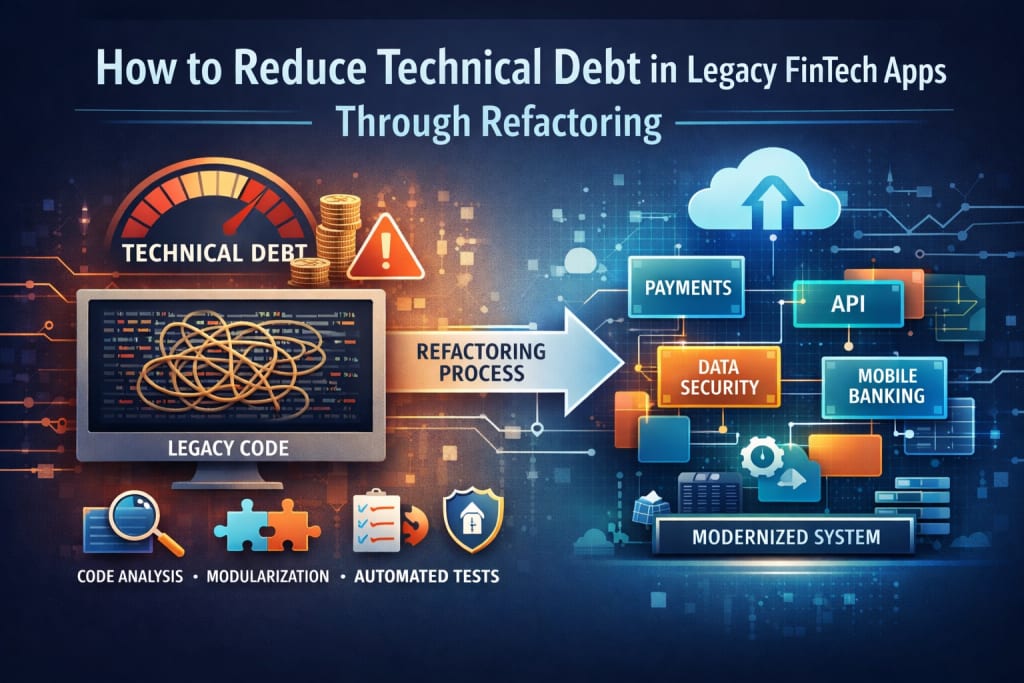
Legacy FinTech applications are the backbone of many financial institutions, powering everything from transaction processing to risk management. However, over time, these applications often accumulate technical debt—the hidden cost of expedient coding decisions, outdated architectures, and insufficient documentation. For FinTech companies, this debt can result in slower feature development, higher operational risks, and difficulties maintaining compliance with evolving regulations. Refactoring—the disciplined process of restructuring existing code without changing its external behavior—is one of the most effective strategies for reducing this debt and ensuring that your systems remain scalable, secure, and maintainable.
In this article, we will explore how FinTech organizations can systematically reduce technical debt in legacy applications through targeted refactoring, covering practical strategies, tools, and best practices.
Understanding Technical Debt in Legacy FinTech Applications
Technical debt is often likened to financial debt: it provides short-term benefits but incurs long-term costs. In a FinTech context, technical debt manifests in several ways:
- Monolithic architectures: Large, tightly coupled systems where changes in one module can inadvertently affect others.
- Outdated frameworks and libraries: Dependencies that are no longer supported or lack security patches.
- Spaghetti code: Poorly structured code that is difficult to understand, test, or maintain.
- Insufficient automated tests: Changes carry high risk because there is no safety net to catch regressions.
- Fragmented documentation: Knowledge about the system is dispersed, making onboarding and troubleshooting slow.
The consequences are tangible: slower delivery of new features, higher risk of system failures, and increased costs for bug fixes and compliance audits. For FinTech applications, where reliability, security, and speed are critical, unchecked technical debt can become a major liability.
Step 1: Assess and Prioritize Technical Debt
Before you start refactoring, it is essential to quantify and prioritize your technical debt. Not all debt carries the same risk, and some areas of the codebase may have higher business impact.
Techniques for assessment:
- Code metrics analysis . Use static analysis tools to identify complex functions, duplicated code, and low test coverage. Tools like SonarQube or Code Climate can provide a risk-based scoring of technical debt.
- Dependency mapping . Map out system dependencies, including internal modules, third-party libraries, and APIs. Identify outdated or unsupported components that pose security or stability risks.
- Business impact evaluation . Align technical debt assessment with business priorities. Modules critical to transaction processing, compliance, or customer-facing services should receive higher priority.
- Stakeholder interviews . Gather input from developers, QA engineers, and product owners to understand pain points in maintenance and feature delivery.
By combining technical and business perspectives, you can create a refactoring roadmap that targets the highest-impact areas first.
Step 2: Adopt a Refactoring Strategy
Refactoring should not be a random or ad-hoc activity; it requires a clear strategy that balances risk, resources, and business continuity. Common approaches include:
1. Incremental Refactoring
Incremental refactoring involves making small, controlled improvements to the codebase over time. This is particularly suitable for FinTech applications because it reduces the risk of disrupting critical systems.
- Break down large modules into smaller, more manageable components.
- Introduce automated tests before and after each change to ensure behavior remains consistent.
- Document changes meticulously to maintain knowledge continuity.
2. Strangler Pattern
The strangler pattern is a technique for gradually replacing parts of a legacy system with new services. Instead of rewriting the entire system at once, new functionality is developed alongside the legacy code, slowly taking over responsibilities.
- Implement new features as microservices or modules that interface with the old system.
- Route traffic progressively from legacy code to new implementations.
- Once the new code handles all functionality, retire the legacy components.
3. Component-Based Refactoring
Legacy monolithic applications often suffer from tightly coupled modules. Refactoring towards a component-based or microservices architecture can reduce complexity, improve scalability, and simplify compliance auditing.
- Identify modules that can be isolated and refactored independently.
- Introduce clean interfaces and well-defined APIs between components.
- Ensure backward compatibility with legacy systems during the transition.
Step 3: Ensure Code Quality and Testing
Technical debt is often perpetuated by inadequate testing and inconsistent coding standards. To refactor effectively, you need to establish robust quality controls:
Automated Testing
- Implement unit, integration, and end-to-end tests.
- Leverage regression testing frameworks to catch unintended side effects of refactoring.
Code Reviews
- Maintain peer review practices to enforce coding standards and prevent the introduction of new debt.
Continuous Integration (CI)
- Integrate automated builds and tests into your CI pipeline.
- Detect errors early and ensure that refactoring does not disrupt deployment schedules.
Documentation Updates
- Update system documentation and API contracts as code changes are made.
- Maintain internal wikis or knowledge bases to capture architecture decisions.
Step 4: Optimize Data and Dependencies
Legacy FinTech applications often involve large, complex datasets and tightly coupled dependencies. Refactoring these areas can improve performance, reliability, and security:
Database Refactoring
- Normalize or restructure database schemas to reduce redundancy and improve maintainability.
- Implement indexing strategies to optimize query performance.
- Introduce versioning and migration scripts to safely update data structures without downtime.
Dependency Management
- Audit third-party libraries and frameworks to ensure they are up-to-date and supported.
- Remove unused or redundant dependencies to reduce attack surfaces and simplify updates.
- Consider containerization (e.g., Docker) to standardize environments and prevent compatibility issues.
Step 5: Monitor and Maintain Refactored Systems
Refactoring is not a one-time effort. Without ongoing maintenance, technical debt can quickly accumulate again. Establishing monitoring and governance practices is essential:
Technical Debt Metrics
- Continuously track complexity, duplication, test coverage, and code smells.
- Use dashboards to visualize debt accumulation and progress over time.
Performance Monitoring
- Implement application performance monitoring (APM) tools to detect bottlenecks and regressions after refactoring.
Regular Code Audits
- Schedule periodic reviews to ensure coding standards are upheld and debt is controlled.
Developer Training
- Provide training on modern coding practices, design patterns, and security standards to prevent the introduction of new debt.
Step 6: Address Organizational Challenges
Reducing technical debt in FinTech applications is as much an organizational challenge as a technical one. Common obstacles include resistance to change, lack of documentation, and limited developer resources. Strategies to address these challenges include:
- Executive Sponsorship: Secure support from leadership to allocate time and budget for refactoring initiatives.
- Cross-Functional Collaboration: Involve business analysts, QA, and operations teams early to ensure changes align with business needs.
- Incremental Wins: Showcase small but meaningful improvements to build momentum and demonstrate value.
- Clear Communication: Maintain transparency about refactoring goals, timelines, and expected outcomes to reduce resistance.
Step 7: Case Example: Refactoring a Legacy Payment Processing Module
Consider a FinTech company that operates a legacy payment processing system handling thousands of transactions per minute. Over time, the codebase became increasingly complex, leading to slow feature rollout and frequent downtime.
Approach Taken by the FinTech development teams:
- Assessment: Code analysis revealed tightly coupled modules, outdated libraries, and minimal test coverage.
- Prioritization: Modules critical for transaction authorization and fraud detection were prioritized.
- Incremental Refactoring: Core modules were broken into microservices with clear API boundaries. Automated tests were added before changes.
- Dependency Updates: Libraries were updated, and redundant modules removed.
- Monitoring: Post-refactoring, APM tools tracked transaction latency and error rates, showing measurable improvements.
Outcome:
- 40% reduction in code complexity
- Faster feature deployment cycles
- Improved system reliability and regulatory compliance
This example illustrates that careful planning, testing, and incremental changes can significantly reduce technical debt without disrupting critical FinTech operations.
About the Creator
Chudovo
Chudovo is a custom software development company, focused on complex systems implementation.
Education Adds Months to Your Life, Smoking Shaves Off Years: What Recent Research Reveals
In health research, scientists increasingly recognize that factors outside of biology — like education and lifestyle choices — have profound effects on how long we live. Two trends emerging from recent studies paint a striking picture: every extra year of education can add measurable months to a person’s life expectancy, while tobacco smoking can cut years off it. These findings offer powerful public‑health lessons about how social conditions and personal behaviors shape longevity.
By Irshad Abbasi 7 days ago in Education
Why Stars Vibrate: The Science of Stellar Pulsations and Star Quakes
Why Stars Vibrate Listening to the Music of the Stars Imagine looking up at the night sky and realizing that the stars are not silent. Not only are they burning, spinning, and moving through space, but they are also vibrating—expanding and shrinking rhythmically like cosmic musical instruments.
By shahkar jalal4 days ago in Education




Comments
There are no comments for this story
Be the first to respond and start the conversation.