
Voices of Love and Defiance
How Rabia Balkhi and Mahsati Ganjavi reshaped the language of love in medieval Islamic culture

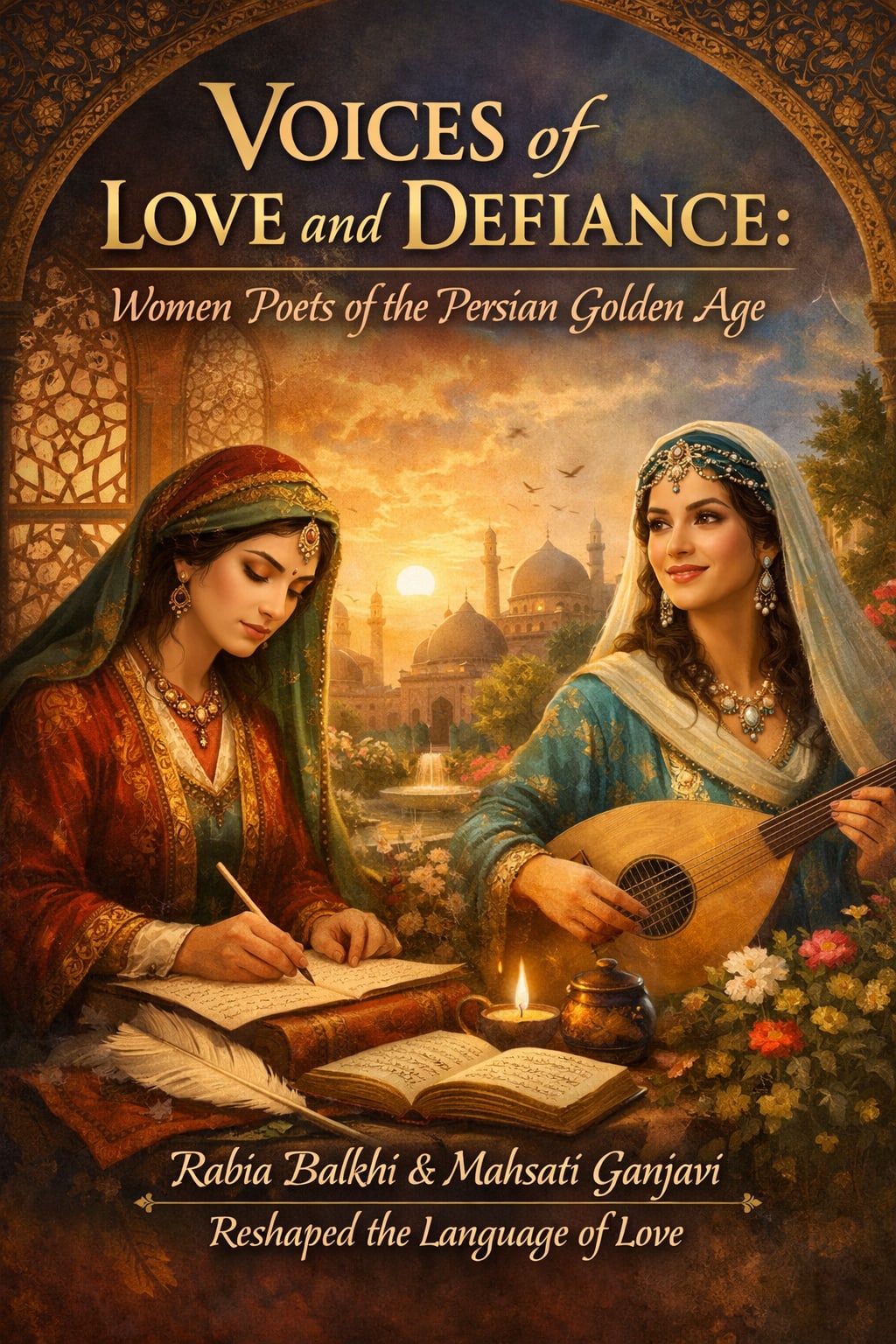
The Islamic Golden Age is often celebrated for its intellectual brilliance—its advancements in science, philosophy, and literature. Yet, within this flourishing cultural landscape, the voices of women are frequently overlooked. Among the most compelling figures to emerge from medieval Persian literature are Rabia Balkhi and Mahsati Ganjavi, two (women poets) who infused poetry with deeply personal expressions of love, longing, and resistance. Their works not only challenged social norms but also expanded the emotional and linguistic boundaries of Persian poetry.
Rabia Balkhi, believed to have lived in the 10th century, is widely regarded as one of the earliest known female poets in Persian literary history. Her life story is steeped in both romance and tragedy. According to traditional accounts, Rabia fell in love with a slave named Baktash—an act that defied the rigid class and gender structures of her time. Her poetry reflects this forbidden love, blending tenderness with quiet rebellion. In a society where women’s voices were largely confined to private spaces, Rabia dared to articulate her emotions publicly, giving poetic form to a deeply human experience.
What distinguishes Rabia’s poetry is its sincerity. Unlike the often symbolic or mystical love found in classical Persian verse, her expressions feel immediate and personal. She writes not merely as a poet, but as a woman fully conscious of her desires and the risks they entail. This authenticity has led many scholars to view her as a pioneering figure who bridged the gap between personal emotion and literary expression. Her tragic end—reportedly orchestrated by her own brother—has only deepened the symbolic power of her legacy, turning her into a figure of both (love) and sacrifice.
A century later, Mahsati Ganjavi emerged as another powerful female voice in Persian literature. Living in the 12th century during the Seljuk period, Mahsati was known not only for her poetry but also for her presence in royal courts. Unlike Rabia, whose life was marked by secrecy and tragedy, Mahsati navigated elite literary circles with confidence and wit. She is particularly celebrated for her rubaiyat (quatrains), which often explore themes of love, pleasure, and the fleeting nature of life.
Mahsati’s poetry is notable for its boldness. She speaks of love in a way that is playful, sensual, and unapologetically direct. Her verses challenge conventional notions of modesty and propriety, presenting a woman who is both intellectually and emotionally autonomous. In doing so, she reclaims the language of love from a male-dominated tradition and reshapes it through a distinctly female perspective.
One of the most remarkable aspects of Mahsati’s work is her use of humor and irony. Where Rabia’s tone is often earnest and tragic, Mahsati employs wit to subvert expectations. She writes of lovers and relationships with a knowing smile, revealing both the joys and absurdities of human connection. This stylistic difference highlights the diversity of women’s voices in Persian literature, demonstrating that female were not confined to a single mode of expression.
Together, Rabia Balkhi and Mahsati Ganjavi represent two complementary dimensions of love poetry in the medieval Islamic world. Rabia embodies the intensity of forbidden love, where emotion transcends societal constraints but ultimately leads to personal sacrifice. Mahsati, on the other hand, celebrates love as an experience to be enjoyed, questioned, and even laughed at. Both approaches, however, share a common thread: the assertion of a woman’s right to feel, to speak, and to be heard.
Their contributions also challenge modern assumptions about women’s roles in Islamic history. Far from being silent or invisible, women like Rabia and Mahsati were active participants in cultural and literary production. Their works remind us that the Islamic Golden Age was not only a period of intellectual achievement but also a time when diverse voices—across gender and class—found ways to express themselves.
In today’s world, where discussions of gender and representation remain deeply relevant, the poetry of Rabia Balkhi and Mahsati Ganjavi continues to resonate. Their words speak across centuries, offering insights into the universal nature of love and the enduring struggle for self-expression. By giving love a new language—one that is intimate, bold, and unapologetically human—they secured their place in the rich tapestry of Persian literary heritage.✒️
About the Creator
Irshad Abbasi
Ali ibn Abi Talib (RA) said 📚
“Knowledge is better than wealth, because knowledge protects you, while you have to protect wealth.
Keep reading
More stories from Irshad Abbasi and writers in Beat and other communities.
The View from the World’s Tallest Bridge
Title: Subtitle: Article (700 words): High above a deep mountain valley, where clouds drift beneath the roadway and the earth appears miles below, stands the world’s tallest bridge — the Duge Bridge in China. Rising an astonishing 565 meters (about 1,854 feet) above the Beipan River, this remarkable structure has become not only a symbol of modern engineering but also a destination for travelers eager to witness one of the most spectacular views on Earth.
By Irshad Abbasi a day ago in Beat
The Solitude of The Chupacabra
Many say that the Chupacabra is a rather recent and modern tale, a mangy coyote or rabied dog. Some point out that it’s just twisted evolution. But very few know the true backstory of the shapeshifter that led to the bloodsucking legend. And perhaps once you will come to know and understand more, you might “forget” a few cattle out to wander.
By Oneg In The Arctic3 days ago in Fiction


Comments
There are no comments for this story
Be the first to respond and start the conversation.