
Oh Tetrad, Hearken unto Me!
Exploring 7th Chords for Depth and Texture

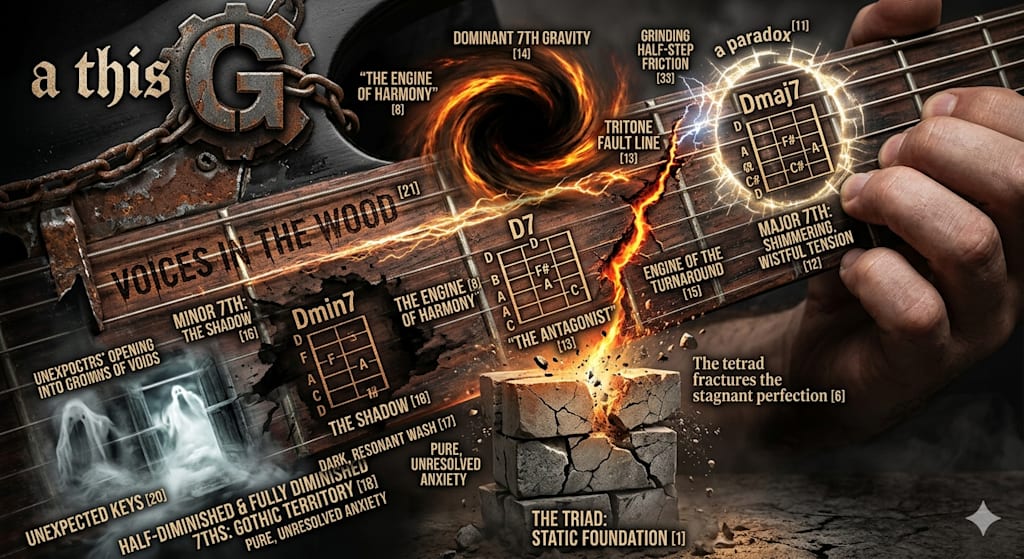
The triad is stone. It is the foundation, structurally sound and completely static. It stands there, immovable, declaring its major or minor allegiance with absolute, unwavering certainty. But the triad has no narrative. It has no pulse.
Enter the tetrad.
By stacking that fourth voice—the seventh—above the root, third, and fifth, you breathe life into the architecture. You introduce friction. You introduce gravity. The 7th chord fractures the stagnant perfection of the triad and turns a static structure into an active verb. It no longer just sits; it pulls, it twists, it demands motion.
The Engine of Harmony
The magic of the 7th interval lies in its inherent instability. It creates a dissonance—sometimes subtle, sometimes violent—that hooks the ear and drags it forward through time.
The Major 7th: It is a paradox. You take the pure, stable major triad and cap it with a major seventh—an interval that sits a grinding half-step away from the root. It creates a shimmering, wistful tension. It refuses to resolve immediately, instead floating in a space of nostalgic ambiguity.
The Dominant 7th: The antagonist of Western harmony. The tritone hiding between its major third and minor seventh acts as a structural fault line. It creates a heavy, inescapable gravity that violently pulls the ear toward the tonic. It is the blues, it is tension, it is the engine of the turnaround.
The Minor 7th: The shadow. By dropping both the third and the seventh, the chord softens into something moody, introspective, and vast. Across a fretboard, grabbing a minor 7th spreads the overtones out, letting them weave together in a dark, resonant wash.
The Half-Diminished and Fully Diminished 7ths: Here lies the gothic territory. A minor triad with a flattened fifth and a minor or diminished seventh. These chords are pure, unresolved anxiety. They crawl through a progression, acting as trapdoors that allow a progression to slip seamlessly into entirely new, unexpected keys.
The Voices in the Wood
When you voice a 7th chord, especially stretching it across the neck of a guitar, you are no longer just playing a chord; you are orchestrating. The distance between the root and that 7th—whether you compress it in a tight, clustered voicing or spread it wide in a drop-2 or drop-3 configuration—dictates the entire emotional weight of the measure.
The tetrad is where jazz breathes and where classical counterpoint finds its deepest emotional peaks. It is the sound of a question being asked, hanging in the air, waiting for the next downbeat to provide the answer.
To bring these tetrads out of the theoretical ether and into the wood and wire, we must look at how they lay across the fretboard. For a player navigating the nuanced territories of jazz and classical repertoire, the standard open chords often lack the necessary voice-leading control.
Instead, let us utilize movable Drop 2 (root on the A string) and Drop 3 (root on the low E string) voicings. These shapes space the intervals beautifully, allowing each note of the tetrad to speak clearly without crowding the overtones.
Here are the tablatures for the D Major 7th, D Minor 7th, and D Dominant 7th, built with absolute structural precision.
1. The D Major 7th (Dmaj7)
The Anatomy: Root (D), Major 3rd (F#), Perfect 5th (A), Major 7th (C#). This is the sound of bright, melancholic stability. The crushing half-step friction between the C# and the theoretical D above it gives this chord its signature wistful shimmer.
Root-5 Voicing (Drop 2 - 5th Fret)
E|---|
B|-7-| (F# - Major 3rd)
G|-6-| (C# - Major 7th)
D|-7-| (A - Perfect 5th)
A|-5-| (D - Root)
E|---|
2. The D Minor 7th (Dmin7)
The Anatomy: Root (D), Minor 3rd (F), Perfect 5th (A), Minor 7th (C). By flattening the third and the seventh, the chord retreats into the shadows. It becomes brooding, resonant, and spacious—the quintessential backbone of a minor ii-V-I progression.
E|---|
B|-6-| (F - Minor 3rd)
G|-5-| (C - Minor 7th)
D|-7-| (A - Perfect 5th)
A|-5-| (D - Root)
E|---|
3. The D Dominant 7th (D7)
The Anatomy: Root (D), Major 3rd (F#), Perfect 5th (A), Minor 7th (C). Here lies the engine of tension. The jagged tritone hiding exactly between the major 3rd (F#) and the minor 7th (C) creates a profound structural instability. It violently demands a resolution, pulling the ear toward G.
Root-5 Voicing (Drop 2 - 5th Fret)
E|---|
B|-7-| (F# - Major 3rd)
G|-5-| (C - Minor 7th)
D|-7-| (A - Perfect 5th)
A|-5-| (D - Root)
E|---|
About the Creator
Nathan McAllister
I create content in the written form and musically as well. I like topics ranging from philosophy, music, cooking and travel. I hope to incorporate some of my music compositions into my writing compositions in this venue.
Cheers,
Nathan
Keep reading
More stories from Nathan McAllister and writers in Beat and other communities.
Melodic Major and Melodic Minor
The world of music theory often feels like a map of well-trodden paths—the bright meadows of the Major scale and the somber forests of the Natural Minor. But for the seeker of true atmosphere, there are two hidden trails that twist through the shadows and the light: the Melodic Minor and its ghostly, underrated sibling, the Melodic Major.
By Nathan McAllister5 days ago in Beat
They’re Coming To Take Me Away Ha-Haa turns 60
There was a one-hit wonder recording in 1966 titled "They're Coming to Take Me Away, Ha-Haaa!"The song made it to number 3 on Billboard's top 100 chart, but in today’s cancel culture might be considered inappropriate.
By Cheryl E Preston9 days ago in Beat
Are You Eager For Midnight? | THIS MUSIC MAY CONTAIN HOPE.
The first time I really heard RAYE was a little over a year ago. Let's be honest, there are some artists you don't even realize you've listen to before until you start having red thread coming out of your ears because of the potential conspiracy wall developing in your brain. Well, on mine, it all starts with a mind-blowing and boggling performance.
By Alexandria Stanwyck6 days ago in Beat
Something Is Beginning, I Think Challenge Winners
This challenge wasn’t about clean starts. It was about that weird in-between where something is beginning, but no one really knows what yet. A lot of these stories leaned into hesitation, into pauses and false starts and that feeling that something is about to happen but hasn’t quite.
By Vocal Curation Teamabout 13 hours ago in Resources




Comments
There are no comments for this story
Be the first to respond and start the conversation.