
Is AI Bad for the Environment?
The Truth Isn’t So Simple

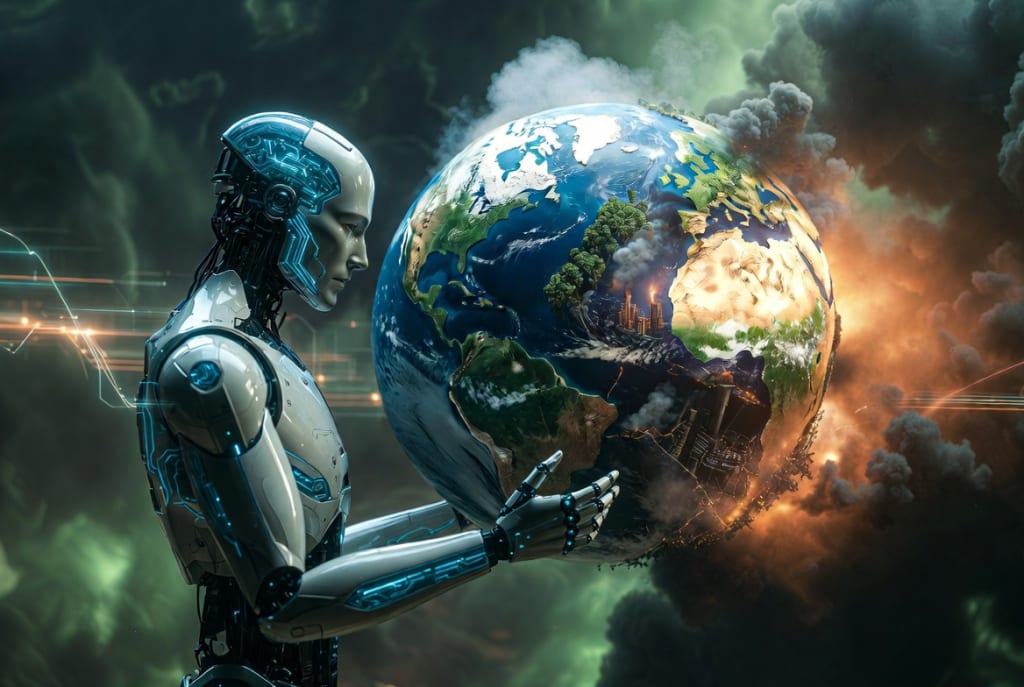
Written with help from Chat GPT
Artificial intelligence is often portrayed as either a miracle or a menace. It can write, design, diagnose, predict, and even create art.
But behind the sleek interfaces and instant answers, a quieter question is emerging:
What is AI costing the Earth?
The answer isn’t black and white. Like most powerful technologies, AI sits in a complicated space—both harmful and potentially healing.
Let’s unpack it.
The Hidden Environmental Cost of AI
Most people don’t think about what happens when they type a prompt into an AI tool. It feels weightless. Instant. Invisible.
But it’s not.
Every AI interaction relies on massive data centers—warehouse-sized facilities filled with servers that require:
Electricity (a lot of it)
Physical materials (metals, rare earth elements, hardware)
Training large AI models can consume as much energy as hundreds of homes use in a year. And once deployed, these systems continue to draw power every time they’re used.
The real impact:
Increased carbon emissions (depending on energy source)
Strain on water resources in certain regions
Electronic waste from rapidly evolving hardware
AI isn’t “in the cloud.”
It’s very much on Earth.
But Here’s the Twist: AI Can Also Help the Planet
This is where things get interesting.
The same technology that consumes energy is also being used to reduce environmental damage.
AI is currently helping to:
🌱 Optimize energy use
Smart grids use AI to reduce wasted electricity and balance renewable energy sources like solar and wind.
🌊 Monitor ecosystems
AI can track deforestation, ocean pollution, and wildlife populations in real time.
🚜 Improve agriculture
Precision farming reduces water use, fertilizer runoff, and soil damage.
🌬️ Fight climate change
AI models are being used to predict climate patterns and improve carbon capture technologies.
In other words, AI might be part of the problem—but it’s also part of the solution.
The Real Issue: Scale and Intention
AI itself isn’t inherently “bad.” The environmental impact depends on how it’s built, powered, and used.
The biggest concerns:
Rapid, unchecked growth of AI systems
Data centers powered by fossil fuels
Overuse for trivial or unnecessary tasks
Lack of transparency from tech companies
The biggest opportunities:
Transitioning to renewable-powered data centers
Designing more energy-efficient models
Using AI intentionally for meaningful, high-impact work
The difference comes down to human choices.
A Deeper Perspective
There’s something almost poetic about this moment in time.
We’ve created a technology from the Earth—metals, minerals, energy—and now that technology is reflecting back to us how we treat the planet.
AI is not separate from nature.
It is, in a strange way, an extension of it.
The question isn’t just:
“Is AI bad for the environment?”
It’s:
“What kind of relationship do we want with the Earth as we build the future?”
Final Thoughts
AI is neither villain nor savior.
It’s a tool—one of the most powerful we’ve ever created.
If we use it carelessly, it will accelerate environmental harm.
If we use it wisely, it could help us repair some of the damage we’ve already done.
The outcome isn’t decided yet.
And that means we still have a choice.
🔥 Contrarian Take: AI Is Worse for the Environment Than You Think
The popular narrative says AI will help solve climate change.
But a growing group of researchers, policymakers, and environmental analysts are saying the opposite:
AI may be accelerating environmental damage at a scale we don’t fully understand yet.
1. AI Is Quietly Becoming a Massive Energy Consumer
AI isn’t just “another tech trend”—it’s triggering one of the largest infrastructure expansions in modern history.
Data center electricity demand is projected to more than double by 2030
Some facilities consume as much power as 100,000 homes
Globally, data centers could become one of the largest electricity consumers on Earth
And here’s the uncomfortable truth:
👉 Much of that energy still comes from fossil fuels.
Recent reporting shows AI growth is already pushing companies back toward natural gas and slowing climate goals
2. The Carbon Footprint Could Rival Entire Cities
Research from Vrije Universiteit Amsterdam (Alex de Vries-Gao) suggests:
AI’s carbon footprint could rival a city the size of New York
Other projections estimate:
AI expansion could add tens of millions of tons of CO₂ annually
That’s comparable to putting millions of cars on the road.
3. AI Is Draining Water Resources (Yes, Water)
This is one of the least discussed—and most alarming—issues.
AI systems may consume massive volumes of freshwater for cooling
Some estimates suggest AI’s water footprint could match global bottled water consumption
This becomes especially concerning in:
Drought-prone regions
Areas already facing water scarcity
4. It’s Straining Power Grids and Raising Costs
AI isn’t just an environmental issue—it’s a systems issue.
Data center expansion is stressing power grids globally
Some regions are seeing rising electricity costs tied to AI demand
There are even proposals to pause new AI data centers due to environmental and infrastructure concerns
5. Efficiency Gains Might Make Things Worse (Jevons Paradox)
Here’s the counterintuitive part:
Even if AI becomes more efficient…
we may just use it more.
Researchers like:
Sasha Luccioni (Hugging Face / climate-AI researcher)
Emma Strubell (AI + energy researcher)
argue that efficiency can lead to more total consumption, not less—a phenomenon known as Jevons Paradox
👉 Cheaper AI → more usage → more total energy
6. The “Hidden Costs” Are Still Unknown
Experts warn that we’re likely underestimating the damage.
Why?
Tech companies don’t fully disclose energy and water use
Hardware manufacturing (chips, GPUs) is rarely included
E-waste and mining impacts are often ignored
Some studies emphasize that AI’s full environmental footprint is largely invisible
👩🔬 Experts & Voices Saying AI Is Environmentally Harmful
Here are credible names and institutions you can reference in your Vocal article:
🔬 Alex de Vries-Gao (Vrije Universiteit Amsterdam)
One of the most cited researchers on AI energy use
Warns AI could rival major cities in carbon + water footprint
🔬 Sasha Luccioni (Hugging Face)
Leading voice on AI sustainability + emissions tracking
Co-author on research about rebound effects and hidden costs
🔬 Emma Strubell (Carnegie Mellon)
Early researcher highlighting carbon cost of training AI models
Shows how large models can emit significant CO₂ during training
🏫 MIT + Harvard researchers
Warn AI’s energy demand is rapidly increasing and tied to fossil fuels
🌍 International Energy Agency (IEA)
Projects massive growth in electricity demand from AI infrastructure
🧠 Academic consensus (Nature / Springer research)
AI impacts include:
Energy
Water
Materials
Land use
Risks increase with unchecked expansion
🏛️ Policymakers (Sanders, AOC, advocacy groups)
Pushing to pause AI data center expansion due to environmental harm
AI isn’t just using resources—it’s scaling faster than our ability to make it sustainable.
At the same time, there’s a growing recognition that we may already be at a climate tipping point—and that traditional approaches alone are no longer enough. This is where AI begins to shift from liability to necessity.
Around the world, AI models are already showing real promise: optimizing renewable energy grids so solar and wind can be used more efficiently, predicting wildfires and extreme weather events before they escalate, accelerating the discovery of new materials for carbon capture and low-emission batteries, reducing fertilizer and water use through precision agriculture, and monitoring illegal deforestation and ocean pollution in real time.
Companies and researchers are even using AI to design more energy-efficient buildings and to map out large-scale ecosystem restoration. The irony may be unavoidable—while AI contributes to environmental strain, it may also be one of the only tools powerful enough to help us course-correct in time.
AI Solutions That are Reversing and even Healing Earth
1. AI Weed-Killing Robots (No Pesticides)
Companies: Carbon Robotics, Blue River Technology (John Deere)
Use computer vision + lasers or precision spraying to identify and destroy weeds
Reduces herbicide use by up to 80–90%
2. Smart Energy Grids
Companies: Google DeepMind, Siemens
AI balances electricity demand and integrates solar/wind efficiently
DeepMind reduced Google data center cooling energy by ~40%
3. AI Wildfire Prediction Systems
Tools: Pano AI, Google FireSat (emerging)
Detect fires early using cameras, satellites, and machine learning
Helps stop small fires before they become catastrophic
4. Precision Agriculture (Water + Fertilizer Reduction)
Companies: Climate Corporation, Prospera
AI analyzes soil, crops, and weather to apply exact amounts of water and nutrients
Cuts waste and reduces runoff pollution
5. Deforestation Monitoring
Organizations: Global Forest Watch, Rainforest Connection
AI analyzes satellite imagery and even listens to chainsaws via audio sensors
Enables near real-time alerts to stop illegal logging
6. Ocean Plastic Detection & Cleanup
Projects: The Ocean Cleanup, Clearbot
AI identifies plastic waste in oceans and rivers
Autonomous systems collect debris at scale
7. AI-Designed New Materials (Batteries & Carbon Capture)
Companies: DeepMind (AlphaFold), Microsoft AI for Earth
Accelerates discovery of:
Better battery materials
Carbon capture compounds
Speeds up breakthroughs that used to take years
8. Building Energy Optimization
Companies: BrainBox AI, Johnson Controls
AI controls HVAC systems in real time
Reduces building emissions by 20–40%
9. Wildlife Protection & Anti-Poaching AI
Tools: PAWS (Protection Assistant for Wildlife Security)
Predicts poaching activity patterns
Helps rangers deploy patrols more effectively
10. AI Air Pollution Monitoring
Companies: IQAir, BreezoMeter (Google)
Combines sensors + AI models to track pollution in real time
Helps cities and individuals reduce exposure and identify sources
About the Creator
Sandy Rowley
AI SEO Expert Sandy Rowley helps businesses grow with cutting-edge search strategies, AI-driven content, technical SEO, and conversion-focused web design. 25+ years experience delivering high-ranking, revenue-generating digital solutions.
Keep reading
More stories from Sandy Rowley and writers in 01 and other communities.
U.S. Government Shutdown Crisis: Airport Delays, DHS Funding Talks, and National Security Concerns Explained
U.S. Government Shutdown Crisis: Airport Delays, DHS Funding Talks, and National Security Concerns Explained How ongoing negotiations, airport disruptions, and border security debates are shaping America’s current political landscape
By Anthony Moriyam 7 days ago in 01
Meetings and Event Technology: Transforming How the World Gathers
Meetings and Event Technology has fundamentally changed the way organisations plan, deliver, and measure their events. From AI-powered registration platforms to immersive hybrid broadcast studios, the tools available to event professionals today are more sophisticated and accessible than ever before. Meetings and Event Technology enables associations, corporations, and professional congress organisers to create richer delegate experiences, streamline operations, and capture data that drives smarter decision-making.
By Meeting Media5 days ago in 01




Comments (1)
How AI works: https://specialdealspot.top/01/how-ai-works-n83eg0a0c%3C/span%3E%3C/span%3E%3C/span%3E%3C/a%3E%3C/p%3E%3C/div%3E%3C/div%3E%3C/div%3E%3Cstyle data-emotion-css="w4qknv-Replies">.css-w4qknv-Replies{display:grid;gap:1.5rem;}