
Gen Z Is Skipping Museums: Digital Experience Solutions Are Why That's Starting to Change
The institutions that are winning back younger visitors share one thing in common: they stopped treating technology as decoration and started using it to do real work.

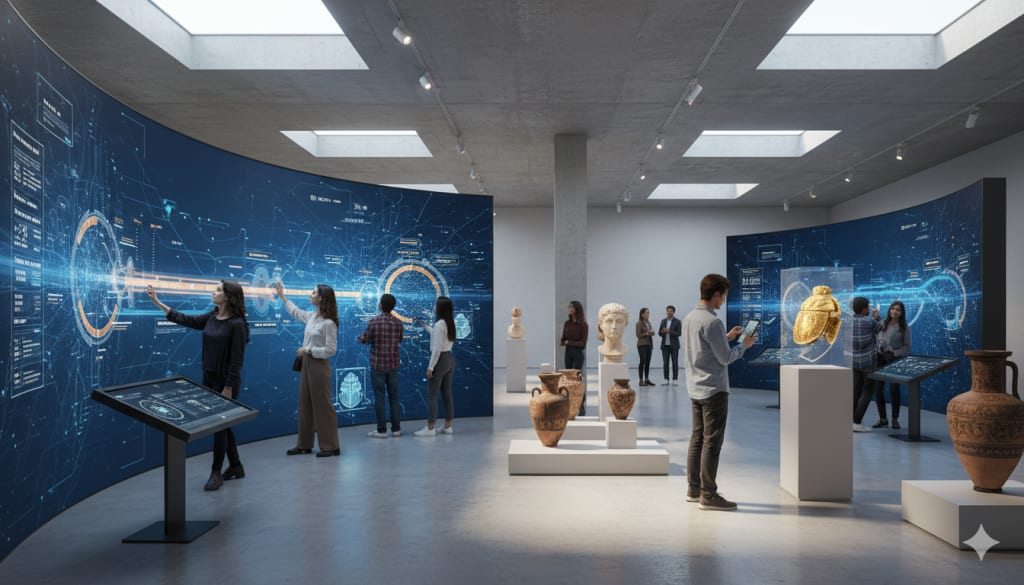
Gen Z visitors do not arrive at a museum expecting to be bored. They arrive expecting interaction. When they find rows of artifacts behind glass with printed labels, most of them do the same thing: they take a photo for social media and move on.
This is not a generational attention span problem. It is a design problem.
Museums built their exhibit formats for a different era. Those formats have not kept pace with how people under 30 process information, explore interests, or decide where to spend their time. Digital experience solutions are the category of tools addressing that gap—and the institutions adopting them are seeing real results.
What Gen Z Actually Expects
Born after 1996, Gen Z grew up with touchscreens, personalized feeds, and on-demand content. They expect systems to respond to them. They expect choices. They do not expect a single, linear path through a gallery where every visitor gets the same information in the same order.
According to the American Alliance of Museums, younger visitors consistently rate "interactive experiences" and "personal relevance" as the top factors in deciding whether to return to a cultural institution. Static displays score low on both measures.
Museums that invest in museum digital transformation are addressing exactly those two factors—making exhibits interactive and making them personally relevant.
The Shift From Passive to Active
Traditional exhibits ask visitors to receive information. Digital exhibit formats ask visitors to do something with it.
A history museum in the Netherlands replaced printed timeline displays with a floor-to-ceiling interactive wall. Visitors touch points on the timeline. The display responds with video, audio, and 3D artifact views. Visitors spend an average of four times longer at that display than at the printed panels it replaced.
That is visitor engagement technology doing measurable work. The engagement increase is not accidental. It follows directly from the design principle: give people agency over what they explore.
Immersive digital experiences extend this further. Projection mapping, augmented reality overlays, and spatial audio create environments that surround visitors rather than just presenting information at them. A prehistoric cave exhibit, for example, can reconstruct the original cave environment at full scale using projection and sound. Visitors read about cave paintings—or they stand inside a reconstruction of the space where ancient people created them. The second option produces stronger memory retention and higher visitor satisfaction scores.
Where AI Changes the Equation
AI smart museums are moving past the idea of a single exhibit format serving all visitors equally.
AI-powered digital experience solutions track how visitors move through a space. They identify which displays hold attention and which get skipped. They adjust audio guide content based on visitor behavior. They surface additional material when a visitor lingers at a specific display longer than average.
This matters for accessibility too. AI-driven systems can automatically shift content into different languages, adjust text size, or switch to audio-first formats for visitors who need them. Museums typically have to build those accommodations manually. AI systems handle them in real time.
The result is an exhibit that behaves differently for a 17-year-old student on a school visit than it does for a 65-year-old historian. Same physical space. Personalized information layer.
The Infrastructure Problem Museums Don't Talk About Enough
Technology in museums fails when institutions treat it as an installation rather than a system. A touchscreen kiosk that cannot be updated by curators, or an AR experience that breaks when the app needs an update, creates a worse visitor experience than the printed label it replaced.
Digital experience consulting and services exist specifically to solve this problem. The consulting work happens before the hardware arrives. It maps out content workflows, identifies how curators will manage updates, plans for accessibility requirements, and builds systems that staff can operate without IT support on every call.
Companies like ViitorCloud provide this type of end-to-end approach. Their Digital Experience Consulting and Services work focuses on building platforms that fit how cultural institutions actually operate—not how a generic enterprise software vendor assumes they do.
Working with a digital experience consulting company that understands both the technology and the institutional context produces better outcomes than deploying off-the-shelf tools and hoping staff adapts.
What the Numbers Show
The museums reporting the strongest results from digital transformation share common traits. They planned visitor journeys before choosing technology. They involved curators and educators in design decisions. They built updated workflows into the system from the start.
The Denver Art Museum redesigned its visitor experience with interactive technology as a core element. Visitor satisfaction scores rose significantly. Return visit rates among younger visitors increased. The institution did not replace its collection. It changed how visitors access it.
The Longer Argument
Museums hold knowledge that matters. The challenge is making that knowledge accessible to people who have grown up in a completely different information environment.
Museum digital transformation is not about making museums look modern. It is about making them work for the people visiting them now. Gen Z visitors are no less curious than previous generations. They are differently equipped. Meeting them where they are requires building experiences that match how they actually engage with information.
The tools exist. The design methods exist. The institutions making this work are the ones treating digital experience solutions as infrastructure—essential, planned, and built to last—rather than as an optional upgrade.
That distinction is what separates a museum that Gen Z visits once from one they recommend to their network.
About the Creator
ViitorCloud Technologies
As a leading software development company, we’ve empowered 500+ startups, SMBs, and enterprises to transform their operations. Upgrade your business with our AI-First Software and Platforms that automate and scale, keeping you future-ready.
Keep reading
More stories from ViitorCloud Technologies and writers in 01 and other communities.
The CTO’s Guide to 2026: Moving from AI Testing to Enterprise-Wide Impact
In 2026, many enterprises remain stuck in the testing phase with artificial intelligence. IT departments build isolated AI programs. These programs work perfectly in controlled environments.
By ViitorCloud Technologies5 days ago in 01
AI Visibility for Creators
Written with the help of AI In 2026, traditional search engines are no longer the only game in town. When people look for recommendations, tutorials, reviews, or inspiration, they increasingly turn to AI-powered tools like ChatGPT, Google AI Overviews, Perplexity, Claude, and Gemini. These platforms don't just list links—they generate concise answers, summaries, and recommendations by pulling from across the web.
By Sandy Rowley5 days ago in 01
Why Your Enterprise App Fails in the Field: 2026
Why Your Enterprise App Fails in the Field: 2026 is a critical question. It is no longer a question of basic coding. It is now a question of environmental resilience. A gap exists between the lab and the field. The app works well in a controlled office. It fails in the hands of a nurse. It fails for the technician or logistics driver. This gap has widened in recent years. We have 5G-Advanced and edge computing now. Yet, field failure still drains digital transformation budgets.
By Devin Rosarioabout 16 hours ago in 01


Comments
There are no comments for this story
Be the first to respond and start the conversation.